Elasticity of Demand — Revision Notes
ICSE · Class 10 · Economics
Elasticity of Demand revision notes for ICSE Class 10 Economics: 4 topics in quick points. Part of the ICSE Class 10 Economics syllabus.
Interactive on Super Tutor
Studying Elasticity of Demand? Get the full interactive chapter.
Quizzes, flashcards, AI doubt-solver and a step-by-step study plan — built for revision notes and more.
Free trial, no card needed.
One of 3 illustrations for Elasticity of Demand in Super Tutor — alongside flashcards, concept maps and practice questions.
See them allKey Topics to Revise
Meaning and Core Idea
- Elasticity of demand tells the amount of change in quantity demanded of a commodity in response to a change in its price.
- It shows the responsiveness or sensitivity of demand to price change.
- A larger reaction means higher elasticity.
Percentage Method and Formula Use
- The percentage method measures price elasticity of demand by taking the ratio of percentage change in demand to percentage change in price.
- The formula can be written in expanded form using change in quantity and change in price.
- The simplified formula is obtained after canceling 100 in both numerator and denominator.
Degrees or Kinds of Price Elasticity of Demand
- There are five kinds or degrees of price elasticity of demand.
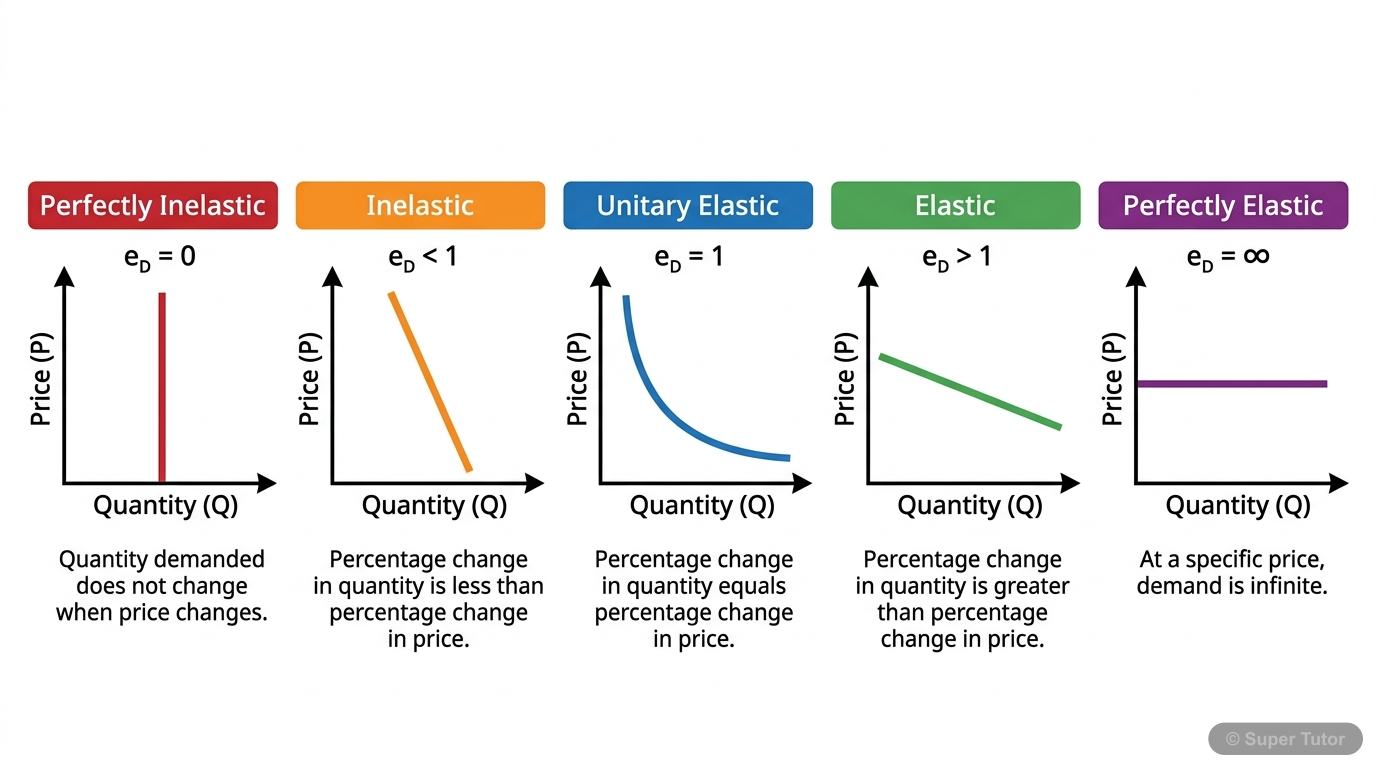
- Perfectly inelastic demand means quantity demanded does not change at all when price changes.
- Inelastic demand means demand changes less than price.
Demand Curves and Total Expenditure
- Perfectly inelastic demand is shown by a vertical demand curve.
- Inelastic demand is shown by a steep demand curve.
- Unit elastic demand is shown by a rectangular hyperbola.
Get complete notes with diagrams and examples
Full NotesKey Concepts
Frequently Asked Questions
What are the important topics in Elasticity of Demand for ICSE Class 10 Economics?
How should I revise Elasticity of Demand for the ICSE Class 10 board exam?
Sources & Official References
Content is aligned to the official syllabus. Refer to the board website for the latest curriculum.
More resources for Elasticity of Demand
Practice Quiz
Test yourself with a quick quiz
Important Questions
Exam-style questions with answers
Formula Sheet
The chapter's formulas in one place
Chapter Summary
Understand the chapter at a glance
Concept Maps
See how topics connect
Study Plan
Step-by-step plan for this chapter
Flashcards
Quick-fire cards for active recall
Syllabus
What topics to cover
For serious students
Get the full Elasticity of Demand chapter — start free.
Quizzes, flashcards, an AI doubt solver and a study plan for ICSE Class 10 Economics. Free to start, no card needed.