Elasticity of Demand — Flashcards
ICSE · Class 10 · Economics
38 flashcards for Elasticity of Demand (ICSE Class 10 Economics) to test yourself on key terms and facts. Sample: "What is price elasticity of demand?"
Interactive on Super Tutor
Studying Elasticity of Demand? Get the full interactive chapter.
Quizzes, flashcards, AI doubt-solver and a step-by-step study plan — built for flashcards and more.
Free trial, no card needed.
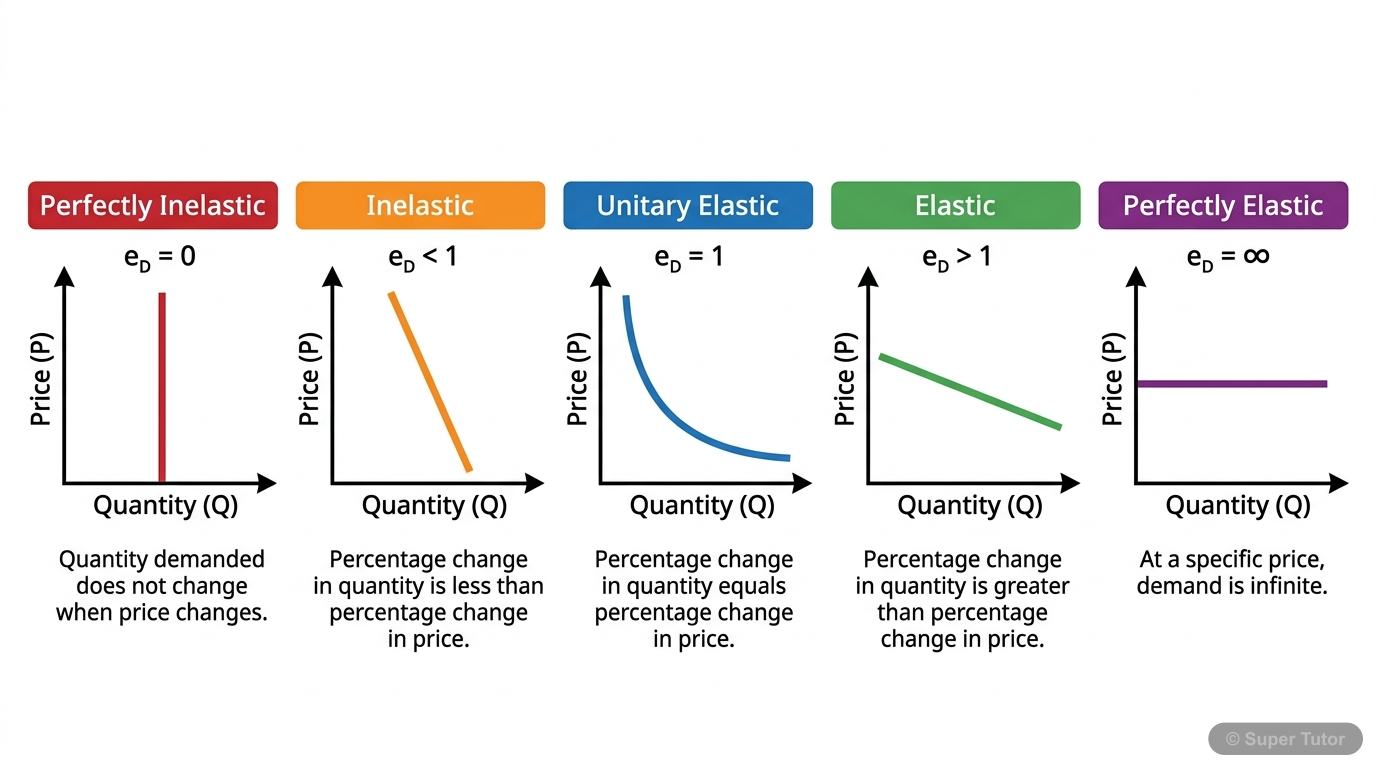
One of 3 illustrations for Elasticity of Demand in Super Tutor — alongside flashcards, concept maps and practice questions.
See them allWhat is price elasticity of demand?
Answer
Price elasticity of demand tells the amount of change in quantity demanded of a commodity in response to a change in its price. It shows how strongly consumers react when price changes. A larger react…
State the formula for price elasticity of demand.
Answer
The formula is: E_d = Percentage change in demand for the good / Percentage change in price of the good. It measures demand response in percentage terms, so it is independent of units.
Why are percentage changes used in measuring elasticity?
Answer
Percentage changes are used because they are independent of units. This makes it possible to compare changes in different goods fairly, even if their units are different.
What is the simplified formula for price elasticity of demand?
Answer
The simplified formula is: E_d = (Delta Q / Delta P) × (P / Q). Here, Delta Q is change in quantity, Delta P is change in price, P is original price, and Q is original quantity.
What does it mean when E_d equals 1?
Answer
When E_d equals 1, demand is unit elastic. This means the percentage change in demand is equal to the percentage change in price. Total expenditure remains the same when price changes.
What does it mean when E_d is greater than 1?
Answer
When E_d is greater than 1, demand is elastic. This means the percentage change in quantity demanded is greater than the percentage change in price. Consumers react strongly to price changes.
What does it mean when E_d is less than 1?
Answer
When E_d is less than 1, demand is inelastic or less elastic. This means the percentage change in quantity demanded is smaller than the percentage change in price. Consumers react weakly to price chan…
What is perfectly inelastic demand?
Answer
Perfectly inelastic demand means quantity demanded does not change at all when price changes. Its value is E_d = 0. Such cases are normally not found in real life, though life saving drugs may have ve…
+30 more flashcards
Practise AllFrequently Asked Questions
What are the important topics in Elasticity of Demand for ICSE Class 10 Economics?
How many flashcards are available for Elasticity of Demand?
How should I revise Elasticity of Demand for the ICSE Class 10 board exam?
Sources & Official References
Content is aligned to the official syllabus. Refer to the board website for the latest curriculum.
More resources for Elasticity of Demand
Practice Quiz
Test yourself with a quick quiz
Important Questions
Exam-style questions with answers
Revision Notes
Key points for last-minute revision
Formula Sheet
The chapter's formulas in one place
Chapter Summary
Understand the chapter at a glance
Concept Maps
See how topics connect
Study Plan
Step-by-step plan for this chapter
Syllabus
What topics to cover
For serious students
Get the full Elasticity of Demand chapter — start free.
Quizzes, flashcards, an AI doubt solver and a study plan for ICSE Class 10 Economics. Free to start, no card needed.