Commercial Banks — Flashcards
ICSE · Class 10 · Economics
38 flashcards for Commercial Banks (ICSE Class 10 Economics) to test yourself on key terms and facts. Sample: "What is a commercial bank?"
Interactive on Super Tutor
Studying Commercial Banks? Get the full interactive chapter.
Quizzes, flashcards, AI doubt-solver and a step-by-step study plan — built for flashcards and more.
Free trial, no card needed.
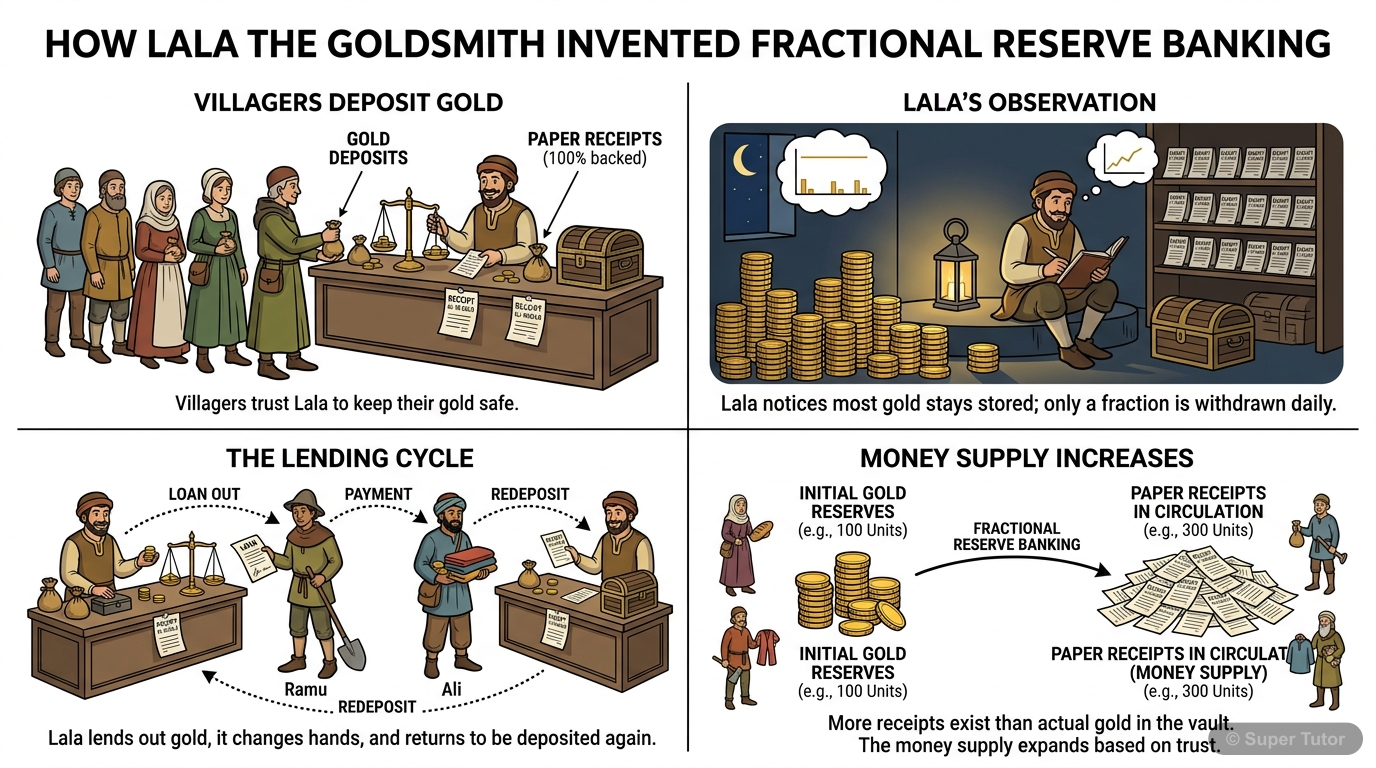
Learn better with visuals Super Tutor pairs illustrations like this with notes and quizzes for Commercial Banks.
Get startedWhat is a commercial bank?
Answer
A commercial bank is a financial institution that accepts deposits from the public and gives loans for the purposes of consumption and investment to make a profit. Banks earn profit by charging higher…
Why are commercial banks important in an economy?
Answer
Commercial banks are important because they mobilise savings, help in capital formation, provide credit to trade and industry, and support economic development by giving funds to productive activities…
What are the three main groups of functions of commercial banks?
Answer
The three main groups are Primary Functions, Agency Functions, and General Utility Functions. Primary functions include accepting deposits and advancing loans. Agency functions include collecting paym…
What are the primary functions of commercial banks?
Answer
The primary functions are accepting deposits and advancing loans. These are the most important basic activities of a commercial bank because they connect savers with borrowers.
What are current deposits?
Answer
Current deposits, also known as demand deposits, are deposits that can be withdrawn by the depositor at any time by means of cheques. They are non-interest bearing accounts and are mainly used by busi…
What are savings deposits?
Answer
Savings deposit accounts are held mainly by households and salaried employees who want to save money for a short period. These accounts pay low interest and usually have restrictions on withdrawals, s…
What are fixed deposits?
Answer
Fixed deposits, also called time deposits, are deposits that can be withdrawn only after a fixed period. They generally range from 7 days to 10 years and carry the highest rate of interest. The longer…
What is a recurring deposit, and how is it different from a fixed deposit?
Answer
Recurring deposits are accepted by banks at regular intervals, usually in instalments, whereas fixed deposits are accepted at a particular point of time. Recurring deposits help build saving habits, w…
+30 more flashcards
Practise AllFrequently Asked Questions
What are the important topics in Commercial Banks for ICSE Class 10 Economics?
How many flashcards are available for Commercial Banks?
How should I revise Commercial Banks for the ICSE Class 10 board exam?
Sources & Official References
Content is aligned to the official syllabus. Refer to the board website for the latest curriculum.
More resources for Commercial Banks
Practice Quiz
Test yourself with a quick quiz
Important Questions
Exam-style questions with answers
Revision Notes
Key points for last-minute revision
Chapter Summary
Understand the chapter at a glance
Concept Maps
See how topics connect
Study Plan
Step-by-step plan for this chapter
Syllabus
What topics to cover
For serious students
Get the full Commercial Banks chapter — start free.
Quizzes, flashcards, an AI doubt solver and a study plan for ICSE Class 10 Economics. Free to start, no card needed.