Consumer Awareness — Flashcards
ICSE · Class 10 · Economics
48 flashcards for Consumer Awareness (ICSE Class 10 Economics) to test yourself on key terms and facts. Sample: "Who is a consumer?"
Interactive on Super Tutor
Studying Consumer Awareness? Get the full interactive chapter.
Quizzes, flashcards, AI doubt-solver and a step-by-step study plan — built for flashcards and more.
Free trial, no card needed.
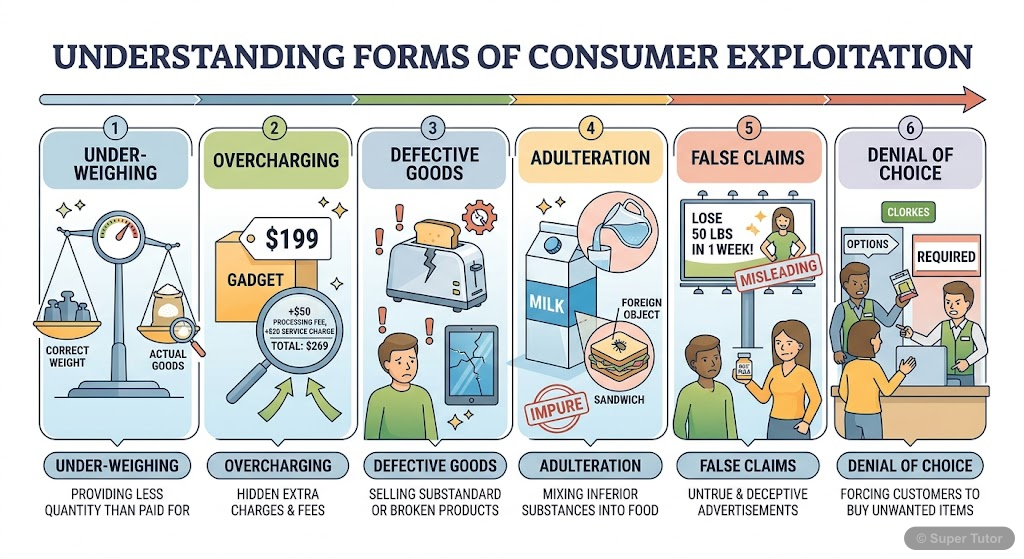
Learn better with visuals Super Tutor pairs illustrations like this with notes and quizzes for Consumer Awareness.
Get startedWho is a consumer?
Answer
A consumer is a person or group of people, such as a household, who are the final users of goods or services. Anyone who buys goods and services for personal use is a consumer.
How is a producer or seller different from a consumer?
Answer
A producer or seller manufactures or sells goods and services. A consumer buys goods and services for use. The producer makes or sells, while the consumer uses the final product.
What is consumer protection?
Answer
Consumer protection means protection of consumers against wrong practices of sellers in the market. It includes protection from unfair trade practices, unsafe goods, false information, and overchargin…
Why is consumer protection needed?
Answer
Consumer protection is needed because consumers may face illiteracy, lack of organisation, unsafe products, spurious goods, and deceptive advertising. These problems make consumers weaker than sellers…
What are the common forms of consumer exploitation?
Answer
Common forms of consumer exploitation include underweight and under measurement, high prices, substandard quality, adulterated products, misleading and false information, lack of safety devices, artif…
What is adulteration?
Answer
Adulteration means mixing inferior quality goods with superior products. In food, it lowers nutritive value and harms health. It is often done to earn higher profits or increase the weight of goods.
What is food adulteration?
Answer
Food adulteration is the process of lowering the nutritive value of food either by removing a vital component or by adding substances of inferior quality. It can cause health problems and financial lo…
What are the main reasons for food adulteration?
Answer
The main reasons are to get more profit, to increase the weight of goods, and to increase the volume of trade by showing lower prices.
+40 more flashcards
Practise AllFrequently Asked Questions
What are the important topics in Consumer Awareness for ICSE Class 10 Economics?
How many flashcards are available for Consumer Awareness?
How should I revise Consumer Awareness for the ICSE Class 10 board exam?
Sources & Official References
Content is aligned to the official syllabus. Refer to the board website for the latest curriculum.
More resources for Consumer Awareness
Practice Quiz
Test yourself with a quick quiz
Important Questions
Exam-style questions with answers
Revision Notes
Key points for last-minute revision
Chapter Summary
Understand the chapter at a glance
Concept Maps
See how topics connect
Study Plan
Step-by-step plan for this chapter
Syllabus
What topics to cover
For serious students
Get the full Consumer Awareness chapter — start free.
Quizzes, flashcards, an AI doubt solver and a study plan for ICSE Class 10 Economics. Free to start, no card needed.