Interchange of Sentences — Important Questions
ICSE · Class 10 · English Language - Archer
42 important questions from Interchange of Sentences for ICSE Class 10 English Language - Archer, with answers. Written for the board exams 2027.
Interactive on Super Tutor
Studying Interchange of Sentences? Get the full interactive chapter.
Quizzes, flashcards, AI doubt-solver and a step-by-step study plan — built for important questions and more.
Free trial, no card needed.
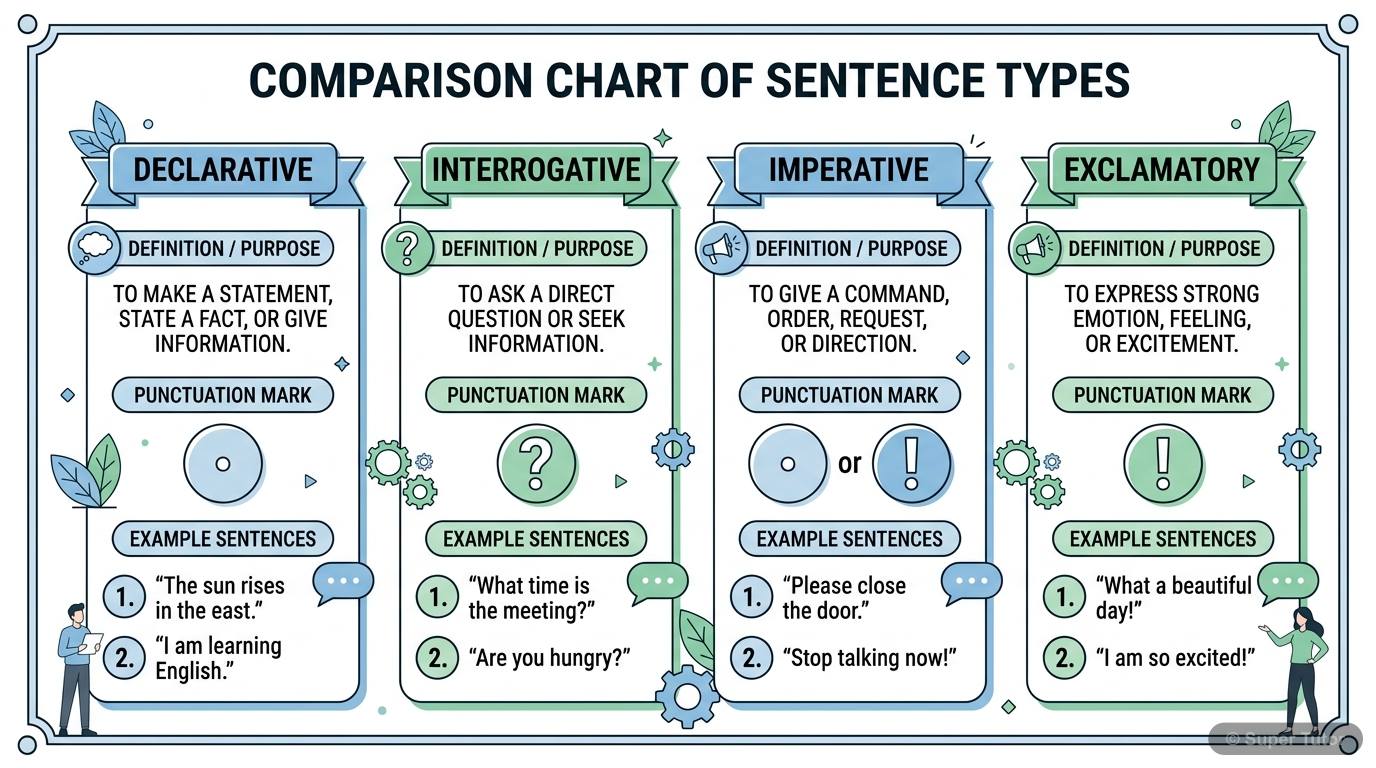
One of 3 illustrations for Interchange of Sentences in Super Tutor — alongside flashcards, concept maps and practice questions.
See them allImportant Questions from Interchange of Sentences
Transform using 'so...that': 'The bag is too heavy to carry.' becomes:
Show answer
The bag is so heavy that it cannot be carried.
The pattern is 'so + adjective + that + cannot/could not + be + past participle' for passive voice transformation. Option B misses the object in active voice. Option C uses 'very' instead of 'so'. Option D misses 'that' which is essential in the structure. The transformation maintains the meaning of impossibility due to excess.
Convert: 'As soon as the bell rang, students rushed out.' Using 'No sooner...than':
Show answer
No sooner did the bell ring than students rushed out.
With 'No sooner', we use inversion: 'No sooner + did/had + subject + base form + than'. For simple past, use 'did + base form'. Option B misses auxiliary verb. Option C incorrectly uses 'had + rang' instead of 'had + rung'. Option D uses 'did + rang' instead of 'did + ring'. Remember: did + base form, had + past participle.
Which degree shows the superlative form of 'Mumbai is larger than any other city in India.'?
Show answer
Mumbai is the largest city in India.
Comparative 'larger than any other' converts to superlative 'the largest'. This shows Mumbai as the biggest among all cities. Option B is comparative form. Option C is also comparative in negative form. Option D uses positive degree 'large' without comparison. Superlative degree uses 'the + -est' or 'the most + adjective'.
The negative form of 'Everyone liked the performance' is:
Show answer
Not everyone liked the performance.
When negating 'everyone', we use 'not everyone' which means 'some did not like'. Option A uses double negative (no one disliked = everyone liked). Option C changes meaning completely (nobody liked). Option D is too strong and changes the meaning. 'Not everyone' maintains partial negation rather than complete negation.
+38 more questions on Interchange of Sentences (ICSE Class 10 English Language - Archer)
Practise AllFrequently Asked Questions
What are the important topics in Interchange of Sentences for ICSE Class 10 English Language - Archer?
How many important questions are there in Interchange of Sentences?
Sources & Official References
Content is aligned to the official syllabus. Refer to the board website for the latest curriculum.
More resources for Interchange of Sentences
Practice Quiz
Test yourself with a quick quiz
Revision Notes
Key points for last-minute revision
Formula Sheet
The chapter's formulas in one place
Chapter Summary
Understand the chapter at a glance
Concept Maps
See how topics connect
Study Plan
Step-by-step plan for this chapter
Flashcards
Quick-fire cards for active recall
Syllabus
What topics to cover
For serious students
Get the full Interchange of Sentences chapter — start free.
Quizzes, flashcards, an AI doubt solver and a study plan for ICSE Class 10 English Language - Archer. Free to start, no card needed.