Water Resources — Study Plan
ICSE · Class 10 · Geography
A step-by-step study plan for Water Resources, ICSE Class 10 Geography: what to learn first, what to practise and when to revise.
Interactive on Super Tutor
Studying Water Resources? Get the full interactive chapter.
Quizzes, flashcards, AI doubt-solver and a step-by-step study plan — built for study plan and more.
Free trial, no card needed.
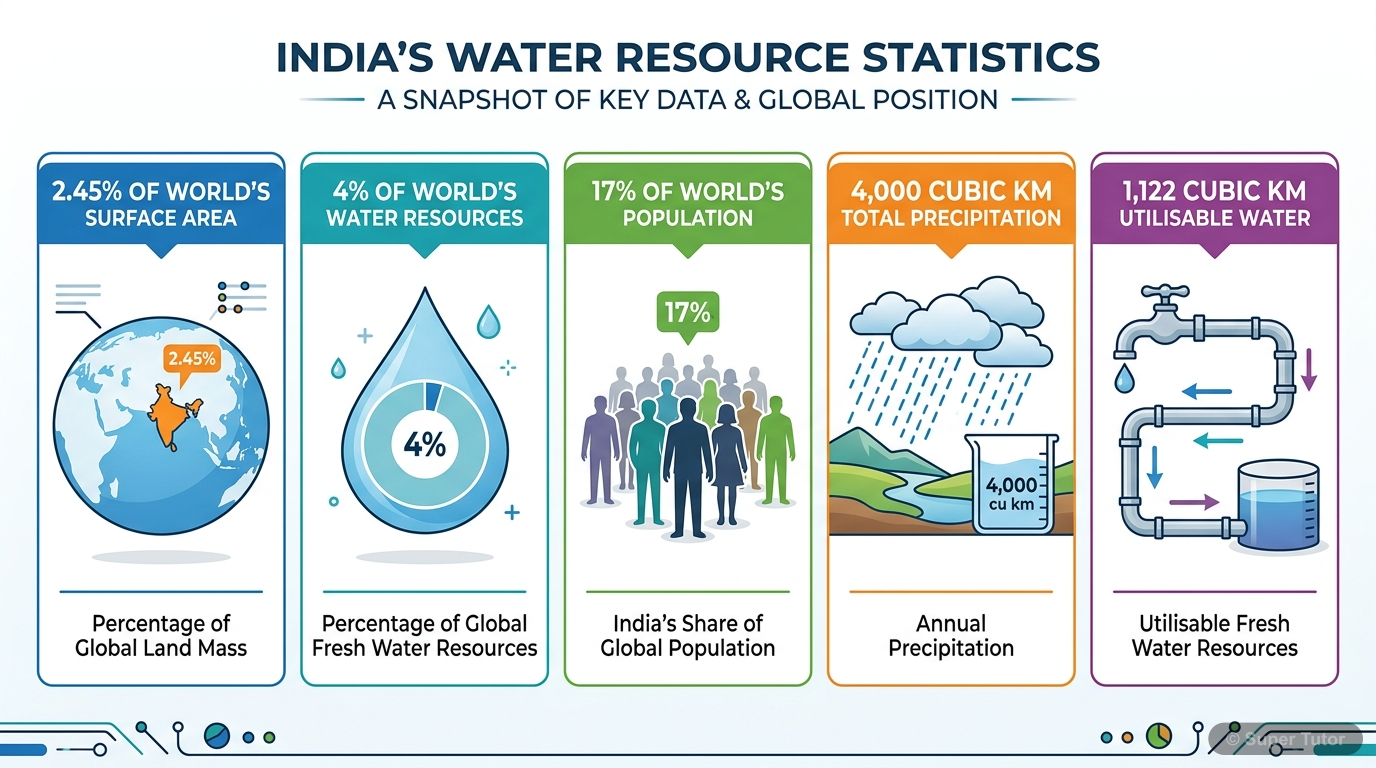
Learn better with visuals Super Tutor pairs illustrations like this with notes and quizzes for Water Resources.
Get startedStudy Plan
Learn the Theory
Read the textbook chapter carefully. Note down definitions, formulas and key ideas. Focus on: 1. Our Water Resources, 2. Importance and Need for Irrigation in India, 3. Favourable Factors for Development of Irrigation.
Practise
Solve the textbook exercises and extra practice questions. There are 40 questions available for this chapter.
Revise & Test
Revise key points without looking at your notes. Take a practice quiz and mark weak areas for another pass.
Spaced Revision
Come back to Water Resources after a week. Use flashcards for quick recall and try past exam questions on this chapter.
What to Focus On
- Surface water includes rivers, lakes, ponds and canals.
- Groundwater is rainwater that seeps into the ground through cracks and crevices.
- The Ganga-Brahmaputra-Meghna system is the largest river system in India by catchment area.
- Irrigation is artificial water supply to crops.
- The south-west monsoon gives 90% of India's rainfall.
- Rainfall in India is seasonal and uneven.
- Soft, fertile soil and gentle slopes help canal and well irrigation.
- Deep clay subsoil stores rainwater and supports groundwater.
- Perennial rivers support irrigation in the plains.
Common Mistakes to Avoid
Groundwater means all water found below the land surface.
Canal irrigation and well irrigation are different because one covers about 40% and the other covers about 12% of irrigated area.
Inundation canals and perennial canals are the same because both carry river water.
Memory Tips
India has only 4% of the world’s water resources despite having 16% of the world’s population
Groundwater definition
Ganga-Brahmaputra-Meghna system is the biggest major river system of India by catchment area
Himalayan rivers are perennial while Peninsular Indian rivers are seasonal
Want a personalised study plan?
Super Tutor builds a day-by-day plan for ICSE Class 10 Geography that fits your exam date and pace.
Create My Study PlanFrequently Asked Questions
What are the important topics in Water Resources for ICSE Class 10 Geography?
How should I revise Water Resources for the ICSE Class 10 board exam?
Sources & Official References
Content is aligned to the official syllabus. Refer to the board website for the latest curriculum.
More resources for Water Resources
Practice Quiz
Test yourself with a quick quiz
Important Questions
Exam-style questions with answers
Revision Notes
Key points for last-minute revision
Chapter Summary
Understand the chapter at a glance
Concept Maps
See how topics connect
Flashcards
Quick-fire cards for active recall
Syllabus
What topics to cover
For serious students
Get the full Water Resources chapter — start free.
Quizzes, flashcards, an AI doubt solver and a study plan for ICSE Class 10 Geography. Free to start, no card needed.