Similarity — Revision Notes
ICSE · Class 10 · Mathematics
Similarity revision notes for ICSE Class 10 Mathematics: 4 topics in quick points. Part of the ICSE Class 10 Mathematics syllabus.
Interactive on Super Tutor
Studying Similarity? Get the full interactive chapter.
Quizzes, flashcards, AI doubt-solver and a step-by-step study plan — built for revision notes and more.
Free trial, no card needed.
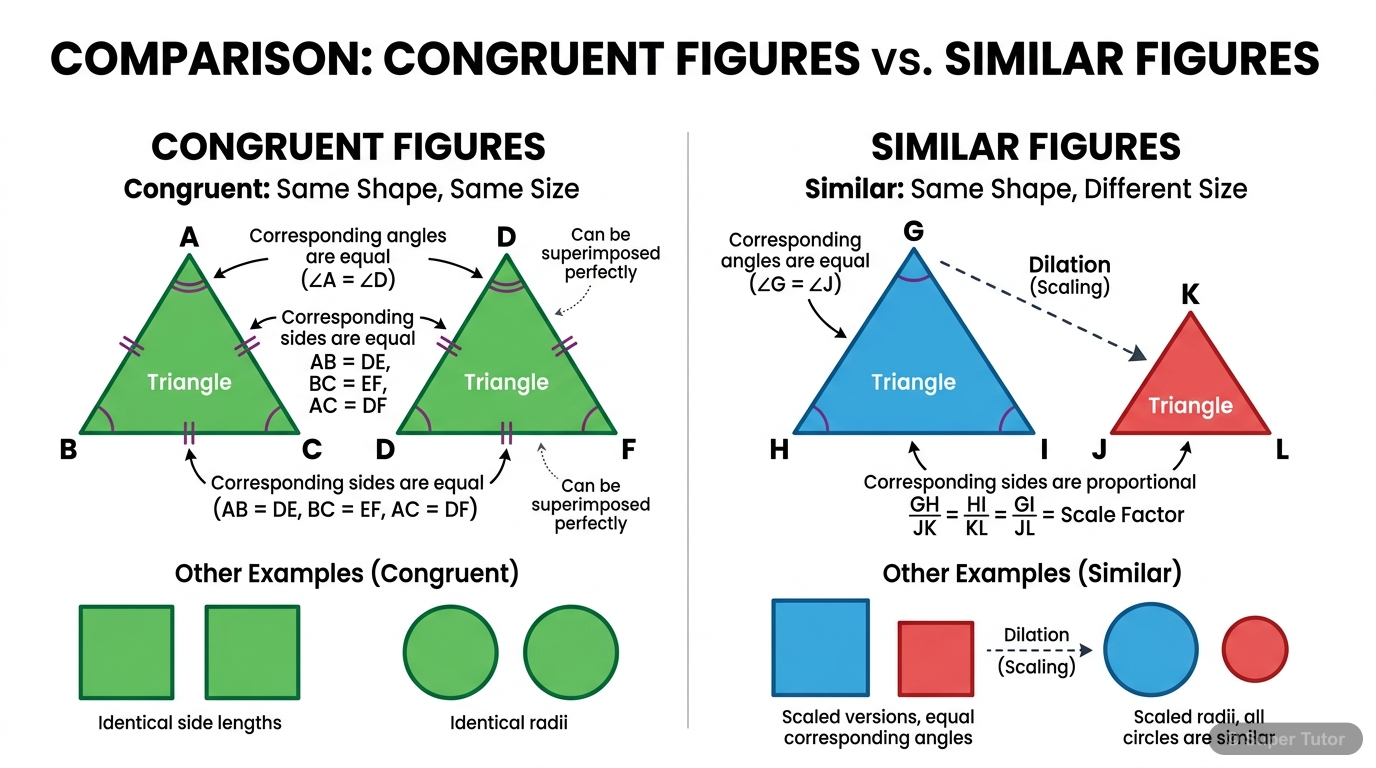
One of 8 illustrations for Similarity in Super Tutor — alongside flashcards, concept maps and practice questions.
See them allKey Topics to Revise
1. Similar Figures and Similar Triangles
- Figures that have the same shape but different size are called similar figures.
- Same shape does not mean equal size.
- Two triangles are similar if their corresponding sides are proportional and their corresponding angles are equal.
2. Conditions for Similarity of Triangles
- There are three main similarity conditions: SSS, AAA, and SAS.
- SSS similarity: three corresponding sides are proportional.
- AAA similarity: corresponding angles are equal.
3. Basic Proportionality Theorem and Its Converse
- Theorem 1: If a line is drawn parallel to one side of a triangle, intersecting the other two sides, then it divides the other two sides proportionally.
- The converse says: if a straight line divides any two sides of a triangle proportionally, then the line is parallel to the third side.
- In the converse proof, the line DE is first assumed not parallel to BC, and a parallel line DP is drawn through D.
4. Internal Angle Bisector Theorem and Its Converse
- The internal bisector of an angle of a triangle divides the opposite side internally in the ratio of the sides containing the angle.
- If AD is the internal bisector of ∠A in △ABC, then BD/DC = AB/AC.
- In Theorem 3, CE is drawn parallel to DA meeting BA produced at E.
Get complete notes with diagrams and examples
Full NotesKey Concepts
Frequently Asked Questions
What are the important topics in Similarity for ICSE Class 10 Mathematics?
How should I revise Similarity for the ICSE Class 10 board exam?
Sources & Official References
Content is aligned to the official syllabus. Refer to the board website for the latest curriculum.
More resources for Similarity
Practice Quiz
Test yourself with a quick quiz
Important Questions
Exam-style questions with answers
Formula Sheet
The chapter's formulas in one place
Chapter Summary
Understand the chapter at a glance
Concept Maps
See how topics connect
Study Plan
Step-by-step plan for this chapter
Flashcards
Quick-fire cards for active recall
Syllabus
What topics to cover
For serious students
Get the full Similarity chapter — start free.
Quizzes, flashcards, an AI doubt solver and a study plan for ICSE Class 10 Mathematics. Free to start, no card needed.