Refraction through a lens — Syllabus
ICSE · Class 10 · Physics
What Refraction through a lens covers in ICSE Class 10 Physics: 4 topics, for the 2026-27 session. Part of the ICSE Class 10 Physics syllabus.
Interactive on Super Tutor
Studying Refraction through a lens? Get the full interactive chapter.
Quizzes, flashcards, AI doubt-solver and a step-by-step study plan — built for syllabus and more.
Free trial, no card needed.
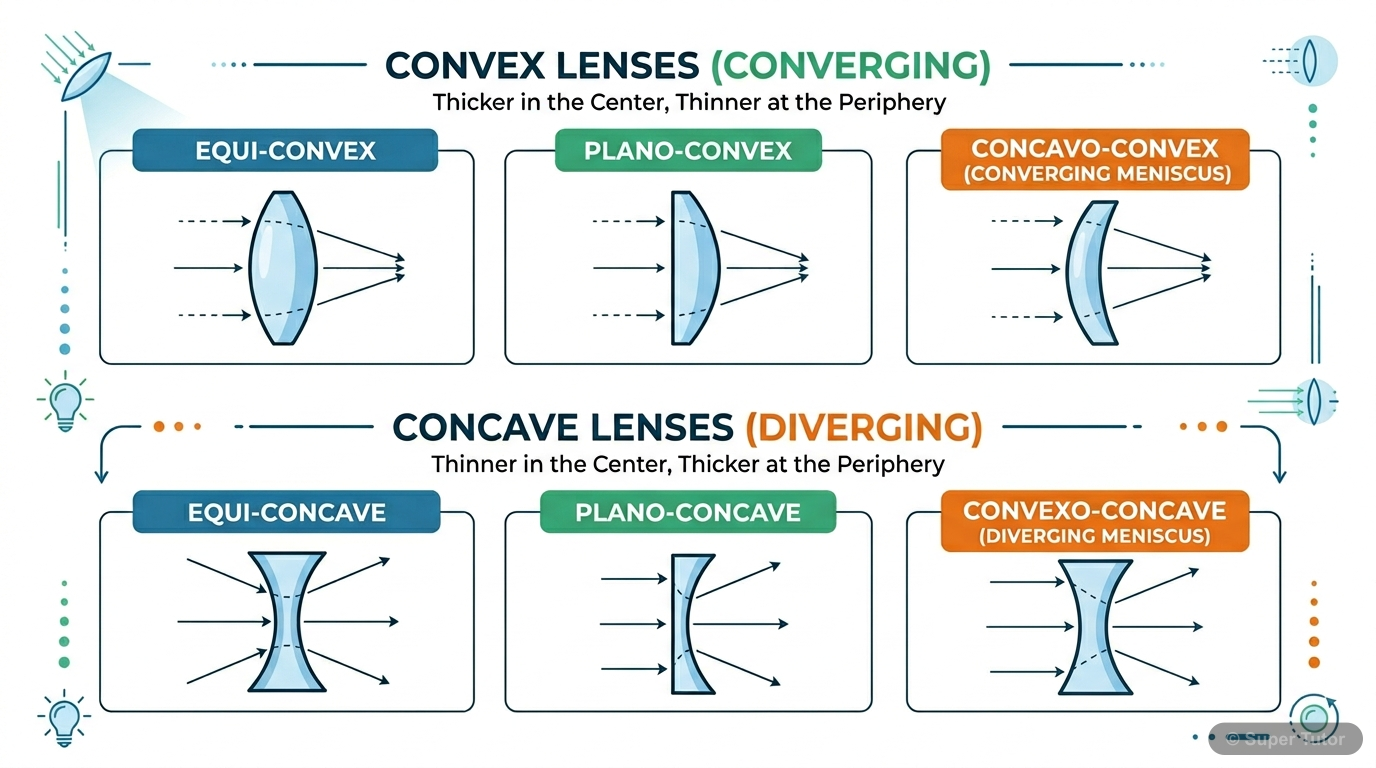
One of 22 illustrations for Refraction through a lens in Super Tutor — alongside flashcards, concept maps and practice questions.
See them allTopics in Refraction through a lens
1. Lens and its types
- A lens is a transparent homogeneous refracting medium bounded by either two curved surfaces or one plane surface and one curved surface.
- Convex lens is thicker in the middle and thinner at the periphery; it converges light and is also called a converging lens.
- Concave lens is thinner in the middle and thicker at the periphery; it diverges light and is also called a diverging lens.
2. Focal points, focal length, and image behaviour
- Usually, when focus is mentioned, it means the second focal point.
- For convex lens, the first focal point is the point from where a divergent beam becomes parallel after refraction.
- For concave lens, the first focal point is the point at which a convergent beam appears to meet and becomes parallel after refraction.
3. Factors affecting focal length and power of a lens
- Focal length depends on refractive index of lens material and surrounding medium.
- Focal length depends on radii of curvature of the lens.
- Focal length is independent of the surface exposed to light, but image intensity depends on surface exposed to light.
4. Sign convention, lens formula, and magnification
- Optical centre is placed at the origin of the coordinate system.
- Distances measured in the direction of incident light are positive; distances opposite to the direction of incident light are negative.
- The object is placed on the left of the lens to match the Cartesian sign convention.
Key Concepts
Central concept: Refraction through a lens
Work through every topic in Refraction through a lens with notes and quizzes
Start This ChapterFrequently Asked Questions
What are the important topics in Refraction through a lens for ICSE Class 10 Physics?
How should I revise Refraction through a lens for the ICSE Class 10 board exam?
Sources & Official References
Content is aligned to the official syllabus. Refer to the board website for the latest curriculum.
More resources for Refraction through a lens
Practice Quiz
Test yourself with a quick quiz
Important Questions
Exam-style questions with answers
Revision Notes
Key points for last-minute revision
Chapter Summary
Understand the chapter at a glance
Concept Maps
See how topics connect
Study Plan
Step-by-step plan for this chapter
Flashcards
Quick-fire cards for active recall
For serious students
Get the full Refraction through a lens chapter — start free.
Quizzes, flashcards, an AI doubt solver and a study plan for ICSE Class 10 Physics. Free to start, no card needed.