Machines — Flashcards
ICSE · Class 10 · Physics
35 flashcards for Machines (ICSE Class 10 Physics) to test yourself on key terms and facts. Sample: "State the meaning of a machine."
Interactive on Super Tutor
Studying Machines? Get the full interactive chapter.
Quizzes, flashcards, AI doubt-solver and a step-by-step study plan — built for flashcards and more.
Free trial, no card needed.
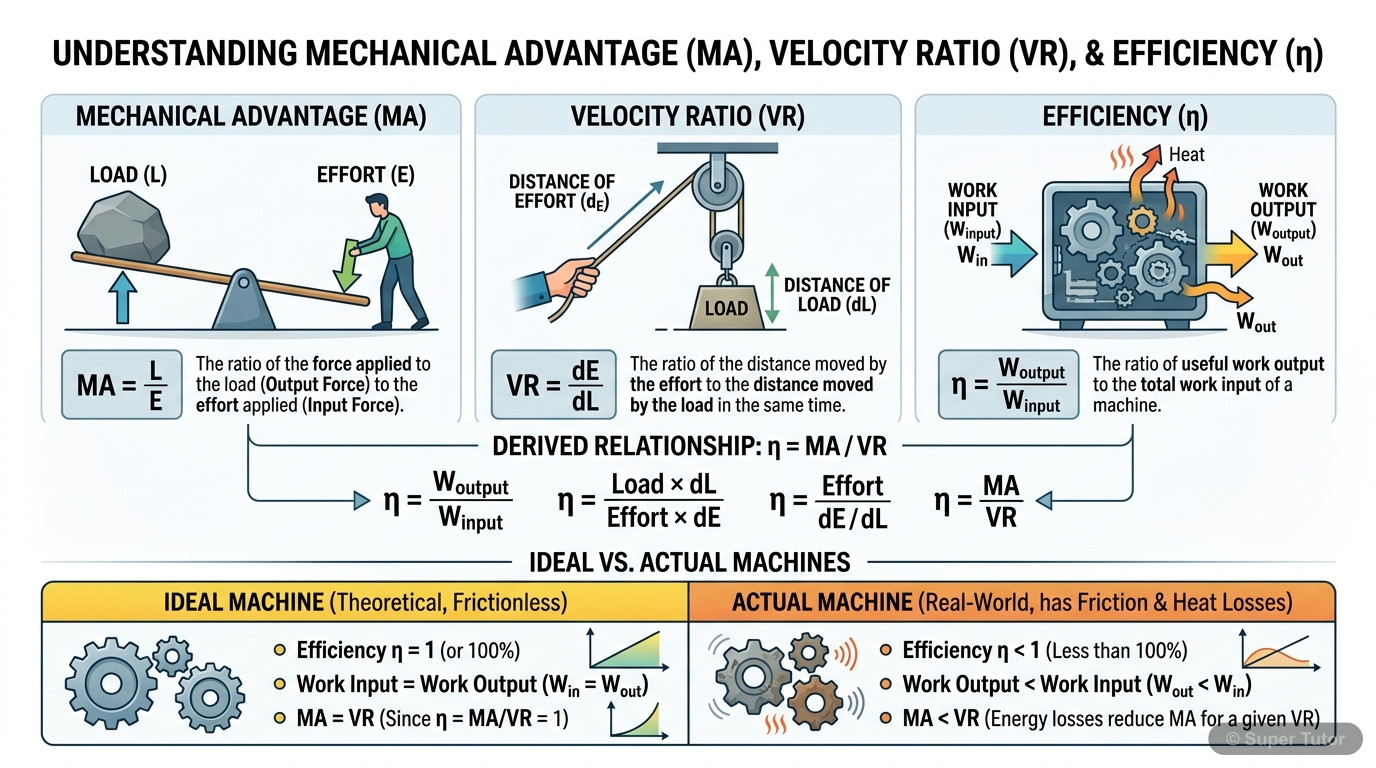
One of 11 illustrations for Machines in Super Tutor — alongside flashcards, concept maps and practice questions.
See them allState the meaning of a machine.
Answer
A machine is a device by which a large resistive force called the load can be overcome at some point by applying a small force called the effort at a convenient point and in a desired direction, or by…
What is the difference between load and effort?
Answer
Load is the resistive force overcome by the machine. Effort is the force applied to the machine to overcome the load. In a simple example, the load is the heavy object and the effort is the force used…
When does a machine work as a force multiplier?
Answer
A machine works as a force multiplier when mechanical advantage is greater than 1, so load is greater than effort. In that case, a small effort can lift a larger load.
When does a machine give gain in speed?
Answer
A machine gives gain in speed when effort is greater than load. In this case, mechanical advantage is less than 1, so the machine helps movement at the cost of force.
State the definition of velocity ratio.
Answer
Velocity ratio is the ratio of velocity of effort to velocity of load. Formula: V.R. = Velocity of effort / Velocity of load It also equals the ratio of displacement of effort to displacement of load.
A machine has effort velocity 8 m/s and load velocity 2 m/s. Find the velocity ratio.
Answer
Given: Velocity of effort = 8 m/s, Velocity of load = 2 m/s Formula: V.R. = Velocity of effort / Velocity of load Step 1: V.R. = 8 / 2 Step 2: V.R. = 4 Answer: Velocity ratio = 4, no unit…
If a machine moves effort through 12 m and load through 3 m in the same time, find the velocity ratio.
Answer
Given: dE = 12 m, dL = 3 m Formula: V.R. = dE / dL Step 1: V.R. = 12 m / 3 m Step 2: V.R. = 4 Answer: Velocity ratio = 4, no unit…
State the definition of efficiency.
Answer
Efficiency is the ratio of useful output work to input work. Formula: η = Woutput / Winput × 100% Unit: no unit, because it is a ratio of two similar quantities. It is usually written in percent.
+27 more flashcards
Practise AllFrequently Asked Questions
What are the important topics in Machines for ICSE Class 10 Physics?
How many flashcards are available for Machines?
How should I revise Machines for the ICSE Class 10 board exam?
Sources & Official References
Content is aligned to the official syllabus. Refer to the board website for the latest curriculum.
More resources for Machines
Practice Quiz
Test yourself with a quick quiz
Important Questions
Exam-style questions with answers
Revision Notes
Key points for last-minute revision
Formula Sheet
The chapter's formulas in one place
Chapter Summary
Understand the chapter at a glance
Concept Maps
See how topics connect
Study Plan
Step-by-step plan for this chapter
Syllabus
What topics to cover
For serious students
Get the full Machines chapter — start free.
Quizzes, flashcards, an AI doubt solver and a study plan for ICSE Class 10 Physics. Free to start, no card needed.