Electrical Power and Household Circuits — Practice Quiz
ICSE · Class 10 · Physics
Try a 4-question quiz on Electrical Power and Household Circuits for ICSE Class 10 Physics: tap an answer to check it and see why.
Interactive on Super Tutor
Studying Electrical Power and Household Circuits? Get the full interactive chapter.
Quizzes, flashcards, AI doubt-solver and a step-by-step study plan — built for practice quiz and more.
Free trial, no card needed.
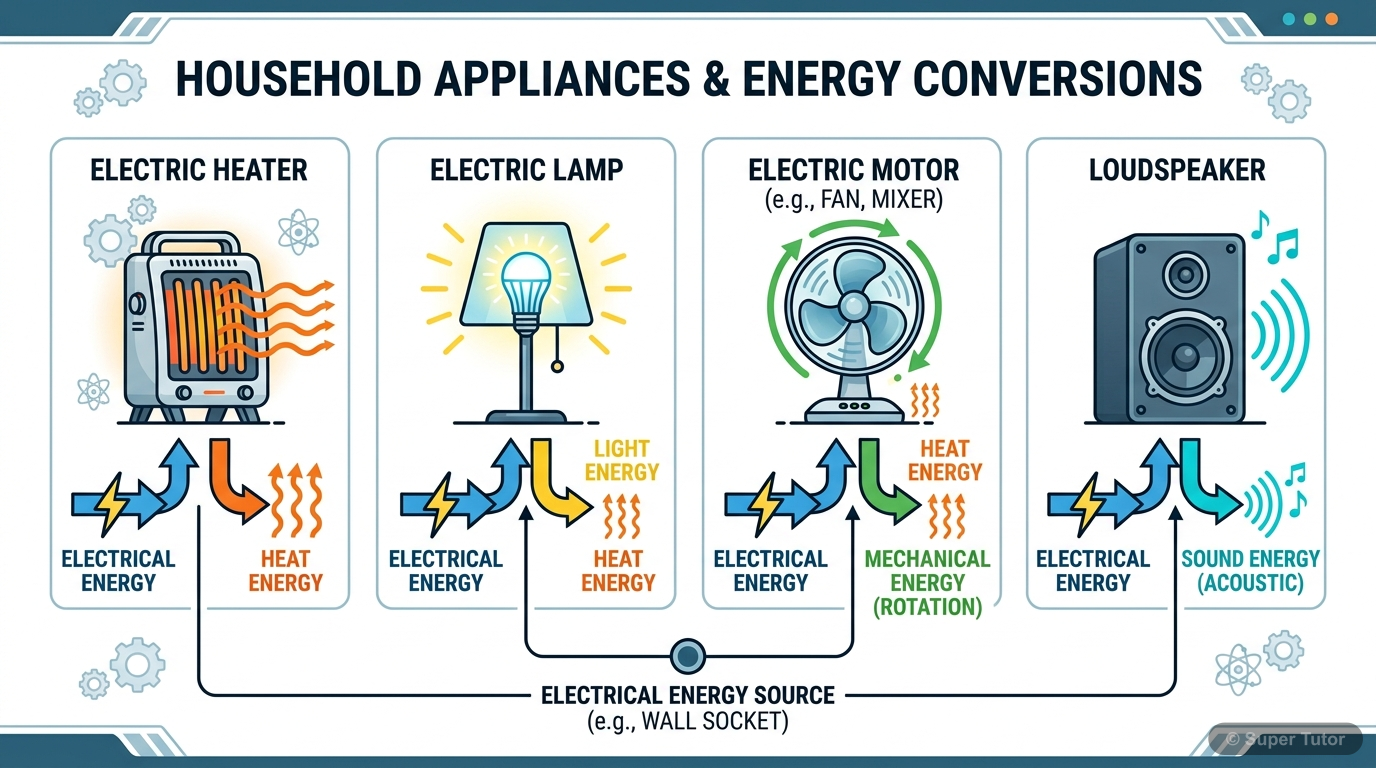
One of 19 illustrations for Electrical Power and Household Circuits in Super Tutor — alongside flashcards, concept maps and practice questions.
See them allQuick Quiz: Electrical Power and Household Circuits
0/4Tap an answer to check it instantly. No sign-up needed for these 4.
What is the commercial unit of electrical energy?
Why is it necessary to connect the fuse in the live wire only?
In a three-pin plug, which pin is the thickest and longest?
What is the standard household voltage supply in India?
Sample Questions
Which of the following formulas correctly represent electrical power?
Show answer
P = V × I, P = I² × R, P = V²/R
All three formulas P = V × I, P = I² × R, and P = V²/R are correct expressions for electrical power. They can be derived from each other using Ohm's law (V = IR).
Calculate the electrical energy consumed by a 100W bulb used for 5 hours.
Show answer
0.5 kWh
Energy = Power × Time = 100W × 5h = 500 Wh = 0.5 kWh. Remember to convert watts to kilowatts by dividing by 1000.
Why are household appliances connected in parallel?
Show answer
Each appliance gets full 220V, Each appliance works independently, If one appliance fails, others continue working
Parallel connection ensures each appliance gets full voltage (220V), works independently, and failure of one doesn't affect others. This is essential for household circuits.
What is the purpose of earthing in electrical appliances?
Show answer
To protect from electric shock
Earthing provides a low resistance path for current to flow to ground if live wire touches the metal body of appliance, preventing electric shock to users and blowing the fuse.
+35 more questions on Electrical Power and Household Circuits (ICSE Class 10 Physics)
Practise AllFrequently Asked Questions
What are the important topics in Electrical Power and Household Circuits for ICSE Class 10 Physics?
How many practice questions are there for Electrical Power and Household Circuits?
Sources & Official References
Content is aligned to the official syllabus. Refer to the board website for the latest curriculum.
More resources for Electrical Power and Household Circuits
Important Questions
Exam-style questions with answers
Revision Notes
Key points for last-minute revision
Formula Sheet
The chapter's formulas in one place
Chapter Summary
Understand the chapter at a glance
Concept Maps
See how topics connect
Study Plan
Step-by-step plan for this chapter
Flashcards
Quick-fire cards for active recall
Syllabus
What topics to cover
For serious students
Get the full Electrical Power and Household Circuits chapter — start free.
Quizzes, flashcards, an AI doubt solver and a study plan for ICSE Class 10 Physics. Free to start, no card needed.