Electrical Power and Household Circuits — Flashcards
ICSE · Class 10 · Physics
36 flashcards for Electrical Power and Household Circuits (ICSE Class 10 Physics) to test yourself on key terms and facts.
Interactive on Super Tutor
Studying Electrical Power and Household Circuits? Get the full interactive chapter.
Quizzes, flashcards, AI doubt-solver and a step-by-step study plan — built for flashcards and more.
Free trial, no card needed.
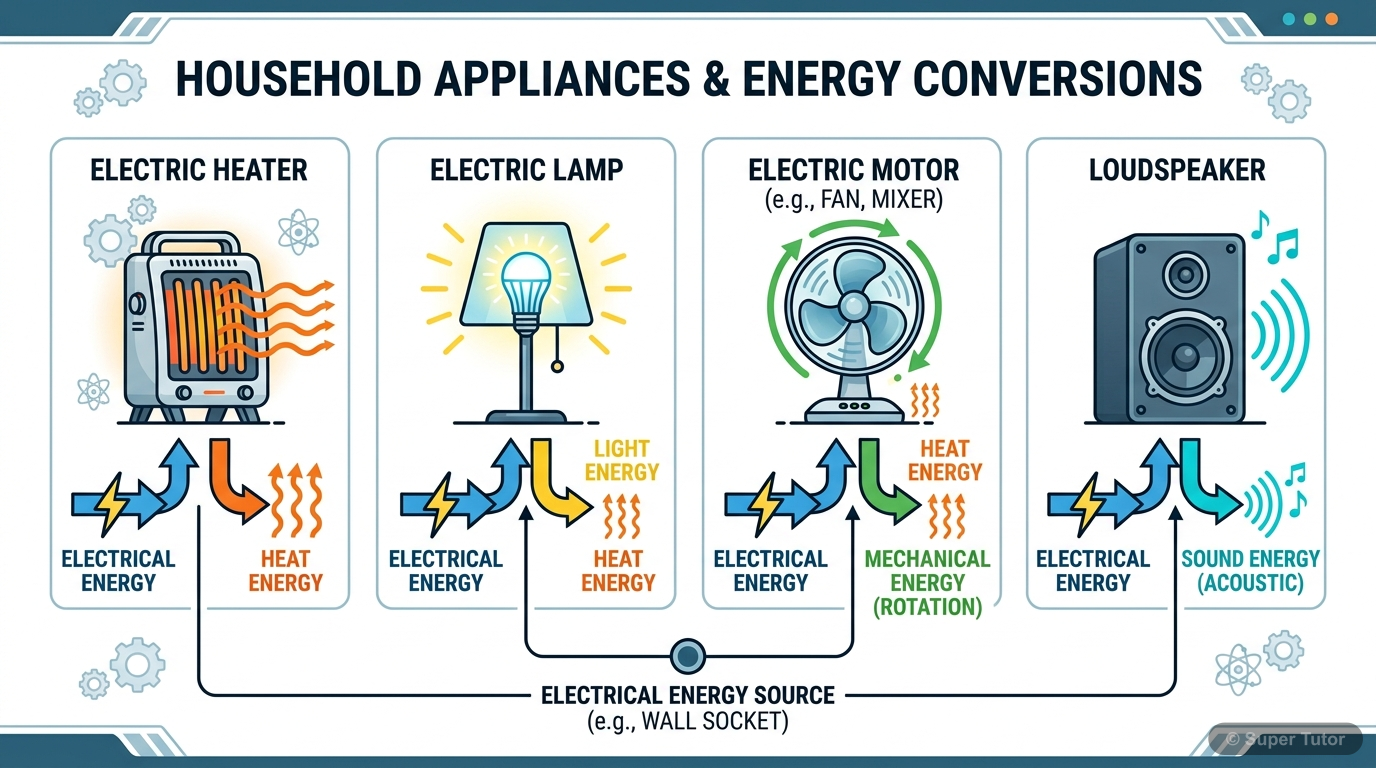
One of 19 illustrations for Electrical Power and Household Circuits in Super Tutor — alongside flashcards, concept maps and practice questions.
See them allState the formula for electrical energy in terms of charge and potential difference.
Answer
Formula: W = QV Meaning: electrical energy W equals charge Q multiplied by potential difference V. Units: W in joule, Q in coulomb, V in volt. Quick example: If Q = 2 C and V = 5 V, then W = 2 × 5 = 1…
State the formula for electrical energy in terms of current, voltage, and time.
Answer
Formula: W = Vit Meaning: electrical energy W equals voltage V × current i × time t. Units: W in joule, V in volt, i in ampere, t in second. Quick example: If V = 220 V, i = 2 A, and t = 10 s, then W …
A current of 3 A flows through a resistor of 4 ohm for 5 s. Find the electrical energy consumed.
Answer
Given: i = 3 A, R = 4 ohm, t = 5 s Formula: W = i^2Rt Step 1: i^2 = 3^2 = 9 A^2 Step 2: W = 9 × 4 × 5 J Step 3: W = 180 J Answer: 180 J…
A voltage of 12 V is applied across a 6 ohm resistor for 10 s. Find the electrical energy consumed.
Answer
Given: V = 12 V, R = 6 ohm, t = 10 s Formula: W = V^2t/R Step 1: V^2 = 12^2 = 144 V^2 Step 2: W = 144 × 10 / 6 J Step 3: W = 1440 / 6 = 240 J Answer: 240 J…
A charge of 10 C moves through a potential difference of 2 V. Find the electrical work done.
Answer
Given: Q = 10 C, V = 2 V Formula: W = QV Step 1: W = 10 × 2 J Step 2: W = 20 J Answer: 20 J…
State the formula for electrical power and its meaning.
Answer
Formula: P = W/t Also: P = Vi, P = V^2/R, P = i^2R Meaning: electrical power is the rate at which electrical energy is used. Units: P in watt, W in joule, t in second, V in volt, i in ampere, R in ohm…
A device works at 220 V and takes 0.5 A current. Find its power.
Answer
Given: V = 220 V, i = 0.5 A Formula: P = Vi Step 1: P = 220 × 0.5 W Step 2: P = 110 W Answer: 110 W…
Why is electrical power important in daily life?
Answer
Electrical power shows how fast an appliance converts electrical energy into other forms. A higher-power appliance uses energy faster. Example: A room heater has higher power than a bulb, so it conver…
+28 more flashcards
Practise AllFrequently Asked Questions
What are the important topics in Electrical Power and Household Circuits for ICSE Class 10 Physics?
How many flashcards are available for Electrical Power and Household Circuits?
How should I revise Electrical Power and Household Circuits for the ICSE Class 10 board exam?
Sources & Official References
Content is aligned to the official syllabus. Refer to the board website for the latest curriculum.
More resources for Electrical Power and Household Circuits
Practice Quiz
Test yourself with a quick quiz
Important Questions
Exam-style questions with answers
Revision Notes
Key points for last-minute revision
Formula Sheet
The chapter's formulas in one place
Chapter Summary
Understand the chapter at a glance
Concept Maps
See how topics connect
Study Plan
Step-by-step plan for this chapter
Syllabus
What topics to cover
For serious students
Get the full Electrical Power and Household Circuits chapter — start free.
Quizzes, flashcards, an AI doubt solver and a study plan for ICSE Class 10 Physics. Free to start, no card needed.