Electrical Power and Household Circuits — Revision Notes
ICSE · Class 10 · Physics
Electrical Power and Household Circuits revision notes for ICSE Class 10 Physics: 4 topics in quick points. Part of the ICSE Class 10 Physics syllabus.
Interactive on Super Tutor
Studying Electrical Power and Household Circuits? Get the full interactive chapter.
Quizzes, flashcards, AI doubt-solver and a step-by-step study plan — built for revision notes and more.
Free trial, no card needed.
One of 19 illustrations for Electrical Power and Household Circuits in Super Tutor — alongside flashcards, concept maps and practice questions.
See them allKey Topics to Revise
Electrical Energy and Electrical Power
- Electrical energy is the energy possessed by electrons due to their motion in a conductor.
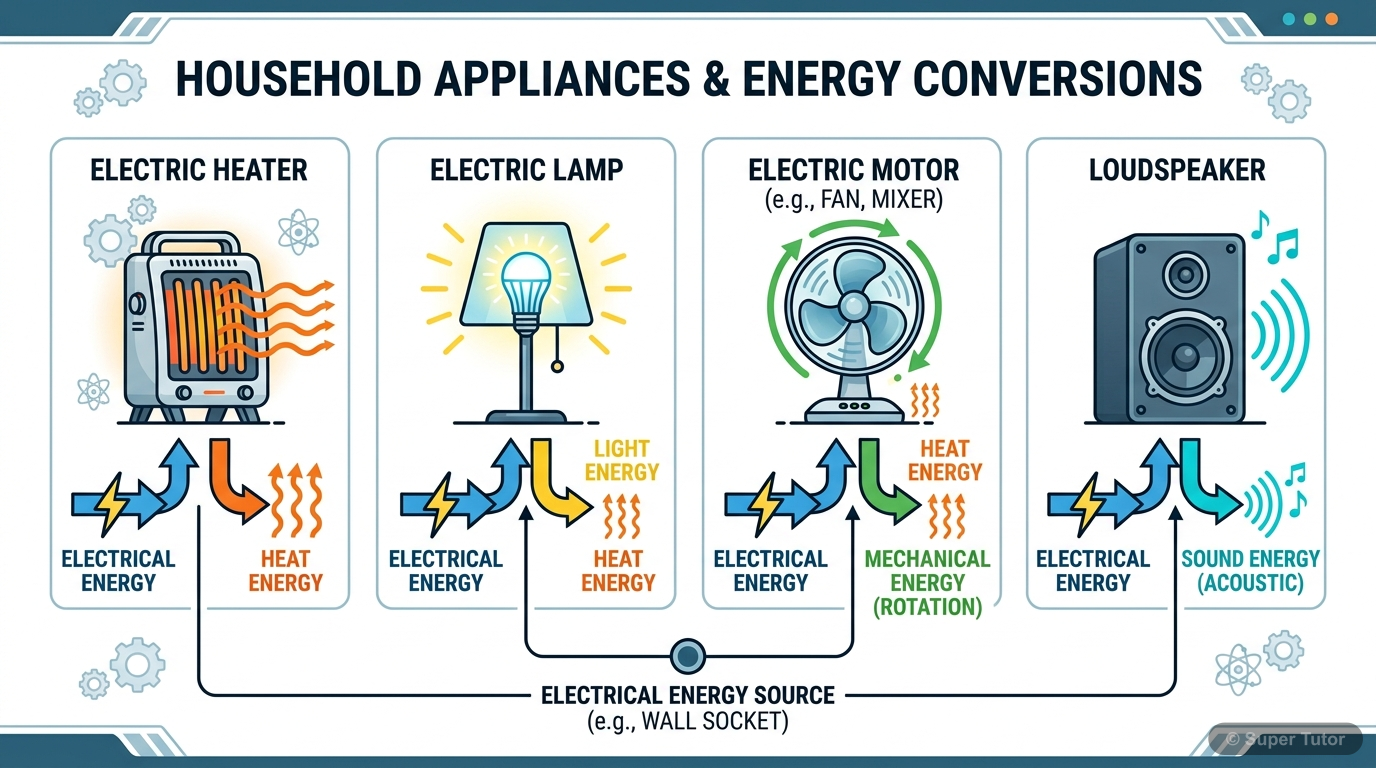
- When current flows through a resistor, electrical energy changes into other forms such as heat, light, sound, or mechanical energy.
- Examples of conversion include heater, electric lamp, electric motor, and loudspeaker.
Power Rating and Domestic Energy Consumption
- Power rating tells how much electrical energy an appliance uses in one second at a given voltage.
- Power rating gives two important values: resistance of the appliance and safe current limit.
- A 100W-220V bulb has resistance 484 ohm and safe current 0.45 A.
Transmission and Distribution of Power
- Electric power is generated at 11 kV to minimize insulation difficulties.
- Lower voltage would require higher current and cause more energy loss.
- Power is transmitted at high voltage and low current to reduce heat loss.
Fuse, MCB, Switches, and Safety
- An electric fuse is a safety device used to limit current and protect appliances.
- A fuse is made of an alloy of copper and tin.
- A fuse has low melting point and high resistance.
Get complete notes with diagrams and examples
Full NotesKey Concepts
Frequently Asked Questions
What are the important topics in Electrical Power and Household Circuits for ICSE Class 10 Physics?
How should I revise Electrical Power and Household Circuits for the ICSE Class 10 board exam?
Sources & Official References
Content is aligned to the official syllabus. Refer to the board website for the latest curriculum.
More resources for Electrical Power and Household Circuits
Practice Quiz
Test yourself with a quick quiz
Important Questions
Exam-style questions with answers
Formula Sheet
The chapter's formulas in one place
Chapter Summary
Understand the chapter at a glance
Concept Maps
See how topics connect
Study Plan
Step-by-step plan for this chapter
Flashcards
Quick-fire cards for active recall
Syllabus
What topics to cover
For serious students
Get the full Electrical Power and Household Circuits chapter — start free.
Quizzes, flashcards, an AI doubt solver and a study plan for ICSE Class 10 Physics. Free to start, no card needed.