Calorimetry — Practice Quiz
ICSE · Class 10 · Physics
Try a 4-question quiz on Calorimetry for ICSE Class 10 Physics: tap an answer to check it and see why. 41 questions in the full chapter test.
Interactive on Super Tutor
Studying Calorimetry? Get the full interactive chapter.
Quizzes, flashcards, AI doubt-solver and a step-by-step study plan — built for practice quiz and more.
Free trial, no card needed.
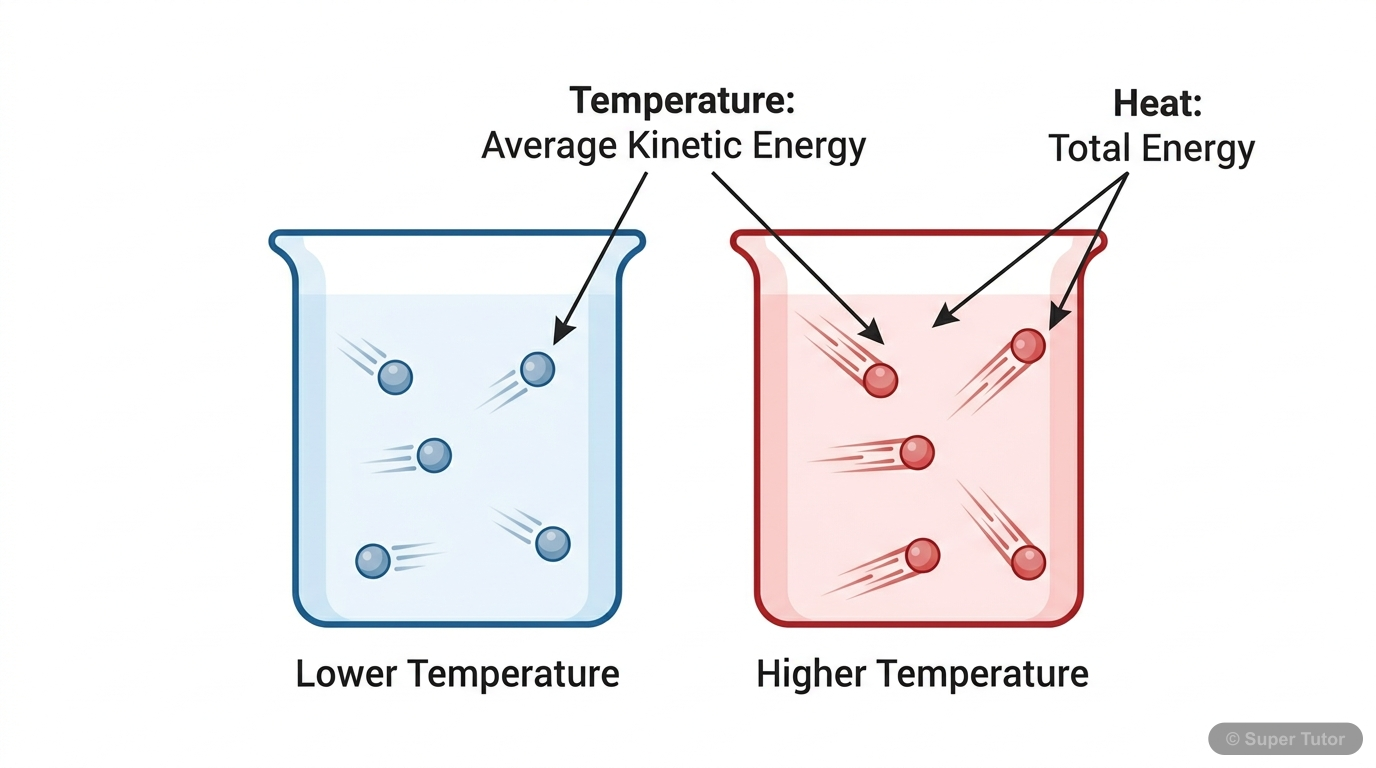
One of 13 illustrations for Calorimetry in Super Tutor — alongside flashcards, concept maps and practice questions.
See them allQuick Quiz: Calorimetry
0/4Tap an answer to check it instantly. No sign-up needed for these 4.
What is the SI unit of heat?
One calorie is the amount of heat required to raise the temperature of:
What is specific heat capacity?
The specific heat capacity of water is:
Sample Questions
Which of the following factors affect the quantity of heat required by a substance? (Select all correct answers)
Show answer
Mass of the substance, Change in temperature, Nature of the material
The quantity of heat depends on three factors: mass (more mass needs more heat), change in temperature (greater change needs more heat), and nature of material (different materials have different specific heat capacities). Color and container shape do not affect heat quantity.
What is the principle of calorimetry?
Show answer
Heat lost by hot body = Heat gained by cold body
The principle of calorimetry states that when two bodies at different temperatures are brought in contact, heat flows from the hot body to the cold body until thermal equilibrium is reached. The heat lost by the hot body equals the heat gained by the cold body (assuming no heat loss to surroundings).
Which material is commonly used to make a calorimeter?
Show answer
Copper
Calorimeters are commonly made of copper because it is a good conductor of heat and has low specific heat capacity. This ensures rapid temperature equalization and minimal heat absorption by the calorimeter itself. The surfaces are polished to reduce radiation losses.
Which of the following are consequences of water's high specific heat capacity? (Select all correct answers)
Show answer
Used in car radiators for cooling, Helps maintain moderate climate near seashores, Animals maintain body temperature
High specific heat capacity of water means it can absorb large amounts of heat without much temperature change. This makes it ideal for cooling systems, climate moderation near water bodies, and temperature regulation in living organisms. It doesn't affect the boiling point significantly.
+37 more questions on Calorimetry (ICSE Class 10 Physics)
Practise AllFrequently Asked Questions
What are the important topics in Calorimetry for ICSE Class 10 Physics?
How many practice questions are there for Calorimetry?
Sources & Official References
Content is aligned to the official syllabus. Refer to the board website for the latest curriculum.
More resources for Calorimetry
Important Questions
Exam-style questions with answers
Revision Notes
Key points for last-minute revision
Formula Sheet
The chapter's formulas in one place
Chapter Summary
Understand the chapter at a glance
Concept Maps
See how topics connect
Study Plan
Step-by-step plan for this chapter
Flashcards
Quick-fire cards for active recall
Syllabus
What topics to cover
For serious students
Get the full Calorimetry chapter — start free.
Quizzes, flashcards, an AI doubt solver and a study plan for ICSE Class 10 Physics. Free to start, no card needed.