Spectrum — Revision Notes
ICSE · Class 10 · Physics
Spectrum revision notes for ICSE Class 10 Physics: 4 topics in quick points. Part of the ICSE Class 10 Physics syllabus.
Interactive on Super Tutor
Studying Spectrum? Get the full interactive chapter.
Quizzes, flashcards, AI doubt-solver and a step-by-step study plan — built for revision notes and more.
Free trial, no card needed.
One of 4 illustrations for Spectrum in Super Tutor — alongside flashcards, concept maps and practice questions.
See them allKey Topics to Revise
1. Deviation, Dispersion and Spectrum
- A prism is a triangular optical device with two refracting surfaces.
- A ray passing through a prism suffers deviation at both surfaces.
- Total deviation through a prism is the sum of deviations at the two refracting surfaces.
2. Visible Spectrum and Invisible Spectrum
- Visible light is the part of the electromagnetic spectrum detected by human eyes.
- Visible light is listed as 4000-8000 A.U. in the electromagnetic spectrum table, and the visible spectrum is also described as 4000 to 7800 A.U. in the text.
- Ultraviolet and infrared radiations are examples of invisible radiations.
3. Electromagnetic Spectrum
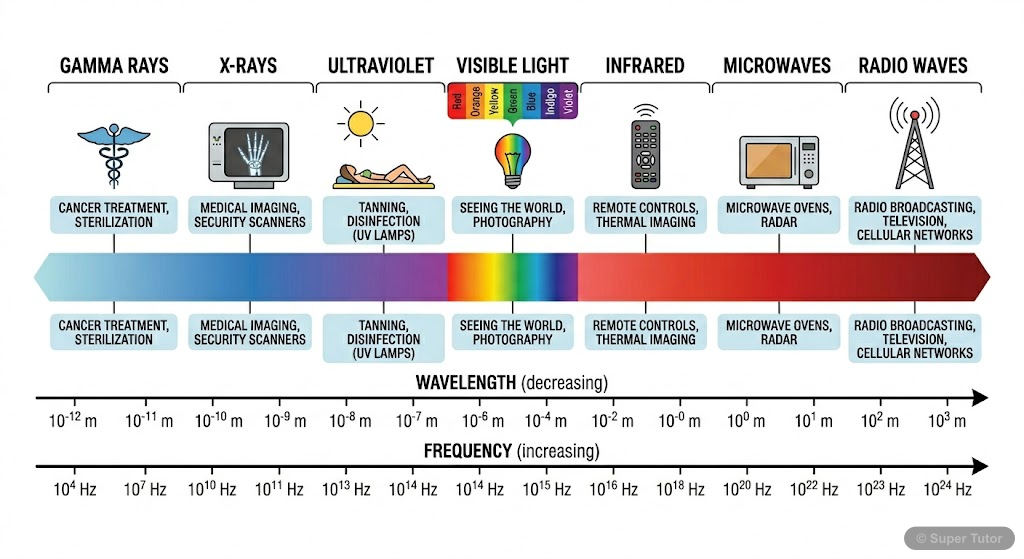
- Electromagnetic waves are classified according to frequency or wavelength, and this arrangement is called the electromagnetic spectrum.
- Electromagnetic waves are transverse waves and do not require a medium to travel.
- They travel with uniform speed 3×10^8 m/s.
4. Properties of Electromagnetic Waves
- Gamma rays cause fluorescence, have high penetrating power, easily pass through the human body, and cause immense biological damage.
- X-rays are chemically more active than UV rays, affect photographic plates, cause fluorescence with zinc sulphide, and penetrate the human body except bones.
- Ultraviolet radiations travel at the speed of light, are scattered by dust, affect photographic plates, produce fluorescence, and obey the laws of reflection and refraction.
Get complete notes with diagrams and examples
Full NotesKey Concepts
Frequently Asked Questions
What are the important topics in Spectrum for ICSE Class 10 Physics?
How should I revise Spectrum for the ICSE Class 10 board exam?
Sources & Official References
Content is aligned to the official syllabus. Refer to the board website for the latest curriculum.
More resources for Spectrum
Practice Quiz
Test yourself with a quick quiz
Important Questions
Exam-style questions with answers
Formula Sheet
The chapter's formulas in one place
Chapter Summary
Understand the chapter at a glance
Concept Maps
See how topics connect
Study Plan
Step-by-step plan for this chapter
Flashcards
Quick-fire cards for active recall
Syllabus
What topics to cover
For serious students
Get the full Spectrum chapter — start free.
Quizzes, flashcards, an AI doubt solver and a study plan for ICSE Class 10 Physics. Free to start, no card needed.