Some Basic Concepts of Chemistry — Concept Maps
ICSE · Class 11 · Chemistry
4 concept maps of Some Basic Concepts of Chemistry for ICSE Class 11 Chemistry, each also written out as a text outline.
Interactive on Super Tutor
Studying Some Basic Concepts of Chemistry? Get the full interactive chapter.
Quizzes, flashcards, AI doubt-solver and a step-by-step study plan — built for concept maps and more.
Free trial, no card needed.
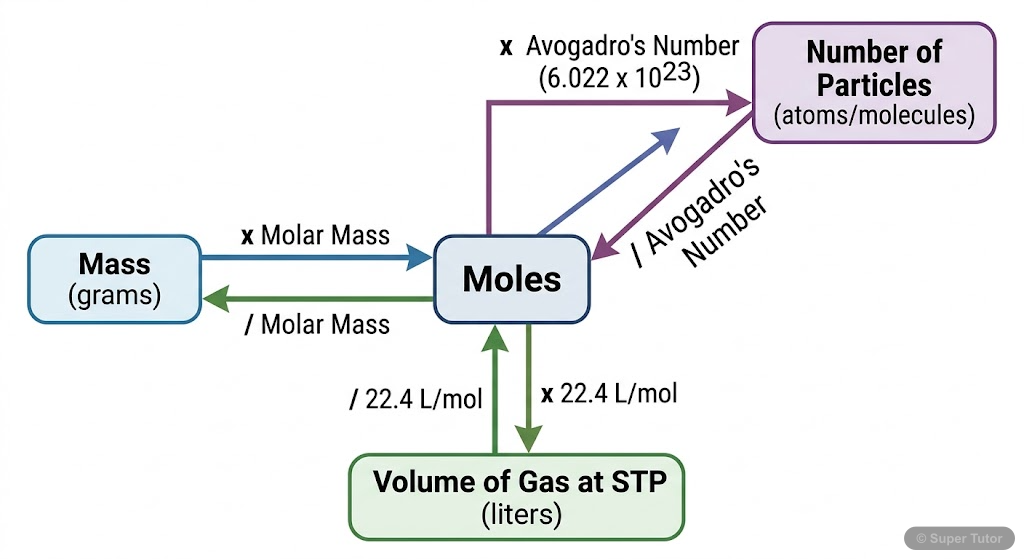
Learn better with visuals Super Tutor pairs illustrations like this with notes and quizzes for Some Basic Concepts of Chemistry.
Complete Overview of Some Basic Concepts of Chemistry
The map in words
- root((Basic Concepts
- of Chemistry))
- Classification of Matter
- Physical States
- Solid
- Liquid
- Gas
- Chemical Classification
- Pure Substances
- Elements
- Metals
- Non-metals
- Metalloids
- Compounds
- Elements
- Mixtures
- Homogeneous
- Heterogeneous
- Pure Substances
- Physical States
- Laws of Chemical Combination
- Conservation of Mass
- Constant Proportion
- Multiple Proportions
- Reciprocal Proportions
- Gay Lussac Law
- Mole Concept
- Avogadro Number 6.022 x 10 power 23
- Gram Atomic Mass
- Gram Molecular Mass
- Molar Volume 22.4 L at STP
- Atomic and Molecular Mass
- Atomic Mass Unit amu
- Isotopic Mass
- Formula Mass
- Concentration Units
- Molarity M
- Molality m
- Mole Fraction
- Normality N
- Mass Percentage
- Stoichiometry
- Balanced Equations
- Limiting Reagent
- Theoretical Yield
- Percent Yield
- Empirical and Molecular Formula
- Empirical Formula
- Molecular Formula
- Vapour Density
- Significant Figures
- Rules for Sig Figs
- Rounding Off
- Scientific Notation
- Classification of Matter
Some Basic Concepts of Chemistry - Topic Overview
The map in words
- Basic Concepts of Chemistry
- Matter and Classification
- Elements
- Metals
- Non-metals
- Metalloids
- Compounds
- Organic
- Inorganic
- Mixtures
- Homogeneous
- Heterogeneous
- Elements
- Atomic Theory
- Atoms
- Indivisible particles
- Unit of reaction
- Molecules
- Homoatomic
- Heteroatomic
- Isotopes
- Same atomic number
- Different mass numbers
- Atoms
- Chemical Combinations
- Laws
- Conservation of mass
- Constant proportion
- Multiple proportions
- Reciprocal proportions
- Combining volumes
- Laws
- Measurements
- Significant figures
- Rules
- Rounding
- Accuracy
- Precision
- Significant figures
- Chemical Equations
- Balanced equations
- Hit and trial
- Partial equation method
- Stoichiometry
- Mole relationships
- Mass relationships
- Volume relationships
- Balanced equations
- Mole Concept
- Avogadro's number
- 6.022 x 10^23
- Gram atomic mass
- Gram molecular mass
- Molar volume
- 22.4 L at STP
- Avogadro's number
- Solutions
- Molarity
- Normality
- Molality
- Mole fraction
- Matter and Classification
Classification of Matter — Complete Mind Map
The map in words
- Matter
- Pure Substances
- Elements
- Metals
- Iron Copper Gold
- Non-Metals
- Carbon Oxygen Sulphur
- Metalloids
- Silicon Germanium
- Metals
- Compounds
- Organic
- Glucose Sucrose
- Inorganic
- NaCl H2SO4 NaOH
- Organic
- Elements
- Mixtures
- Homogeneous
- Alloys
- Brass Bronze
- Solutions
- Salt in Water
- Gases
- Air LPG
- Alloys
- Heterogeneous
- Suspension
- Sand in Water
- Colloid
- Milk Smoke
- Mechanical
- Sand and Iron
- Suspension
- Homogeneous
- Pure Substances
The study of matter, its classification, measurements, laws of chemical combination, atomic and molecular concepts, mole concept, equivalents, solution concentration, and stoichiometric calculations
The map in words
- The study of matter, its classification, measurements, laws of chemical combination, atomic and molecular concepts, mole concept, equivalents, solution concentration, and stoichiometric calculations
- Importance and scope of chemistry
- Matter and its classification
- Properties of matter and measurement
- Physical quantities and SI units
- Particulate nature of matter
- Dalton's atomic theory and its present position
- Laws of chemical combination
- Atomic mass and isotopic mass
Explore these maps interactively
Explore DiagramsFrequently Asked Questions
What are the important topics in Some Basic Concepts of Chemistry for ICSE Class 11 Chemistry?
What do the concept maps for Some Basic Concepts of Chemistry show?
How should I revise Some Basic Concepts of Chemistry for Class 11 exams?
Sources & Official References
Content is aligned to the official syllabus. Refer to the board website for the latest curriculum.
More resources for Some Basic Concepts of Chemistry
Practice Quiz
Test yourself with a quick quiz
Important Questions
Exam-style questions with answers
Revision Notes
Key points for last-minute revision
Formula Sheet
The chapter's formulas in one place
Chapter Summary
Understand the chapter at a glance
Study Plan
Step-by-step plan for this chapter
Flashcards
Quick-fire cards for active recall
Syllabus
What topics to cover
For serious students
Get the full Some Basic Concepts of Chemistry chapter — start free.
Quizzes, flashcards, an AI doubt solver and a study plan for ICSE Class 11 Chemistry. Free to start, no card needed.