Some Basic Concepts of Chemistry — Flashcards
ICSE · Class 11 · Chemistry
49 flashcards for Some Basic Concepts of Chemistry (ICSE Class 11 Chemistry) to test yourself on key terms and facts.
Interactive on Super Tutor
Studying Some Basic Concepts of Chemistry? Get the full interactive chapter.
Quizzes, flashcards, AI doubt-solver and a step-by-step study plan — built for flashcards and more.
Free trial, no card needed.
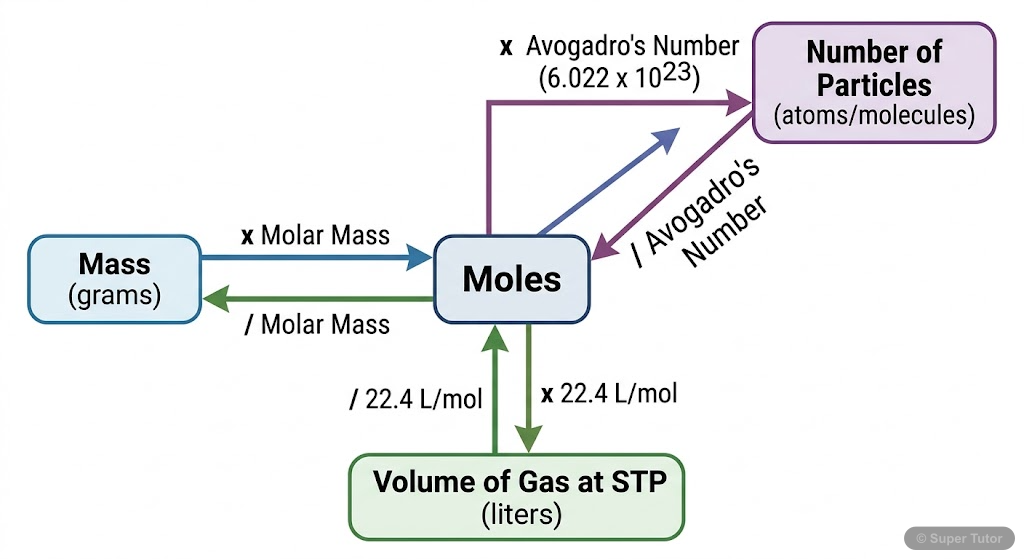
Learn better with visuals Super Tutor pairs illustrations like this with notes and quizzes for Some Basic Concepts of Chemistry.
What is matter, and how is it classified physically?
Answer
Matter is anything that has mass and occupies volume. Physical classification of matter is based on state: solids, liquids, and gases. Solids have definite shape and volume, liquids have definite volu…
What are elements, compounds, and mixtures?
Answer
An element is a pure substance that cannot be broken into simpler substances by ordinary physical or chemical methods. A compound is a pure substance formed by chemical combination of two or more diff…
How are homogeneous and heterogeneous mixtures different?
Answer
In a homogeneous mixture, the components are uniformly distributed throughout the sample. In a heterogeneous mixture, the components are not uniformly distributed and different parts may have differen…
Why is water a compound and air a mixture?
Answer
Water is a compound because hydrogen and oxygen are chemically combined in a fixed mass ratio of 1:8 and can be separated only by chemical means. Air is a mixture because its gases are physically mixe…
What is the difference between physical and chemical properties?
Answer
Physical properties can be measured without changing the identity of the substance. Examples include colour, odour, density, melting point, boiling point, and specific heat. Chemical properties involv…
State the Law of Conservation of Mass with the balanced reaction for its laboratory verification.
Answer
During any physical or chemical change, the total mass of products is always equal to the total mass of reactants. It is verified in a special H-shaped Landolt's tube using the reaction: AgNO3(aq) + N…
What happens when calcium carbonate is heated?
Answer
CaCO3(s) → CaO(s) + CO2(g) This is a decomposition reaction. The reaction shows conservation of mass because the total mass of products equals the mass of the reactant.
What is the Law of Constant Composition?
Answer
A chemical compound, no matter from which source it is obtained, always contains the same elements combined together in the same definite proportion by mass. For example, water always contains hydroge…
+41 more flashcards
Practise AllFrequently Asked Questions
What are the important topics in Some Basic Concepts of Chemistry for ICSE Class 11 Chemistry?
How many flashcards are available for Some Basic Concepts of Chemistry?
How should I revise Some Basic Concepts of Chemistry for Class 11 exams?
Sources & Official References
Content is aligned to the official syllabus. Refer to the board website for the latest curriculum.
More resources for Some Basic Concepts of Chemistry
Practice Quiz
Test yourself with a quick quiz
Important Questions
Exam-style questions with answers
Revision Notes
Key points for last-minute revision
Formula Sheet
The chapter's formulas in one place
Chapter Summary
Understand the chapter at a glance
Concept Maps
See how topics connect
Study Plan
Step-by-step plan for this chapter
Syllabus
What topics to cover
For serious students
Get the full Some Basic Concepts of Chemistry chapter — start free.
Quizzes, flashcards, an AI doubt solver and a study plan for ICSE Class 11 Chemistry. Free to start, no card needed.