Organic Chemistry: Some Basic Principles and Techniques — Practice Quiz
ICSE · Class 11 · Chemistry
Try a 4-question quiz on Organic Chemistry: Some Basic Principles and Techniques for ICSE Class 11 Chemistry: tap an answer to check it and see why.
Interactive on Super Tutor
Studying Organic Chemistry: Some Basic Principles and Techniques? Get the full interactive chapter.
Quizzes, flashcards, AI doubt-solver and a step-by-step study plan — built for practice quiz and more.
Free trial, no card needed.
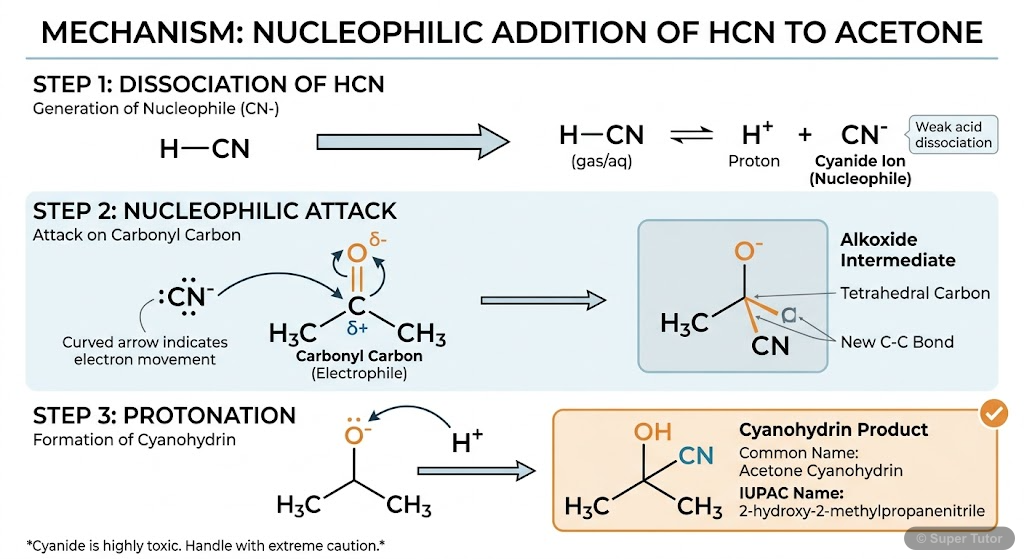
Learn better with visuals Super Tutor pairs illustrations like this with notes and quizzes for Organic Chemistry: Some Basic Principles and Techniques.
Quick Quiz: Organic Chemistry: Some Basic Principles and Techniques
0/4Tap an answer to check it instantly. No sign-up needed for these 4.
A compound has 0.500 g of silver salt and leaves 0.325 g of silver on ignition. What is the equivalent mass of the acid from which the salt was formed?
A chloroplatinate salt of a monoacid base has mass 0.400 g and leaves 0.125 g of platinum on ignition. What is the molecular mass of the base?
In Carius estimation, 0.246 g of an organic substance gives 0.2584 g of AgBr. What is the percentage of bromine in the compound?
A 0.234 g sample gives 0.334 g of BaSO4 in the Carius method. What is the percentage of sulphur in the compound?
Sample Questions
A 1.5 g sample of an organic compound gives 2.5090 g of Mg2P2O7. What is the percentage of phosphorus?
Show answer
46.71%
Percentage of phosphorus = (62 / 222) × (mass of Mg2P2O7 / mass of compound) × 100. Substituting gives (62 / 222) × (2.5090 / 1.5) × 100 = 46.71%.
A compound of mass 0.20 g is analysed by Liebig's method and gives 0.44 g of CO2 and 0.18 g of H2O. What are the percentages of carbon and hydrogen respectively?
Show answer
Carbon = 60.0%, Hydrogen = 10.0%
For carbon, %C = (12/44) × (mass of CO2 / mass of compound) × 100 = (12/44) × (0.44 / 0.20) × 100 = 60.0%. For hydrogen, %H = (2/18) × (mass of H2O / mass of compound) × 100 = (2/18) × (0.18 / 0.20) × 100 = 10.0%.
A 0.303 g organic compound is Kjeldahlised. The ammonia evolved is absorbed in 50 mL of 0.1 N H2SO4, and the excess acid requires 25 mL of 0.1 N NaOH. What is the percentage of nitrogen?
Show answer
11.55%
The acid neutralised by ammonia = 50 - 25 = 25 mL. Gram equivalents of NH3 = (0.1 × 25) / 1000. Mass of nitrogen = this equivalent × 14 = 0.035 g. Percentage nitrogen = (0.035 / 0.303) × 100 = 11.55%.
In Duma's method, 0.22 g of a compound gives 34 mL of moist nitrogen at 17 °C and 733.4 mm pressure. If aqueous tension at 17 °C is 13.4 mm, what is the percentage of nitrogen?
Show answer
17.23%
Dry nitrogen pressure = 733.4 - 13.4 = 720 mm. Convert 34 mL at 720 mm and 290 K to STP: V2 = (720 × 34 × 273) / (290 × 760) = 30.32 mL. Then %N = [28 × V(STP) × 100] / [22400 × mass] = [28 × 30.32 × 100] / [22400 × 0.22] = 17.23%.
+59 more questions on Organic Chemistry: Some Basic Principles and Techniques (ICSE Class 11 Chemistry)
Practise AllFrequently Asked Questions
What are the important topics in Organic Chemistry: Some Basic Principles and Techniques for ICSE Class 11 Chemistry?
How many practice questions are there for Organic Chemistry: Some Basic Principles and Techniques?
Sources & Official References
Content is aligned to the official syllabus. Refer to the board website for the latest curriculum.
More resources for Organic Chemistry: Some Basic Principles and Techniques
Important Questions
Exam-style questions with answers
Revision Notes
Key points for last-minute revision
Formula Sheet
The chapter's formulas in one place
Chapter Summary
Understand the chapter at a glance
Concept Maps
See how topics connect
Study Plan
Step-by-step plan for this chapter
Flashcards
Quick-fire cards for active recall
Syllabus
What topics to cover
For serious students
Get the full Organic Chemistry: Some Basic Principles and Techniques chapter — start free.
Quizzes, flashcards, an AI doubt solver and a study plan for ICSE Class 11 Chemistry. Free to start, no card needed.