Chemical Thermodynamics — Practice Quiz
ICSE · Class 11 · Chemistry
Try a 4-question quiz on Chemical Thermodynamics for ICSE Class 11 Chemistry: tap an answer to check it and see why. 91 questions in the full chapter test.
Interactive on Super Tutor
Studying Chemical Thermodynamics? Get the full interactive chapter.
Quizzes, flashcards, AI doubt-solver and a step-by-step study plan — built for practice quiz and more.
Free trial, no card needed.
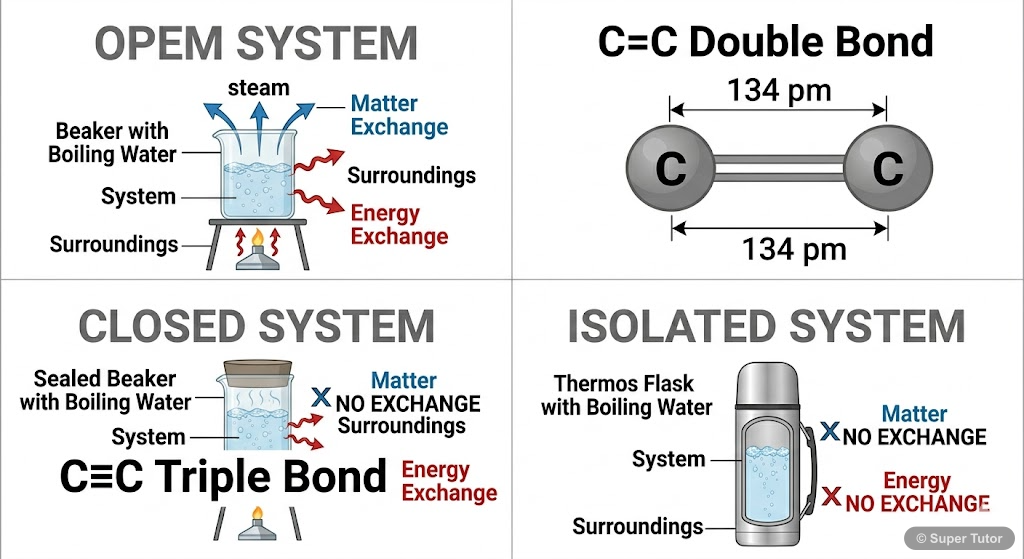
One of 4 illustrations for Chemical Thermodynamics in Super Tutor — alongside flashcards, concept maps and practice questions.
Quick Quiz: Chemical Thermodynamics
0/4Tap an answer to check it instantly. No sign-up needed for these 4.
For the reaction N₂(g) + 3H₂(g) → 2NH₃(g), ΔH = -92.38 kJ at 298 K. What is the value of ΔU at 298 K? (R = 8.314 J K⁻¹ mol⁻¹)
Which of the following conditions guarantees that a reaction is spontaneous at ALL temperatures?
The heat of combustion of methane is -890 kJ mol⁻¹ measured at constant volume (bomb calorimeter) at 298 K. What is ΔH for CH₄(g) + 2O₂(g) → CO₂(g) + 2H₂O(l)? (R = 8.314 J K⁻¹mol⁻¹)
For a reversible isothermal expansion of an ideal gas, work done by the gas when 2 moles expand from 5 L to 25 L at 300 K is: (R = 8.314 J K⁻¹ mol⁻¹, log 5 = 0.699)
Sample Questions
The standard entropy change (ΔS°) for the reaction SO₂(g) + ½O₂(g) → SO₃(g) is calculated using S° values: SO₂ = 248.5, O₂ = 205.0, SO₃ = 256.2 J K⁻¹ mol⁻¹. What is ΔS°?
Show answer
-94.8 J K⁻¹ mol⁻¹
Step 1: ΔS° = ΣS°(products) - ΣS°(reactants). Step 2: S°(products) = S°[SO₃(g)] = 256.2. Step 3: S°(reactants) = S°[SO₂(g)] + ½ × S°[O₂(g)] = 248.5 + ½×205.0 = 248.5 + 102.5 = 351.0. Step 4: ΔS° = 256.2 - 351.0 = -94.8 J K⁻¹ mol⁻¹. The negative sign makes sense because gas moles decrease (fewer gaseous molecules = less disorder). Option B has wrong sign. Option C uses full O₂ (not ½).
For the reaction Ag₂O(s) ⇌ 2Ag(s) + ½O₂(g), ΔH = +30.54 kJ mol⁻¹ and ΔS = +0.06 kJ K⁻¹ mol⁻¹. The temperature at which ΔG = 0 is:
Show answer
509 K
Step 1: At equilibrium, ΔG = 0, so ΔH = TΔS. Step 2: T = ΔH/ΔS. Step 3: T = 30.54 kJ mol⁻¹ ÷ 0.06 kJ K⁻¹ mol⁻¹ = 509 K. Step 4: Below 509 K, TΔS < ΔH, so ΔG > 0 (non-spontaneous forward). Above 509 K, TΔS > ΔH, so ΔG < 0 (spontaneous forward — Ag₂O decomposes). Option B incorrectly uses ΔS in J units without converting. Option C uses an incorrect formula.
The standard free energy change ΔG° for a reaction at 300 K is +38.74 kJ. What is the value of equilibrium constant K at this temperature? (R = 8.314 J K⁻¹ mol⁻¹)
Show answer
1.8 × 10⁻⁷
Step 1: Use ΔG° = -2.303RT log K. Step 2: log K = -ΔG°/(2.303RT) = -(38740)/(2.303 × 8.314 × 300) = -38740/5748 = -6.74. Step 3: K = 10⁻⁶·⁷⁴ = 1.8 × 10⁻⁷. Step 4: A positive ΔG° means the products are not favoured at standard conditions (K < 1). Option B is the reciprocal (K > 1, which would require ΔG° < 0). Option C uses wrong sign in the exponent.
A system absorbs 400 J of heat and does 150 J of work on the surroundings. Then the system undergoes a cyclic process returning to initial state. What is the total change in internal energy after the complete cycle?
Show answer
Zero
Step 1: Internal energy (U) is a state function — it depends only on the current state of the system, not the path. Step 2: In a cyclic process, the initial state and final state are identical. Step 3: Therefore, ΔU = U_final - U_initial = 0. Step 4: Even though q = +400 J and w = -150 J in one step (giving ΔU = 250 J for that step), returning to the initial state means the sum of all ΔU over the entire cycle is zero. The values of q and w mentioned are distractors — the key concept is that ΔU_cycle = 0.
+87 more questions on Chemical Thermodynamics (ICSE Class 11 Chemistry)
Practise AllFrequently Asked Questions
What are the important topics in Chemical Thermodynamics for ICSE Class 11 Chemistry?
How many practice questions are there for Chemical Thermodynamics?
Sources & Official References
Content is aligned to the official syllabus. Refer to the board website for the latest curriculum.
More resources for Chemical Thermodynamics
Important Questions
Exam-style questions with answers
Revision Notes
Key points for last-minute revision
Formula Sheet
The chapter's formulas in one place
Chapter Summary
Understand the chapter at a glance
Concept Maps
See how topics connect
Study Plan
Step-by-step plan for this chapter
Flashcards
Quick-fire cards for active recall
Syllabus
What topics to cover
For serious students
Get the full Chemical Thermodynamics chapter — start free.
Quizzes, flashcards, an AI doubt solver and a study plan for ICSE Class 11 Chemistry. Free to start, no card needed.