Organic Chemistry: Some Basic Principles and Techniques — Chapter Summary
ICSE · Class 11 · Chemistry
Summary of Organic Chemistry: Some Basic Principles and Techniques for ICSE Class 11 Chemistry. Part of the ICSE Class 11 Chemistry syllabus.
Interactive on Super Tutor
Studying Organic Chemistry: Some Basic Principles and Techniques? Get the full interactive chapter.
Quizzes, flashcards, AI doubt-solver and a step-by-step study plan — built for chapter summary and more.
Free trial, no card needed.
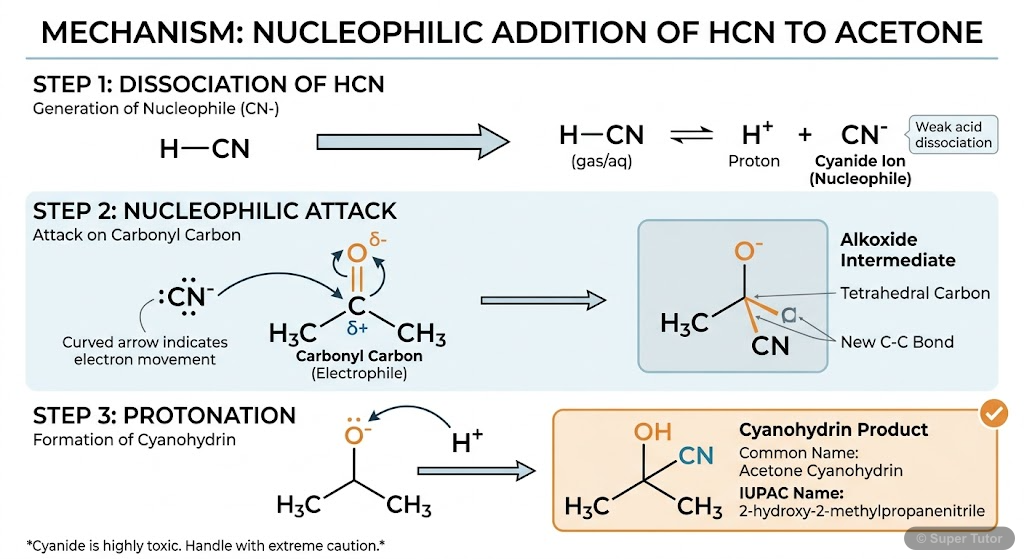
Learn better with visuals Super Tutor pairs illustrations like this with notes and quizzes for Organic Chemistry: Some Basic Principles and Techniques.
Overview
Organic chemistry is the study of hydrocarbons and the compounds derived from them. Carbon forms more than five million compounds because of catenation, tetracovalency, multiple bond formation, and isomerism. Organic compounds are generally covalent, show wide structural variety, and are studied thr
Key Concepts
Organic chemistry deals with hydrocarbons
Organic chemistry deals with hydrocarbons and the compounds derived from hydrocarbons. Carbon compounds are studied separately because they are very n
Berzelius defined organic compounds as substances
Berzelius defined organic compounds as substances derived from living organisms. Wohler prepared urea in the laboratory in 1828 by boiling aqueous amm
Carbon atoms can link with one
Carbon atoms can link with one another by stable covalent bonds to form straight chains, branched chains, and rings. Ground state carbon has only two
sp3
sp3, sp2, and sp hybridisation explain the shapes of methane, ethane, ethene, and ethyne. Bond length decreases in the order C-C 154 pm > C=C 134 pm >
Pi bonds restrict rotation because breaking
Pi bonds restrict rotation because breaking a pi bond needs energy. This gives rise to cis and trans forms in suitable alkenes. Compounds of the type
Learning Objectives
- Understand why carbon forms an exceptionally large number of compounds.
- Classify organic compounds into open-chain, cyclic, alicyclic, aromatic, and heterocyclic types.
- Use basic IUPAC rules for naming open-chain, cyclic, and aromatic compounds.
- Recognise structural and stereo isomerism, including geometrical and optical isomerism.
- Identify the effect of bond breaking and electron displacement in organic reactions.
Frequently Asked Questions
What are the important topics in Organic Chemistry: Some Basic Principles and Techniques for ICSE Class 11 Chemistry?
How should I revise Organic Chemistry: Some Basic Principles and Techniques for Class 11 exams?
Sources & Official References
Content is aligned to the official syllabus. Refer to the board website for the latest curriculum.
More resources for Organic Chemistry: Some Basic Principles and Techniques
Practice Quiz
Test yourself with a quick quiz
Important Questions
Exam-style questions with answers
Revision Notes
Key points for last-minute revision
Formula Sheet
The chapter's formulas in one place
Concept Maps
See how topics connect
Study Plan
Step-by-step plan for this chapter
Flashcards
Quick-fire cards for active recall
Syllabus
What topics to cover
For serious students
Get the full Organic Chemistry: Some Basic Principles and Techniques chapter — start free.
Quizzes, flashcards, an AI doubt solver and a study plan for ICSE Class 11 Chemistry. Free to start, no card needed.