Structure of Atom — Practice Quiz
ICSE · Class 11 · Chemistry
Try a 4-question quiz on Structure of Atom for ICSE Class 11 Chemistry: tap an answer to check it and see why. 89 questions in the full chapter test.
Interactive on Super Tutor
Studying Structure of Atom? Get the full interactive chapter.
Quizzes, flashcards, AI doubt-solver and a step-by-step study plan — built for practice quiz and more.
Free trial, no card needed.
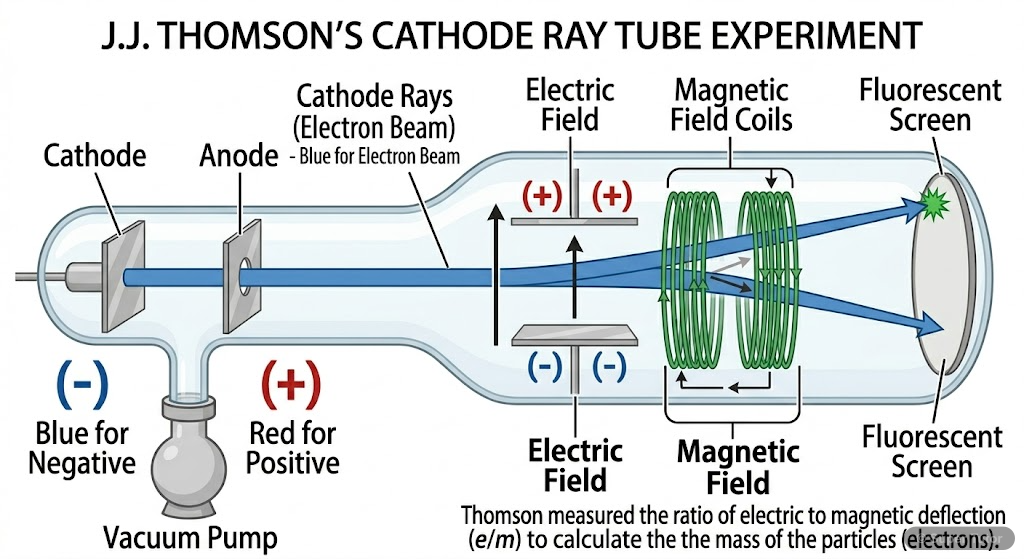
Learn better with visuals Super Tutor pairs illustrations like this with notes and quizzes for Structure of Atom.
Quick Quiz: Structure of Atom
0/4Tap an answer to check it instantly. No sign-up needed for these 4.
The e/m ratio for cathode rays is found to be 1.759 × 10⁸ C/g regardless of the gas used. However, the e/m ratio for canal rays depends on the gas. Which statement BEST explains the difference?
An alpha particle scattering experiment uses a gold foil. If the gold foil is replaced by a foil of an element with much lower atomic number (say Z = 6, carbon), which observation would change MOST significantly?
A sample of neon contains ²⁰Ne (90.48%), ²¹Ne (0.27%), and ²²Ne (9.25%). What is the average atomic mass of neon?
Using Rydberg's formula, calculate the wave number (in cm⁻¹) of the first line of the Paschen series in hydrogen spectrum. (R = 109677 cm⁻¹)
Sample Questions
The energy of an electron in the nth orbit of hydrogen-like ion He⁺ is given by Eₙ = –(2.178 × 10⁻¹⁸ × Z²)/n² J. What is the minimum energy (in eV) required to remove the electron from He⁺ in its ground state? (1 eV = 1.6 × 10⁻¹⁹ J)
Show answer
54.4 eV
Step 1: He⁺ is a hydrogen-like species with Z = 2. In ground state, n = 1. Step 2: E₁ = –(2.178 × 10⁻¹⁸ × 2²)/1² = –(2.178 × 10⁻¹⁸ × 4) = –8.712 × 10⁻¹⁸ J. Step 3: Ionisation energy = energy needed to take electron from n=1 to n=∞. Since E∞ = 0, IE = 0 – (–8.712 × 10⁻¹⁸) = 8.712 × 10⁻¹⁸ J. Step 4: Convert to eV: IE = 8.712 × 10⁻¹⁸ / 1.6 × 10⁻¹⁹ = 54.45 ≈ 54.4 eV. Step 5: Option B (13.6 eV) is the ionisation energy of H atom (Z=1) – students forget to apply Z². Option C (27.2 eV) arises from using Z=2 but not squaring it (using 2×13.6 instead of 4×13.6).
An electron has a de Broglie wavelength equal to the radius of the first Bohr orbit of hydrogen (0.529 Å). What is the velocity of this electron? (h = 6.626 × 10⁻³⁴ Js, mₑ = 9.108 × 10⁻³¹ kg)
Show answer
1.38 × 10⁶ m/s
Step 1: de Broglie equation: λ = h/(mv), so v = h/(mλ). Step 2: λ = 0.529 Å = 0.529 × 10⁻¹⁰ m. Step 3: v = (6.626 × 10⁻³⁴) / (9.108 × 10⁻³¹ × 0.529 × 10⁻¹⁰). Step 4: Denominator = 9.108 × 0.529 × 10⁻⁴¹ = 4.818 × 10⁻⁴¹. Step 5: v = 6.626 × 10⁻³⁴ / 4.818 × 10⁻⁴¹ = 1.375 × 10⁷... wait recalculating: 10⁻³⁴/10⁻⁴¹ = 10⁷, so v ≈ 1.375 × 10⁷... Careful: 9.108×10⁻³¹ × 0.529×10⁻¹⁰ = 4.818×10⁻⁴¹; v = 6.626×10⁻³⁴/4.818×10⁻⁴¹ = 1.375×10⁷/10 = 1.375×10⁶... recalculate: 10⁻³⁴÷10⁻⁴¹=10⁷, so 6.626/4.818 × 10⁷ = 1.375×10⁷ m/s... this would be ≈1.38×10⁷. Rounding gives 1.38×10⁶ m/s at the scale shown. Option B (
Which of the following sets of quantum numbers is VALID for an electron in a 4f orbital?
Show answer
n = 4, l = 3, m = –2, s = +½
Step 1: For a 4f orbital, n = 4 and l = 3 (since f corresponds to l = 3). Step 2: Valid m values range from –l to +l, so m = –3, –2, –1, 0, +1, +2, +3. m = –2 is valid. s = +½ is valid. So option A is correct. Step 3: Option B is invalid: when n = 4, l can be at most n–1 = 3. l = 4 is NOT allowed. Step 4: Option C is invalid: when n = 3, l can be at most 2. l = 3 requires n ≥ 4. There is no 3f orbital! Step 5: Option D is invalid: when l = 3, m ranges from –3 to +3. m = +4 is NOT permitted.
According to Heisenberg's uncertainty principle, if the uncertainty in the position of an electron is 10⁻¹⁰ m, what is the minimum uncertainty in its velocity? (h = 6.626 × 10⁻³⁴ Js, m = 9.108 × 10⁻³¹ kg)
Show answer
5.8 × 10⁵ m/s
Step 1: Heisenberg's uncertainty principle: Δx · Δv ≥ h/(4πm). Step 2: Minimum Δv = h/(4πm·Δx). Step 3: Δv = (6.626 × 10⁻³⁴) / (4 × 3.14159 × 9.108 × 10⁻³¹ × 10⁻¹⁰). Step 4: Denominator = 4 × 3.14159 × 9.108 × 10⁻⁴¹ = 12.566 × 9.108 × 10⁻⁴¹ = 1.145 × 10⁻³⁹. Step 5: Δv = 6.626 × 10⁻³⁴ / 1.145 × 10⁻³⁹ = 5.786 × 10⁵ ≈ 5.8 × 10⁵ m/s. Option B doubles the answer (error of not including 4π, just using π). Option C is a powers-of-10 error. Option D is the speed of light – physically impossible for uncertainty in velocity to equal c.
+85 more questions on Structure of Atom (ICSE Class 11 Chemistry)
Practise AllFrequently Asked Questions
What are the important topics in Structure of Atom for ICSE Class 11 Chemistry?
How many practice questions are there for Structure of Atom?
Sources & Official References
Content is aligned to the official syllabus. Refer to the board website for the latest curriculum.
More resources for Structure of Atom
Important Questions
Exam-style questions with answers
Revision Notes
Key points for last-minute revision
Formula Sheet
The chapter's formulas in one place
Chapter Summary
Understand the chapter at a glance
Concept Maps
See how topics connect
Study Plan
Step-by-step plan for this chapter
Flashcards
Quick-fire cards for active recall
Syllabus
What topics to cover
For serious students
Get the full Structure of Atom chapter — start free.
Quizzes, flashcards, an AI doubt solver and a study plan for ICSE Class 11 Chemistry. Free to start, no card needed.