Organic Chemistry: Some Basic Principles and Techniques — Flashcards
ICSE · Class 11 · Chemistry
60 flashcards for Organic Chemistry: Some Basic Principles and Techniques (ICSE Class 11 Chemistry) to test yourself on key terms and facts.
Interactive on Super Tutor
Studying Organic Chemistry: Some Basic Principles and Techniques? Get the full interactive chapter.
Quizzes, flashcards, AI doubt-solver and a step-by-step study plan — built for flashcards and more.
Free trial, no card needed.
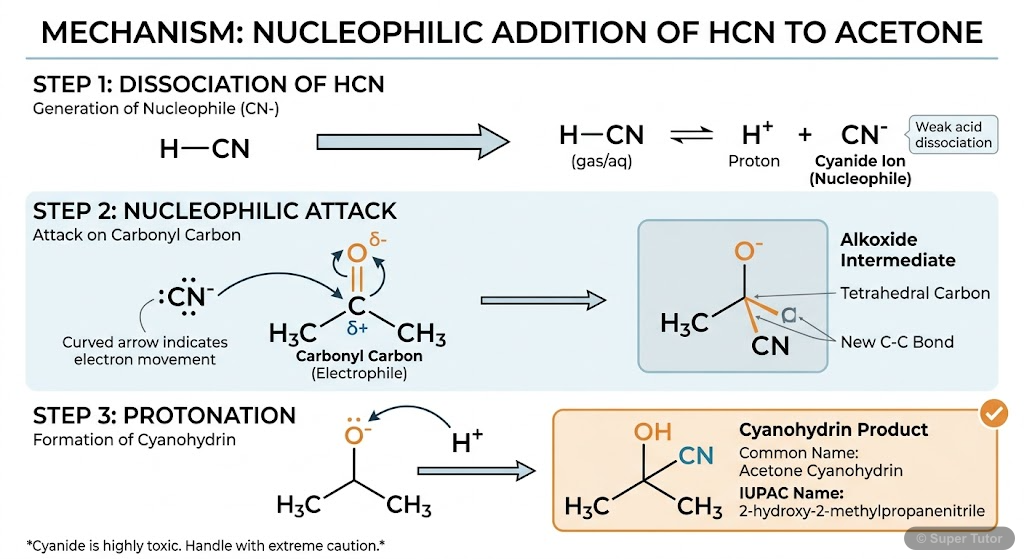
Learn better with visuals Super Tutor pairs illustrations like this with notes and quizzes for Organic Chemistry: Some Basic Principles and Techniques.
What is organic chemistry?
Answer
Organic chemistry is the branch of chemistry dealing with the study of hydrocarbons and the compounds which could be thought of as derivatives of hydrocarbons. Organic compounds are mainly covalent, w…
Why does carbon form such a large number of compounds?
Answer
Carbon forms more than five million compounds because of three main reasons: catenation, ability to form multiple bonds, and isomerism. Strong C-C bonds and tetravalency make long chains and rings sta…
What is catenation?
Answer
Catenation is the property of atoms of an element to link with one another by stable covalent bonds to form straight chains, branched chains, or rings. Carbon shows this property to the maximum extent…
Why is carbon tetravalent?
Answer
Ground state carbon has configuration 1s2 2s2 2px1 2py1, which gives only two half-filled orbitals. In the excited state, one electron from 2s is promoted to 2pz, giving 1s2 2s1 2px1 2py1 2pz1. Now fo…
What is the geometry of carbon compounds in methane-like bonding?
Answer
van't Hoff and Le Bel predicted that the four valencies of carbon are directed towards the four corners of a regular tetrahedron at 109°28'. This explains the tetrahedral shape of methane and many sp3…
How do hybridisation and bond type affect C-C bond length?
Answer
Bond length order is sp3-sp3 (154 pm) > sp2-sp2 (134 pm) > sp-sp (120 pm). More s-character means shorter bond length because the bond is closer to the nucleus.
Why is rotation around a C=C bond restricted?
Answer
A C=C bond contains one sigma bond and one pi bond. Breaking the pi bond requires absorption of about 251 kJ/mol, so free rotation is not possible under normal conditions.
Which compounds show geometrical isomerism?
Answer
Geometrical isomerism is shown by compounds containing carbon-carbon double bonds. Compounds of the type aaC=Cab cannot show it, because the two possible arrangements are identical.
+52 more flashcards
Practise AllFrequently Asked Questions
What are the important topics in Organic Chemistry: Some Basic Principles and Techniques for ICSE Class 11 Chemistry?
How many flashcards are available for Organic Chemistry: Some Basic Principles and Techniques?
How should I revise Organic Chemistry: Some Basic Principles and Techniques for Class 11 exams?
Sources & Official References
Content is aligned to the official syllabus. Refer to the board website for the latest curriculum.
More resources for Organic Chemistry: Some Basic Principles and Techniques
Practice Quiz
Test yourself with a quick quiz
Important Questions
Exam-style questions with answers
Revision Notes
Key points for last-minute revision
Formula Sheet
The chapter's formulas in one place
Chapter Summary
Understand the chapter at a glance
Concept Maps
See how topics connect
Study Plan
Step-by-step plan for this chapter
Syllabus
What topics to cover
For serious students
Get the full Organic Chemistry: Some Basic Principles and Techniques chapter — start free.
Quizzes, flashcards, an AI doubt solver and a study plan for ICSE Class 11 Chemistry. Free to start, no card needed.