Organic Chemistry: Some Basic Principles and Techniques — Syllabus
ICSE · Class 11 · Chemistry
What Organic Chemistry: Some Basic Principles and Techniques covers in ICSE Class 11 Chemistry: 4 topics, for the 2026-27 session.
Interactive on Super Tutor
Studying Organic Chemistry: Some Basic Principles and Techniques? Get the full interactive chapter.
Quizzes, flashcards, AI doubt-solver and a step-by-step study plan — built for syllabus and more.
Free trial, no card needed.
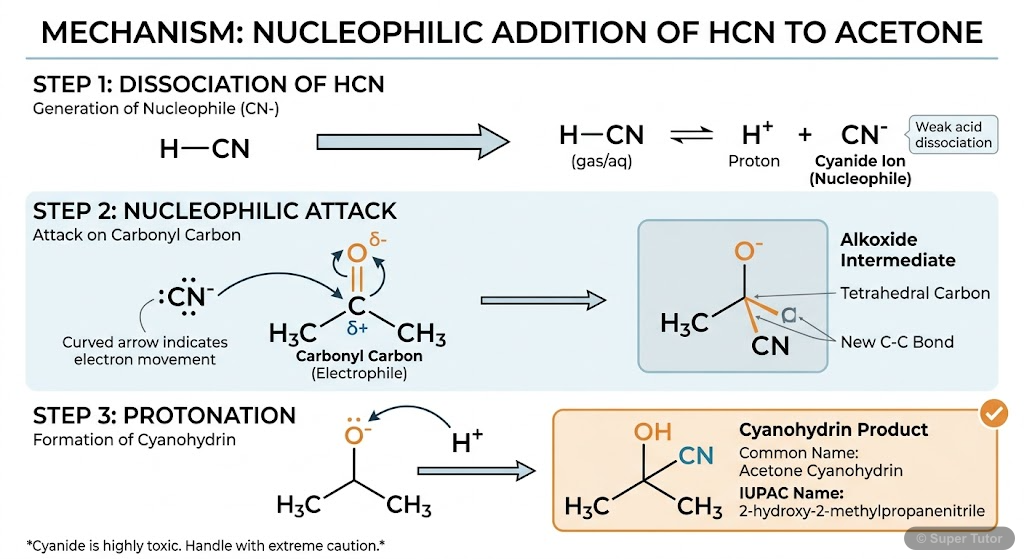
Learn better with visuals Super Tutor pairs illustrations like this with notes and quizzes for Organic Chemistry: Some Basic Principles and Techniques.
Topics in Organic Chemistry: Some Basic Principles and Techniques
1. Basic idea of organic chemistry
- More than five million organic compounds of carbon are known.
- Organic compounds are mainly covalent, while inorganic compounds are generally ionic.
- Berzelius defined organic compounds as compounds derived from living organisms.
2. Why carbon forms so many compounds
- Carbon shows catenation, multiple bonding, and isomerism.
- Catenation is the ability of atoms to link with one another by stable covalent bonds to form straight chains, branched chains, or rings.
- Carbon shows catenation to the maximum extent because of strong C-C bonds and tetracovalency.
3. Classification of organic compounds and homologous series
- Organic compounds can be open chain or closed chain.
- Open chain compounds are also called acyclic or aliphatic compounds.
- Closed chain compounds are cyclic compounds.
4. Representation of organic compounds and IUPAC nomenclature
- Organic compounds may be represented by molecular formula, structural formula, condensed structural formula, bond line notation, and polygon formulae.
- In bond line notation, carbon and hydrogen atoms are not shown; only bonds are shown.
- In polygon formulae, each corner of the polygon represents a carbon atom.
Key Concepts
Central concept: Organic chemistry as the study of carbon compounds, their structure, naming, properties, reactions, and methods of analysis
Work through every topic in Organic Chemistry: Some Basic Principles and Techniques with notes and quizzes
Start This ChapterFrequently Asked Questions
What are the important topics in Organic Chemistry: Some Basic Principles and Techniques for ICSE Class 11 Chemistry?
How should I revise Organic Chemistry: Some Basic Principles and Techniques for Class 11 exams?
Sources & Official References
Content is aligned to the official syllabus. Refer to the board website for the latest curriculum.
More resources for Organic Chemistry: Some Basic Principles and Techniques
Practice Quiz
Test yourself with a quick quiz
Important Questions
Exam-style questions with answers
Revision Notes
Key points for last-minute revision
Formula Sheet
The chapter's formulas in one place
Chapter Summary
Understand the chapter at a glance
Concept Maps
See how topics connect
Study Plan
Step-by-step plan for this chapter
Flashcards
Quick-fire cards for active recall
For serious students
Get the full Organic Chemistry: Some Basic Principles and Techniques chapter — start free.
Quizzes, flashcards, an AI doubt solver and a study plan for ICSE Class 11 Chemistry. Free to start, no card needed.