Structure of Atom — Chapter Summary
ICSE · Class 11 · Chemistry
Summary of Structure of Atom for ICSE Class 11 Chemistry. Part of the ICSE Class 11 Chemistry syllabus. The structure of atom explains how matter is built.
Interactive on Super Tutor
Studying Structure of Atom? Get the full interactive chapter.
Quizzes, flashcards, AI doubt-solver and a step-by-step study plan — built for chapter summary and more.
Free trial, no card needed.
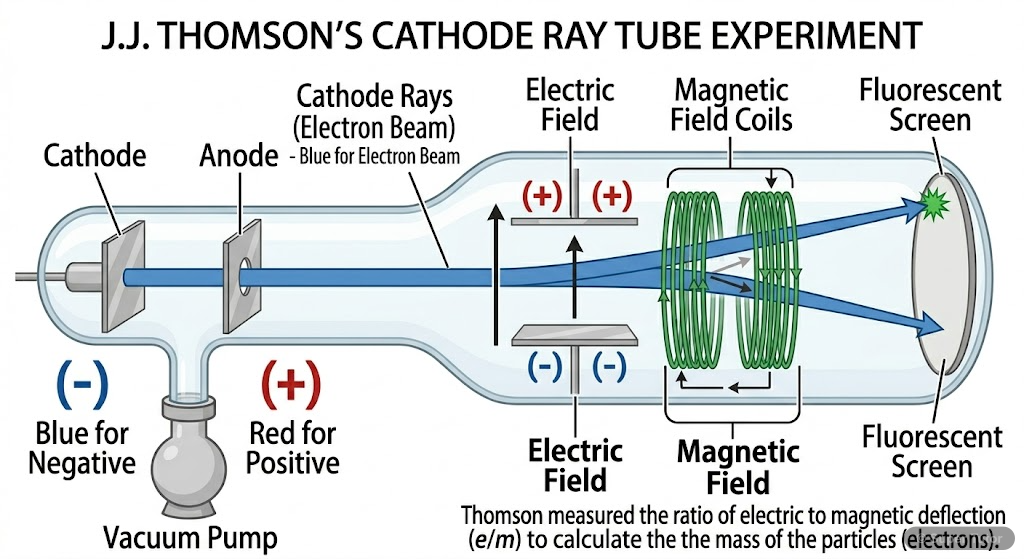
Learn better with visuals Super Tutor pairs illustrations like this with notes and quizzes for Structure of Atom.
Overview
The structure of atom explains how matter is built at the smallest level and how electrons, protons, and neutrons are arranged. The chapter moves from Dalton’s idea of indivisible atoms to the discovery of subatomic particles, nuclear structure, atomic number, mass number, isotopes, isobars, electro
Key Concepts
Matter was first viewed as being
Matter was first viewed as being made of extremely small, structureless, indivisible atoms of fixed mass. Atoms of one element are alike and differ fr
An electron is a negatively charged
An electron is a negatively charged subatomic particle with charge 1.6021 × 10^-19 C and mass 9.108 × 10^-28 g. J.J. Thomson found the e/m value of ca
A proton is a positively charged
A proton is a positively charged subatomic particle with mass 1.672 × 10^-24 g and charge 1.6021 × 10^-19 C. It is actually an ionised hydrogen atom,
A neutron is electrically neutral
A neutron is electrically neutral, has mass 1.675 × 10^-24 g, and is not present in ordinary hydrogen. Chadwick discovered it in 1932 by bombarding be
Rutherford’s alpha
Rutherford’s alpha-particle scattering experiment showed that most of an atom is empty space and that almost all the mass and positive charge are conc
Learning Objectives
- Understand the evolution of atomic models from Dalton to the quantum mechanical model
- Describe the discovery and properties of electron, proton, and neutron
- Explain atomic number, mass number, isotopes, isobars, and related terms
- Relate electromagnetic radiation to atomic spectra and energy changes
- Use Bohr’s model to explain hydrogen spectrum and electron transitions
Frequently Asked Questions
What are the important topics in Structure of Atom for ICSE Class 11 Chemistry?
How should I revise Structure of Atom for Class 11 exams?
Sources & Official References
Content is aligned to the official syllabus. Refer to the board website for the latest curriculum.
More resources for Structure of Atom
Practice Quiz
Test yourself with a quick quiz
Important Questions
Exam-style questions with answers
Revision Notes
Key points for last-minute revision
Formula Sheet
The chapter's formulas in one place
Concept Maps
See how topics connect
Study Plan
Step-by-step plan for this chapter
Flashcards
Quick-fire cards for active recall
Syllabus
What topics to cover
For serious students
Get the full Structure of Atom chapter — start free.
Quizzes, flashcards, an AI doubt solver and a study plan for ICSE Class 11 Chemistry. Free to start, no card needed.