Structure of Atom — Flashcards
ICSE · Class 11 · Chemistry
56 flashcards for Structure of Atom (ICSE Class 11 Chemistry) to test yourself on key terms and facts. Sample: "What did Dalton's atomic theory say about"
Interactive on Super Tutor
Studying Structure of Atom? Get the full interactive chapter.
Quizzes, flashcards, AI doubt-solver and a step-by-step study plan — built for flashcards and more.
Free trial, no card needed.
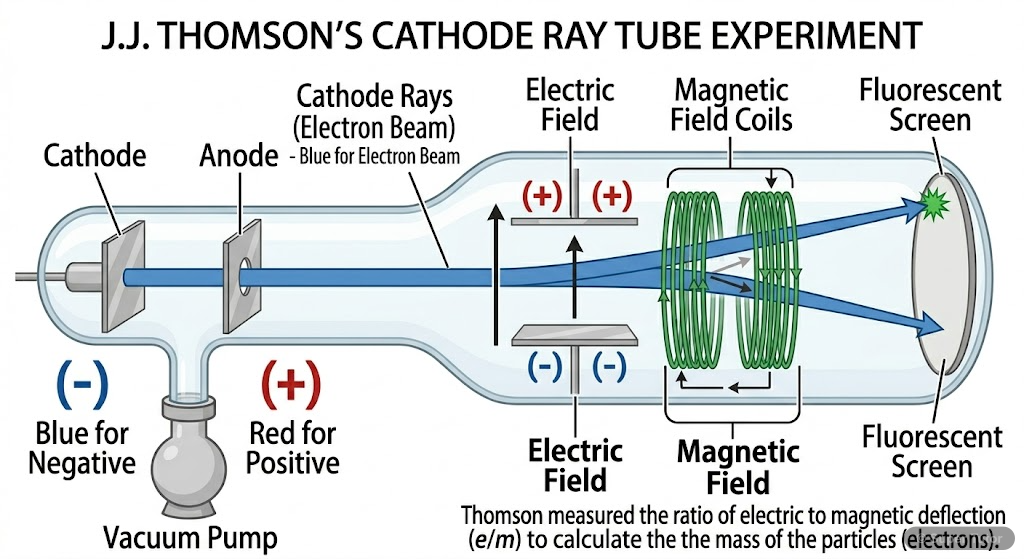
Learn better with visuals Super Tutor pairs illustrations like this with notes and quizzes for Structure of Atom.
What did Dalton's atomic theory say about atoms?
Answer
Matter was composed of extremely small particles called atoms which were structureless, possessed fixed mass and were indivisible. Atoms of a given element were alike and differed from atoms of other …
How were cathode rays identified in a discharge tube?
Answer
Cathode rays are streams of electrons. They travel in straight lines, produce fluorescence, and get deflected towards the positive electrode in an electric field, showing that they are negatively char…
What is the charge-to-mass ratio of electron particles found by Thomson?
Answer
The charge-to-mass ratio was found to be 1.759 × 10^8 C/g in 1897. This was measured using cathode rays and showed that the same particle was present regardless of the gas used.
What are the mass and charge of an electron?
Answer
An electron has charge = 1.6021 × 10^-19 C and mass = 9.108 × 10^-28 g. It is about 1/1837 of the mass of a hydrogen atom.
How did Millikan determine the charge on an electron?
Answer
Millikan used the oil drop method in 1909. The present accepted value of electronic charge is 4.8032 × 10^-10 e.s.u. or 1.6022 × 10^-19 C.
What are canal rays and what do they show?
Answer
Canal rays are positive rays produced when a perforated cathode is used in a discharge tube. They deflect towards the negative electrode in an electric field, so they contain positively charged partic…
Why does the e/m value of canal rays change with the gas used?
Answer
The particles in canal rays are positive ions formed from the gas inside the tube. Since different gases form different ions, the e/m value changes with the gas used.
What is a proton?
Answer
A proton is a subatomic particle with mass 1.672 × 10^-24 g and charge +1.6021 × 10^-19 C. It is actually an ionised hydrogen atom and can be represented as H+.
+48 more flashcards
Practise AllFrequently Asked Questions
What are the important topics in Structure of Atom for ICSE Class 11 Chemistry?
How many flashcards are available for Structure of Atom?
How should I revise Structure of Atom for Class 11 exams?
Sources & Official References
Content is aligned to the official syllabus. Refer to the board website for the latest curriculum.
More resources for Structure of Atom
Practice Quiz
Test yourself with a quick quiz
Important Questions
Exam-style questions with answers
Revision Notes
Key points for last-minute revision
Formula Sheet
The chapter's formulas in one place
Chapter Summary
Understand the chapter at a glance
Concept Maps
See how topics connect
Study Plan
Step-by-step plan for this chapter
Syllabus
What topics to cover
For serious students
Get the full Structure of Atom chapter — start free.
Quizzes, flashcards, an AI doubt solver and a study plan for ICSE Class 11 Chemistry. Free to start, no card needed.