Structure of Atom — Concept Maps
ICSE · Class 11 · Chemistry
4 concept maps of Structure of Atom for ICSE Class 11 Chemistry, each also written out as a text outline. Part of the ICSE Class 11 Chemistry syllabus.
Interactive on Super Tutor
Studying Structure of Atom? Get the full interactive chapter.
Quizzes, flashcards, AI doubt-solver and a step-by-step study plan — built for concept maps and more.
Free trial, no card needed.
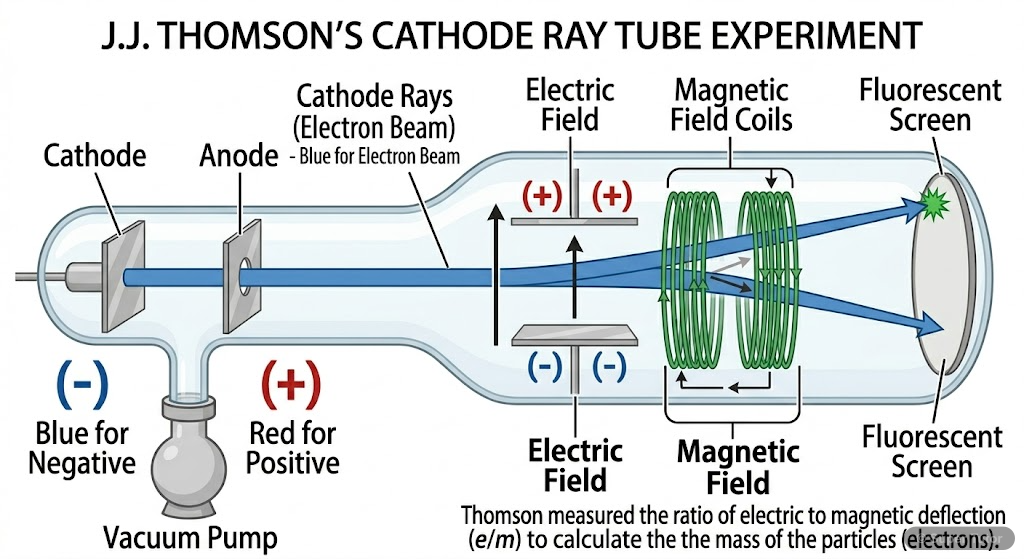
Learn better with visuals Super Tutor pairs illustrations like this with notes and quizzes for Structure of Atom.
Structure of Atom - Complete Concept Overview
The map in words
- STRUCTURE OF ATOM
- Fundamental Particles
- Electron
- Negative charge
- 9.108 × 10⁻³¹ kg
- e/m = 1.759 × 10⁸ C/g
- Proton
- Positive charge
- 1.672 × 10⁻²⁴ g
- Mass 1837× electron
- Neutron
- No charge
- 1.675 × 10⁻²⁴ g
- Slightly heavier than proton
- Electron
- Atomic Models
- Thomson Model
- Plum-pudding
- Electrons embedded
- Disproved by Rutherford
- Rutherford Model
- Nuclear nucleus
- Electrons orbit
- Explains alpha scattering
- Bohr Model
- Quantized orbits
- Explains H spectrum
- Limited to single electron
- Quantum Mechanical
- Schrödinger equation
- Wave functions
- Orbitals not orbits
- Thomson Model
- Electromagnetic Radiation
- Properties
- Wavelength λ
- Frequency ν
- c = λν
- Energy
- E = hν
- Photons discrete
- Planck constant
- Spectrum
- Visible light
- VIBGYOR range
- Atomic spectra discrete
- Properties
- Atomic Spectra
- Hydrogen Series
- Lyman UV
- Balmer visible
- Paschen IR
- Brackett IR
- Pfund IR
- Rydberg Formula
- ν̄ = R(1/n₁² - 1/n₂²)
- Predicts wavelengths
- Works for H and H-like
- Hydrogen Series
- Wave-Particle Duality
- de-Broglie Wavelength
- λ = h/mv
- Electrons ~3.32 Å
- Measurable for microscopic
- Uncertainty Principle
- Cannot know x and p both
- ΔxΔp ≥ h/4π
- Eliminates Bohr orbits
- de-Broglie Wavelength
- Quantum Numbers
- Principal n
- 1,2,3,4,5,6,7
- Determines energy
- Determines shell
- Azimuthal l
- 0 to n-1
- s,p,d,f subshells
- Determines shape
- Magnetic m
- -l to +l
- Spatial orientation
- Explains Zeeman effect
- Spin s
- +1/2 or -1/2
- Two per orbital maximum
- Principal n
- Orbitals
- s-orbitals
- Spherical shape
- 1 orbital per s subshell
- 2 electrons max
- p-orbitals
- Dumbbell shaped
- 3 orientations p_x p_y p_z
- 6 electrons max
- d-orbitals
- Complex shapes
- 5 orientations
- 10 electrons max
- f-orbitals
- Very complex
- 7 orientations
- 14 electrons max
- s-orbitals
- Electronic Configuration
- Aufbau Principle
- Fill lowest energy first
- 1s 2s 2p 3s 3p 4s 3d 4p...
- Hund's Rule
- Unpaired electrons parallel
- Pairing only when full
- Pauli Principle
- No identical (n,l,m,s)
- Max 2 per orbital opposite
- Half-filled Stability
- d⁵ extra stable
- d¹⁰ extra stable
- Explains Cr Cu exceptions
- Aufbau Principle
- Fundamental Particles
Structure of Atom – Complete Chapter Overview
The map in words
- Structure of Atom
- Subatomic Particles
- Electron
- Cathode Rays
- e/m = 1.759E8 C/g
- Charge = 1.6E-19 C
- Mass = 9.1E-31 kg
- Proton
- Canal Rays
- e/m varies with gas
- Mass = 1.672E-24 g
- Neutron
- Chadwick 1932
- Be + He to C + n
- Mass = 1.675E-24 g
- Electron
- Atomic Models
- Thomson Model
- Plum Pudding
- Electrons embedded
- Failed Rutherford test
- Rutherford Model
- Gold Foil Experiment
- Nuclear Model
- Failed stability test
- Bohr Model
- Fixed Circular Orbits
- H and H-like only
- Quantized Energy
- Quantum Mechanical Model
- Schrodinger Equation
- Orbitals not Orbits
- Probability Picture
- Thomson Model
- Atomic Properties
- Atomic Number Z
- Protons in nucleus
- Moseley X-ray method
- Mass Number A
- Protons plus Neutrons
- Isotopes
- Same Z different A
- Same chemical properties
- Isobars
- Same A different Z
- Different elements
- Atomic Number Z
- Electromagnetic Radiation
- Wave Properties
- Wavelength lambda
- Frequency nu
- c = nu x lambda
- Planck Quantum Theory
- E = h nu
- Discrete quanta
- Photoelectric Effect
- Threshold Frequency
- Work Function
- Einstein Equation
- Wave Properties
- Quantum Numbers
- Principal n
- Shell size energy
- 1 2 3 4
- Azimuthal l
- Subshell shape
- 0 1 2 3 = s p d f
- Magnetic m
- Orientation
- -l to +l
- Spin s
- Plus half minus half
- Principal n
- Electron Filling Rules
- Pauli Exclusion
- Max 2 per orbital
- Opposite spins
- Hund Rule
- Maximize unpaired
- Same spin direction
- Aufbau Principle
- Increasing energy order
- 4s before 3d
- Pauli Exclusion
- Subatomic Particles
Flowchart showing the discharge tube experiment process and how cathode rays were identified as electrons
The map in words
- Discharge Tube Setup
- High Voltage Applied
- Very Low Pressure
- Cathode Rays Emitted
- Properties of Rays
- Travel Path: Straight Lines
- Particles Identified
- Electrons Discovered
- Particles Identified
- Charge: Negative
- Energy: Kinetic Energy
- Deflection: Toward Positive
- Travel Path: Straight Lines
- Properties of Rays
- Cathode Rays Emitted
- Very Low Pressure
- High Voltage Applied
Structure of Atom
The map in words
- Structure of Atom
- Atomic nature of matter
- Fundamental subatomic particles
- Discovery of electron
- Discovery of proton
- Atomic models
- Rutherford's experiment
- Discovery of neutron
- Atomic number and mass number
Explore these maps interactively
Explore DiagramsFrequently Asked Questions
What are the important topics in Structure of Atom for ICSE Class 11 Chemistry?
What do the concept maps for Structure of Atom show?
How should I revise Structure of Atom for Class 11 exams?
Sources & Official References
Content is aligned to the official syllabus. Refer to the board website for the latest curriculum.
More resources for Structure of Atom
Practice Quiz
Test yourself with a quick quiz
Important Questions
Exam-style questions with answers
Revision Notes
Key points for last-minute revision
Formula Sheet
The chapter's formulas in one place
Chapter Summary
Understand the chapter at a glance
Study Plan
Step-by-step plan for this chapter
Flashcards
Quick-fire cards for active recall
Syllabus
What topics to cover
For serious students
Get the full Structure of Atom chapter — start free.
Quizzes, flashcards, an AI doubt solver and a study plan for ICSE Class 11 Chemistry. Free to start, no card needed.