The Great Depression — Concept Maps
ICSE · Class 11 · History
4 concept maps of The Great Depression for ICSE Class 11 History, each also written out as a text outline. Part of the ICSE Class 11 History syllabus.
Interactive on Super Tutor
Studying The Great Depression? Get the full interactive chapter.
Quizzes, flashcards, AI doubt-solver and a step-by-step study plan — built for concept maps and more.
Free trial, no card needed.
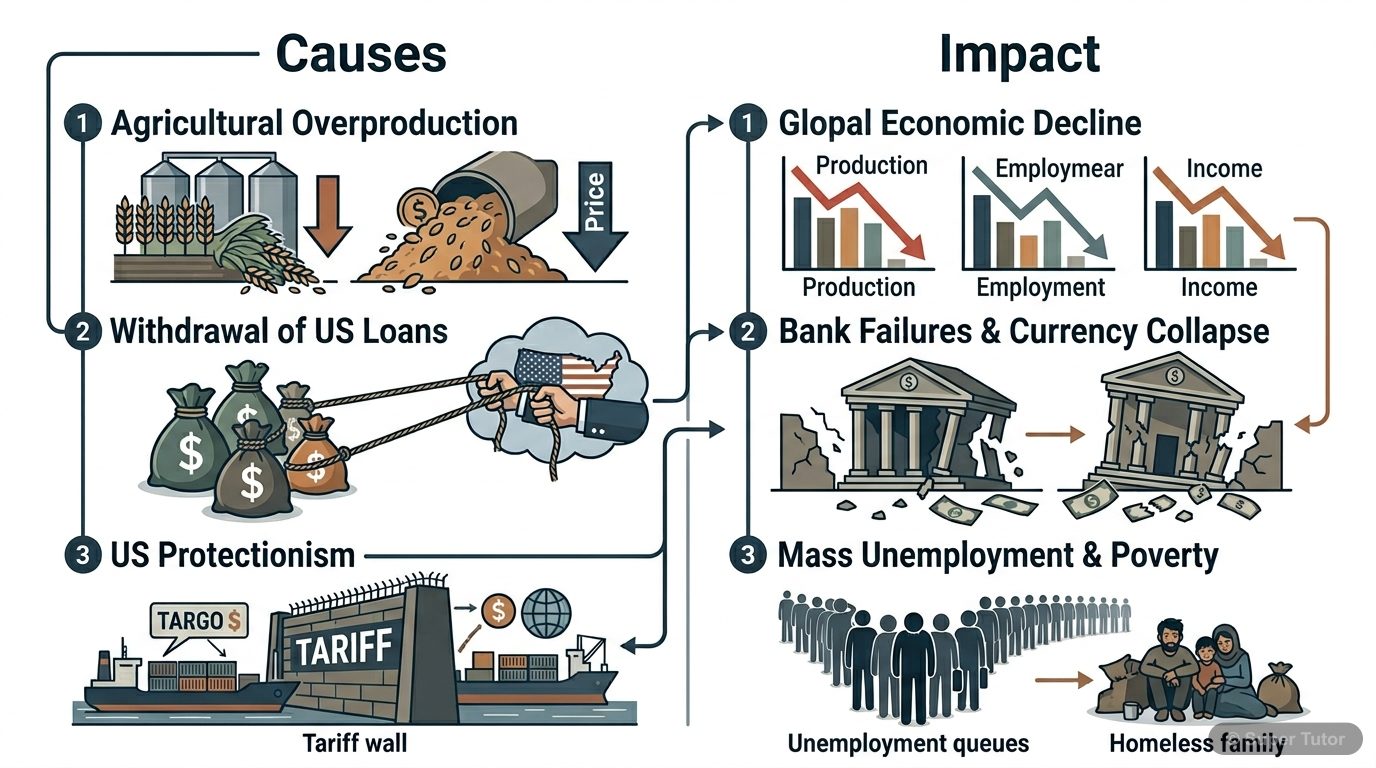
Learn better with visuals Super Tutor pairs illustrations like this with notes and quizzes for The Great Depression.
The Great Depression – Chapter Overview Mind Map
The map in words
- The Great Depression
- USA Boom and Crash
- Republican Era 1921-33
- Harding
- Coolidge
- Hoover
- Policy of Laissez-faire
- 1920s Great Boom
- 29 million cars by 1929
- Skyscrapers and Electronics
- Wall Street Crash 1929
- Over-production
- Speculation
- Weapons Slump
- Unequal Wealth
- Consequences
- 80 percent stock drop
- 14 million unemployed
- Banks closed
- Republican Era 1921-33
- Roosevelts New Deal
- Banking Reform
- Closed and reopened banks
- Guaranteed deposits
- Public Works Administration
- Roads, bridges, schools
- National Recovery Administration
- Blue Eagle badge
- Tennessee Valley Authority
- Dams for irrigation and electricity
- Social Security Act 1935
- First welfare legislation
- Opposition
- Supreme Court
- Conservative judges
- Banking Reform
- Impact on Germany
- Weimar Republic
- Unpopular after Versailles
- Dawes Plan 1924
- Young Plan 1929
- Depression Impact
- 6 million unemployed
- 90 percent reparations cancelled
- Rise of Nazism
- 12 to 107 Nazi seats
- Hitler elected 1933
- Weimar Republic
- Impact on Japan
- Protectionism worldwide
- Silk Industry Collapse
- Price fell to one-fifth
- Rural Poverty
- Army Officers turn Fascist
- Manchuria Invasion 1931
- Path to World War II
- USA Boom and Crash
Mind map showing the various dimensions of American prosperity in the 1920s, including industrial growth, consumer culture, economic indicators, and social changes.
The map in words
- 1920s American Prosperity
- Industrial Growth
- Automobile Production
- Factory Mechanization
- New Technologies
- Consumer Culture
- Cinema Industry
- Electric Appliances
- Radio Broadcasting
- Economic Indicators
- Stock Market Boom
- Bank Capital Growth
- Export Dominance
- Social Changes
- Women Emancipation
- Urban Development
- Lifestyle Revolution
- Industrial Growth
Flowchart showing how multiple economic weaknesses converged to cause the stock market crash and trigger the Great Depression.
The map in words
- Overproduction in Industry
- Market Saturation
- Loss of Confidence
- Stock Prices Collapse
- Bank Failures
- Great Depression Begins
- Bank Failures
- Stock Prices Collapse
- Loss of Confidence
- Market Saturation
- Excessive Stock Speculation
- Inflated Share Prices
- Declining Farm Prices
- Reduced Agricultural Income
- Unequal Wealth Distribution
- Low Consumer Purchasing Power
The Great Depression and its impact on the United States, Germany, and Japan
The map in words
- The Great Depression and its impact on the United States, Germany, and Japan
- Post-World War I America
- Economic boom of the 1920s
- Wall Street Crash of 1929
- Causes of the Great Depression
- Hoover’s response
- Franklin D. Roosevelt and the New Deal
- Supreme Court opposition
- Germany under the Weimar Republic
Explore these maps interactively
Explore DiagramsFrequently Asked Questions
What are the important topics in The Great Depression for ICSE Class 11 History?
What do the concept maps for The Great Depression show?
How should I revise The Great Depression for Class 11 exams?
Sources & Official References
Content is aligned to the official syllabus. Refer to the board website for the latest curriculum.
More resources for The Great Depression
Practice Quiz
Test yourself with a quick quiz
Important Questions
Exam-style questions with answers
Revision Notes
Key points for last-minute revision
Chapter Summary
Understand the chapter at a glance
Study Plan
Step-by-step plan for this chapter
Flashcards
Quick-fire cards for active recall
Syllabus
What topics to cover
For serious students
Get the full The Great Depression chapter — start free.
Quizzes, flashcards, an AI doubt solver and a study plan for ICSE Class 11 History. Free to start, no card needed.