Gandhian Nationalism (1916-1922) — Concept Maps
ICSE · Class 11 · History
4 concept maps of Gandhian Nationalism (1916-1922) for ICSE Class 11 History, each also written out as a text outline.
Interactive on Super Tutor
Studying Gandhian Nationalism (1916-1922)? Get the full interactive chapter.
Quizzes, flashcards, AI doubt-solver and a step-by-step study plan — built for concept maps and more.
Free trial, no card needed.
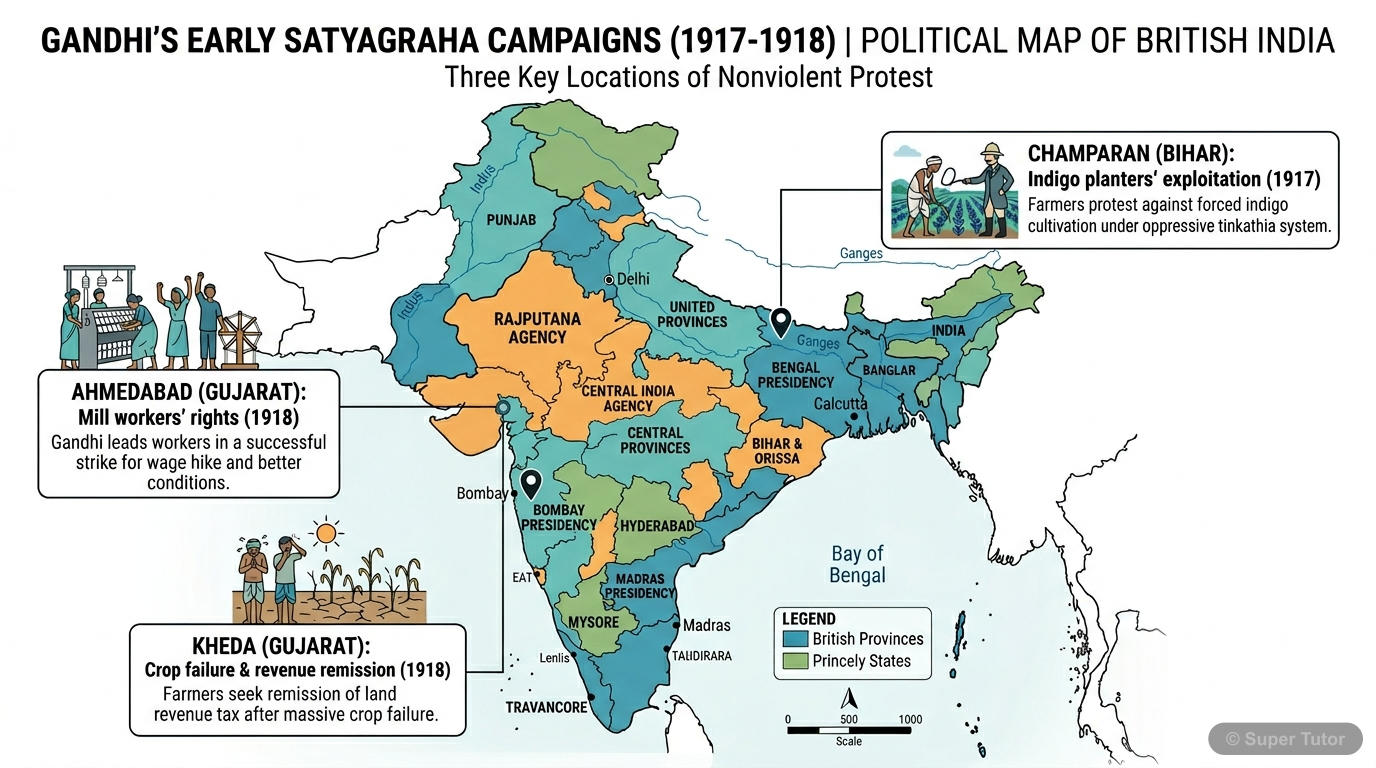
One of 4 illustrations for Gandhian Nationalism (1916-1922) in Super Tutor — alongside flashcards, concept maps and practice questions.
Gandhian Nationalism: Key Events Timeline (1916-1922)
The map in words
- 1915
- Gandhi arrives in India
- 1915
- Satyagraha Ashram founded near Ahmedabad
- 1917
- Rowlatt Committee appointed
- 1919
- Rowlatt Act passed in March
- 1919
- Gandhiji calls for Satyagraha
- 1919
- Hartal on April 6, 1919
- 1919
- Jallianwala Bagh Massacre on April 13
- 1919
- Tagore renounces knighthood
- 1919
- All-India Khilafat Conference in November
- 1920
- Khilafat Committee formed in Bombay
- 1920
- Special Congress session in Calcutta endorses Non-Cooperation
- 1920
- Nagpur Session (December) endorses Non-Cooperation
- 1921
- Non-Cooperation Movement begins all over India
- 1922
- Chauri Chaura incident on February 5
- 1922
- Movement withdrawn on February 12
- 1922
- Gandhi arrested on March 10
Timeline of Gandhian Nationalism (1915-1922)
The map in words
- 1915
- Gandhi returns to India
- 1915
- Satyagraha Ashram founded near Ahmedabad
- 1917
- Rowlatt Committee set up by British
- 1919
- Rowlatt Act passed
- 1919
- Satyagraha Sabha formed in Bombay
- 1919
- Hartal on 6 April across India
- 1919
- Jallianwala Bagh Massacre - 13 April
- 1919
- Tagore renounces Knighthood - 30 May
- 1919
- All India Khilafat Conference - Delhi
- 1920
- Gandhi becomes Khilafat Committee President
- 1920
- Calcutta Special Session adopts Non-Cooperation
- 1920
- Nagpur Session endorses movement - December
- 1921
- Mass Non-Cooperation movement across India
- 1922
- Chauri Chaura incident - 5 February
- 1922
- Bardoli Resolution suspends movement - 12 February
- 1922
- Gandhi arrested - 10 March
Flowchart showing the multiple impacts of Gandhian nationalism and its connection to subsequent independence movements
The map in words
- Gandhian Nationalism 1916-1922
- Multiple Impacts
- Political Impact
- Congress Mass Organization
- Civil Disobedience 1930
- Quit India Movement 1942
- Independence 1947
- Quit India Movement 1942
- Civil Disobedience 1930
- Non-Violence as Strategy
- Pattern for Future Movements
- Congress Mass Organization
- Economic Impact
- British Exports Decline
- Indian Industry Growth
- Swadeshi Economic Model
- Social Impact
- Common People Empowered
- National Consciousness
- Political Participation
- Global Impact
- Independence Movements
- Civil Rights Movements
- Global Non-Violence Model
- Political Impact
- Multiple Impacts
Gandhian Nationalism from 1916 to 1922 and its transformation of the Indian national movement
The map in words
- Gandhian Nationalism from 1916 to 1922 and its transformation of the Indian national movement
- Gandhi's return and new politics
- Rowlatt Act agitation, 1919
- Jallianwala Bagh massacre, 13 April 1919
- Khilafat Movement
- Non-Cooperation Movement, 1919-1922
- Opposition and debate within Congress
- Social and economic causes
- Early phases of Non-Cooperation
Explore these maps interactively
Explore DiagramsFrequently Asked Questions
What are the important topics in Gandhian Nationalism (1916-1922) for ICSE Class 11 History?
What do the concept maps for Gandhian Nationalism (1916-1922) show?
How should I revise Gandhian Nationalism (1916-1922) for Class 11 exams?
Sources & Official References
Content is aligned to the official syllabus. Refer to the board website for the latest curriculum.
More resources for Gandhian Nationalism (1916-1922)
Practice Quiz
Test yourself with a quick quiz
Important Questions
Exam-style questions with answers
Revision Notes
Key points for last-minute revision
Chapter Summary
Understand the chapter at a glance
Study Plan
Step-by-step plan for this chapter
Flashcards
Quick-fire cards for active recall
Syllabus
What topics to cover
For serious students
Get the full Gandhian Nationalism (1916-1922) chapter — start free.
Quizzes, flashcards, an AI doubt solver and a study plan for ICSE Class 11 History. Free to start, no card needed.