The Great Depression — Chapter Summary
ICSE · Class 11 · History
Summary of The Great Depression for ICSE Class 11 History. Key concepts: After Wilson, The 1920s brought rapid and Marxian explanation blames.
Interactive on Super Tutor
Studying The Great Depression? Get the full interactive chapter.
Quizzes, flashcards, AI doubt-solver and a step-by-step study plan — built for chapter summary and more.
Free trial, no card needed.
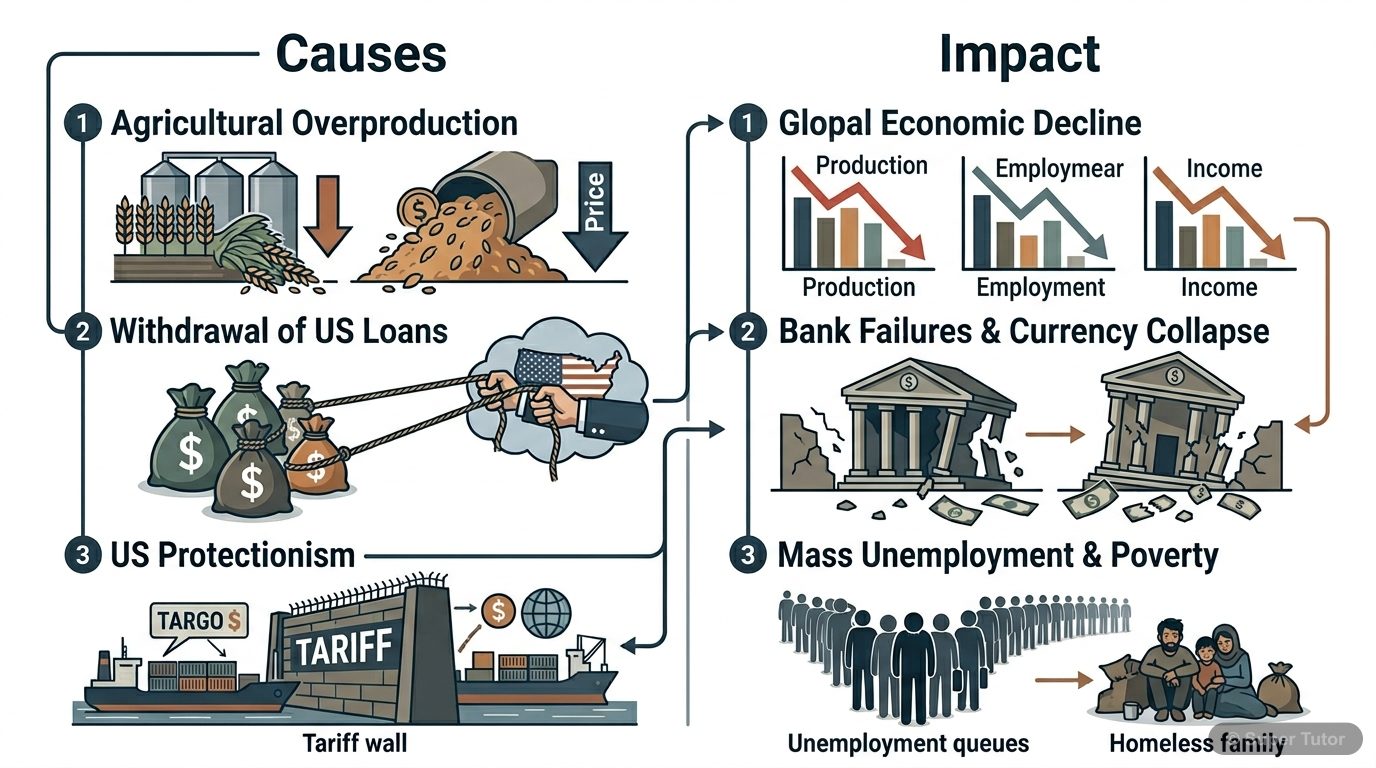
Learn better with visuals Super Tutor pairs illustrations like this with notes and quizzes for The Great Depression.
Overview
The Great Depression was a major economic crisis that began after the Wall Street Crash of October 1929. It ended the long period of American prosperity in the 1920s and caused massive unemployment, bank failures, and falling industrial output. Its effects spread beyond the United States and deeply
Key Concepts
After Wilson
After Wilson, three Republican Presidents followed: Harding, Coolidge, and Hoover. They generally followed a policy of laissez faire and preferred lim
The 1920s brought rapid industrial growth
The 1920s brought rapid industrial growth, rising consumer goods, more electricity use, and a major rise in car ownership. In 1919 there were 6 millio
Marxian explanation blames over production
Marxian explanation blames over production. Liberal historians point to several causes: businessmen assumed prosperity would continue, the stock marke
By 1932 stock exchange prices had
By 1932 stock exchange prices had dropped by 80%. Most banks closed their doors, and 14 million people became unemployed. Agricultural prices also fel
Hoover raised tariffs on imports
Hoover raised tariffs on imports, reduced taxes, passed the Emergency Relief and Reconstructions Act for federal loans to state governments, expanded
Learning Objectives
- Understand the rise of American prosperity in the 1920s and the causes of the crash of 1929.
- Explain the impact of the Great Depression on the United States, Germany, and Japan.
- Describe the responses of Hoover and Roosevelt to the economic crisis.
- Understand the rise and fall of the Weimar Republic under depression pressure.
- Recognize how economic crisis influenced political changes in Germany and Japan.
Frequently Asked Questions
What are the important topics in The Great Depression for ICSE Class 11 History?
How should I revise The Great Depression for Class 11 exams?
Sources & Official References
Content is aligned to the official syllabus. Refer to the board website for the latest curriculum.
More resources for The Great Depression
For serious students
Get the full The Great Depression chapter — start free.
Quizzes, flashcards, an AI doubt solver and a study plan for ICSE Class 11 History. Free to start, no card needed.