Emotions and Motivation
ICSE · Class 11 · Psychology
Most important questions from Emotions and Motivation for ICSE Class 11 Psychology board exam 2026. MCQs, short answer, and long answer questions with marks.
Interactive on Super Tutor
Studying Emotions and Motivation? Get the full interactive chapter.
Quizzes, flashcards, AI doubt-solver and a step-by-step study plan — built for important questions and more.
1,000+ Class 11 students started this chapter today
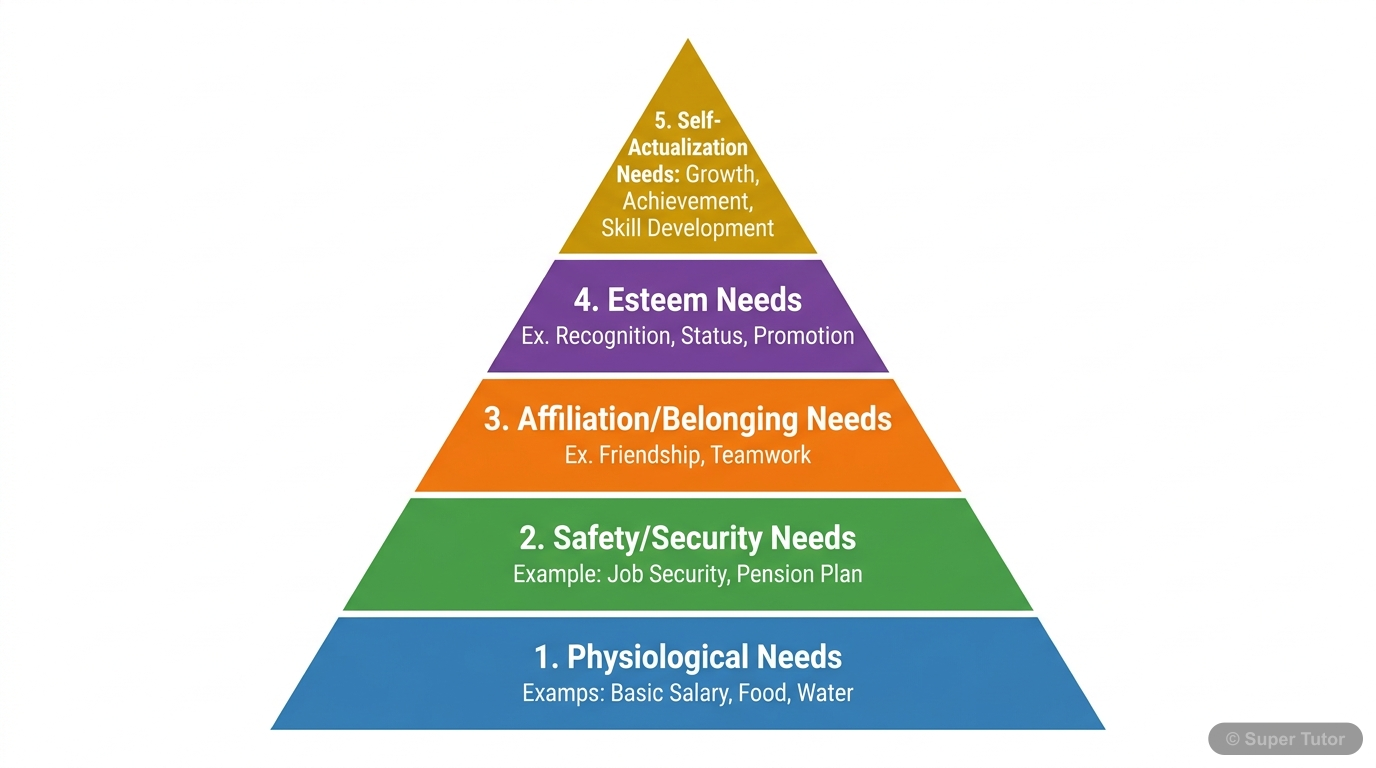
This is just one of 5+ visuals inside Super Tutor's Emotions and Motivation chapter
Explore the full setSample Questions
The Cannon-Bard theory of emotion states that physiological arousal and the experience of emotion occur:
Show answer
Simultaneously and independently
Step 1: Cannon-Bard theory was proposed as an alternative to James-Lange theory. Step 2: Walter Cannon argued that physiological changes and emotional experience do NOT follow one after the other. Step 3: Instead, both occur at the same time (simultaneously) and independently of each other. Step 4: According to this theory, the thalamus sends signals both to the cortex (for emotional experience) and to the hypothalamus (for physiological changes) at the same time. Step 5: Option C describes the Schachter-Singer theory, not Cannon-Bard, making it incorrect here.
The Schachter-Singer theory of emotion is also known as the:
Show answer
Two-factor theory of emotion
Step 1: The Schachter-Singer theory focuses on two key factors that together produce an emotional experience. Step 2: These two factors are (1) physical/physiological arousal and (2) cognitive interpretation of the stimulus causing that arousal. Step 3: Because it relies on both these factors, it is called the 'Two-factor theory of emotion'. Step 4: James-Lange theory is the physiological theory, and Cannon-Bard is the subjective theory. Step 5: There is no major 'instinct theory of emotion', making that option incorrect.
Motivation involves which three major components?
Show answer
Activation, persistence, and intensity
Step 1: Motivation is the psychological force that drives a person to act towards a goal. Step 2: Psychologists have identified three core components of motivation. Step 3: Activation refers to the initial decision or urge to start a behaviour. Persistence refers to the continued effort to pursue the goal despite obstacles. Intensity refers to the degree of energy and effort put into pursuing the goal. Step 4: Option A lists cognitive processes. Option C lists types of emotions, not motivation components. Option D mixes motivation forces with cognition. Step 5: Therefore, Activation, Persisten
Which part of the brain is mainly responsible for regulating hunger and thirst drives?
Show answer
Hypothalamus
Step 1: The question asks about the brain area controlling hunger and thirst. Step 2: The hypothalamus is a small but vital structure located in the brain. Step 3: It regulates hunger by generating the need for food and signalling when that need is satisfied (stopping eating). Step 4: Similarly, it controls the thirst drive using signals like dryness of mouth and cellular dehydration. Step 5: The cerebellum controls balance and coordination; the frontal lobe is for thinking and planning; the medulla controls basic life functions like breathing – none of these primarily regulate hunger or thirs
+40 more questions available
Practice AllFrequently Asked Questions
What are the important topics in Emotions and Motivation for ICSE Class 11 Psychology?
How to score full marks in Emotions and Motivation — ICSE Class 11 Psychology?
How many important questions are there in Emotions and Motivation?
Sources & Official References
Content is aligned to the official syllabus. Refer to the board website for the latest curriculum.
More resources for Emotions and Motivation
Practice Quiz
Test yourself with a quick quiz
Revision Notes
Key points for last-minute revision
Formula Sheet
All formulas in one place
Chapter Summary
Understand the chapter at a glance
Concept Maps
See how topics connect visually
Study Plan
Step-by-step plan to ace this chapter
Flashcards
Quick-fire cards for active recall
Syllabus
What topics to cover
NCERT Solutions
Every textbook question solved step by step
For serious students
Get the full Emotions and Motivation chapter — for free.
Quizzes, flashcards, AI doubt-solver and a step-by-step study plan for ICSE Class 11 Psychology.