Human Reproduction — Concept Maps
ICSE · Class 12 · Biology
4 concept maps of Human Reproduction for ICSE Class 12 Biology, each also written out as a text outline. Part of the ICSE Class 12 Biology syllabus.
Interactive on Super Tutor
Studying Human Reproduction? Get the full interactive chapter.
Quizzes, flashcards, AI doubt-solver and a step-by-step study plan — built for concept maps and more.
Free trial, no card needed.
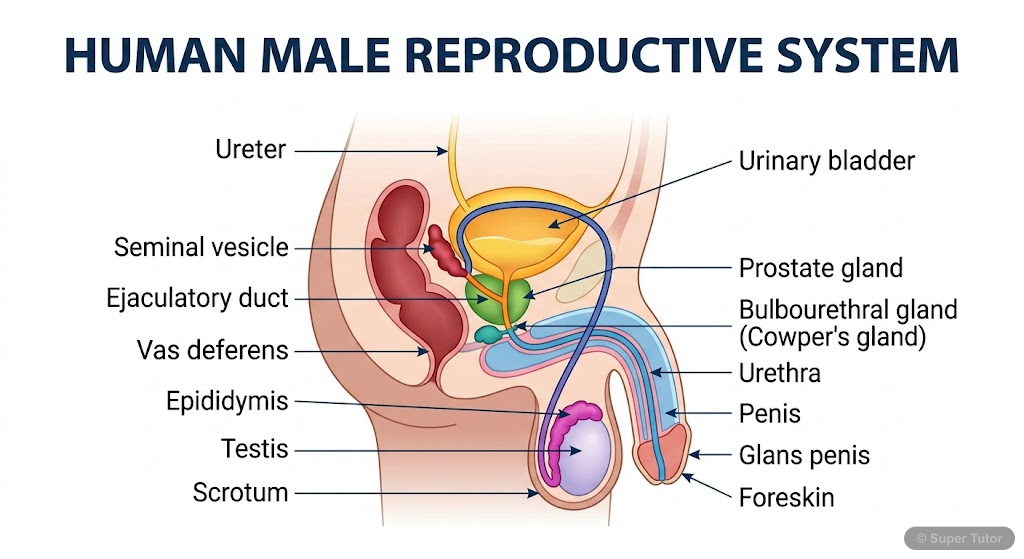
One of 7 illustrations for Human Reproduction in Super Tutor — alongside flashcards, concept maps and practice questions.
Mind map showing the hierarchical organization of male reproductive system components including primary organs, duct system, accessory glands, and external genitalia
The map in words
- Male Reproductive System
- Primary Organs
- Testes
- Produce sperm
- Produce testosterone
- Scrotum
- Maintains low temperature
- Protects testes
- Testes
- Duct System
- Seminiferous tubules
- Epididymis
- Vas deferens
- Ejaculatory duct
- Urethra
- Accessory Glands
- Seminal vesicles
- 60% of semen
- Prostate gland
- 30% of semen
- Bulbourethral glands
- Lubrication
- Seminal vesicles
- External Genitalia
- Penis
- Contains urethra
- Erectile tissue
- Penis
- Primary Organs
Flowchart showing the hierarchical structure of testis from gross anatomy to cellular components and their functions
The map in words
- Testis Structure
- Three Protective Layers
- Tunica vaginalis Outer layer
- Tunica albuginea Middle layer
- Tunica vasculosa Inner vascular layer
- Testicular Lobules ~250 per testis
- Seminiferous Tubules
- Cell Types in Tubule Wall
- Germ cells: Spermatogonia
- Undergo Meiosis
- Produce Sperm
- Undergo Meiosis
- Hormone producing: Leydig Cells Testosterone
- Support cells: Sertoli Cells Nutrition
- Germ cells: Spermatogonia
- Cell Types in Tubule Wall
- Seminiferous Tubules
- Three Protective Layers
Mind map showing the hierarchical organization of female reproductive system including external vulva, internal reproductive organs, and accessory glands
The map in words
- Female Reproductive System
- External Genitalia Vulva
- Mons pubis
- Fatty cushion
- Clitoris
- Homologous to glans
- Erectile tissue
- Labia majora
- Large fleshy folds
- Labia minora
- Small inner folds
- Vestibule
- Vaginal opening
- Urethral opening
- Bartholin glands
- Mucus secretion
- Mons pubis
- Internal Organs
- Ovaries
- Produce ova
- Produce hormones
- 2-4 cm in length
- Fallopian Tubes
- 10 cm long
- Ciliated epithelium
- Uterus
- Pyriform shaped
- Site of pregnancy
- Vagina
- Birth canal
- 10-15 cm long
- Ovaries
- Accessory Glands
- Mammary glands
- Produce milk
- Mammary glands
- External Genitalia Vulva
Human reproduction is the biological process that produces new individuals through the formation of gametes, fertilization, embryonic development, pregnancy, birth, and milk production after birth.
The map in words
- Human reproduction is the biological process that produces new individuals through the formation of gametes, fertilization, embryonic development, pregnancy, birth, and milk production after birth.
- Human reproductive system
- Gametogenesis
- Puberty
- Menstrual cycle
- Fertilization
- Embryonic development
- Placenta
- Parturition
Explore these maps interactively
Explore DiagramsFrequently Asked Questions
What are the important topics in Human Reproduction for ICSE Class 12 Biology?
What do the concept maps for Human Reproduction show?
How should I revise Human Reproduction for the ICSE Class 12 board exam?
Sources & Official References
Content is aligned to the official syllabus. Refer to the board website for the latest curriculum.
More resources for Human Reproduction
Practice Quiz
Test yourself with a quick quiz
Important Questions
Exam-style questions with answers
Revision Notes
Key points for last-minute revision
Chapter Summary
Understand the chapter at a glance
Study Plan
Step-by-step plan for this chapter
Flashcards
Quick-fire cards for active recall
Syllabus
What topics to cover
For serious students
Get the full Human Reproduction chapter — start free.
Quizzes, flashcards, an AI doubt solver and a study plan for ICSE Class 12 Biology. Free to start, no card needed.