Organisms and Populations — Concept Maps
ICSE · Class 12 · Biology
4 concept maps of Organisms and Populations for ICSE Class 12 Biology, each also written out as a text outline. Part of the ICSE Class 12 Biology syllabus.
Interactive on Super Tutor
Studying Organisms and Populations? Get the full interactive chapter.
Quizzes, flashcards, AI doubt-solver and a step-by-step study plan — built for concept maps and more.
Free trial, no card needed.
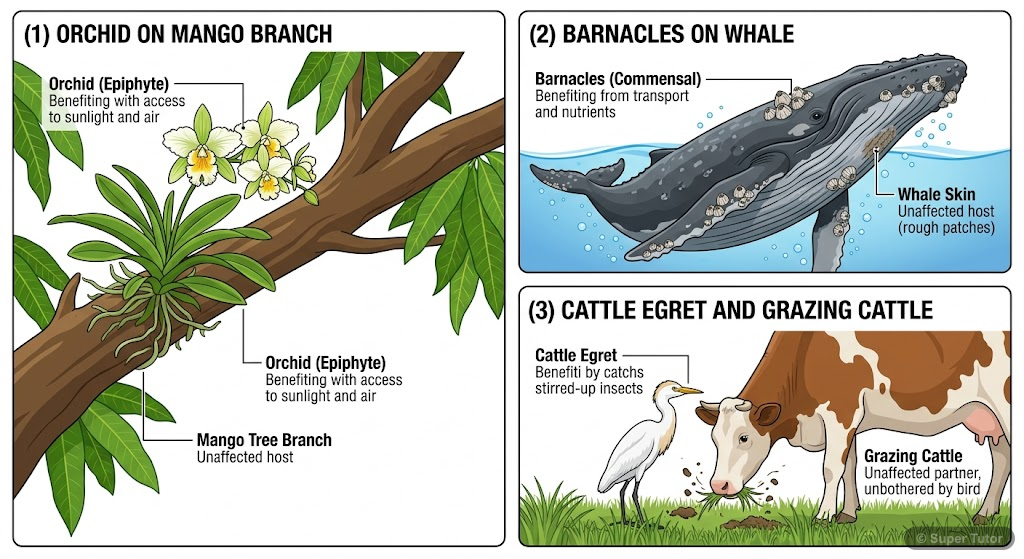
Learn better with visuals Super Tutor pairs illustrations like this with notes and quizzes for Organisms and Populations.
Population Growth Models Comparison
The map in words
- POPULATION GROWTH
- Exponential Growth\nJ-shaped curve
- Formula: dN/dt = rN
- Unlimited resources\nIdeal conditions
- N increases without limit
- Logistic Growth\nS-shaped sigmoid curve
- Formula: dN/dt = rN × K-N / K
- Limited resources\nReal conditions
- N approaches K\nCarrying capacity
- K-N/K = 0 when N=K\ngrowth stops
- Exponential Growth\nJ-shaped curve
Population Interactions Summary Table
The map in words
- Interaction Type
- Effect on Species A / B
- Mutualism: +/+\nBoth benefit\nLichen, Mycorrhiza
- Commensalism: +/0\nOne benefit, one neutral\nBarnacle on whale
- Competition: -/-\nBoth harmed\nGause's exclusion
- Predation: +/-\nPredator+, Prey-\nLynx and hare
- Parasitism: +/-\nParasite+, Host-\nCuscuta, Plasmodium
- Amensalism: 0/-\nOne neutral, one harmed\nPenicillium vs bacteria
- Effect on Species A / B
Population Attributes and Measurement Methods
The map in words
- POPULATION ATTRIBUTES
- Density N
- Count per unit area\nQuadrat / Mark-recapture
- Natality birth rate b
- Increases population
- Mortality death rate d
- Decreases population
- Age Distribution
- Broad base: Growing
- Bell shape: Stable
- Narrow base: Declining
- Sex Ratio
- More females = faster growth
- Density N
Organisms and Populations
The map in words
- Organisms and Populations
- Levels of ecological organization
- Population
- Population interactions
- Positive interspecific interactions
- Negative interspecific interactions
- Population growth
- Growth curves
- Age pyramids
Explore these maps interactively
Explore DiagramsFrequently Asked Questions
What are the important topics in Organisms and Populations for ICSE Class 12 Biology?
What do the concept maps for Organisms and Populations show?
How should I revise Organisms and Populations for the ICSE Class 12 board exam?
Sources & Official References
Content is aligned to the official syllabus. Refer to the board website for the latest curriculum.
More resources for Organisms and Populations
Practice Quiz
Test yourself with a quick quiz
Important Questions
Exam-style questions with answers
Revision Notes
Key points for last-minute revision
Formula Sheet
The chapter's formulas in one place
Chapter Summary
Understand the chapter at a glance
Study Plan
Step-by-step plan for this chapter
Flashcards
Quick-fire cards for active recall
Syllabus
What topics to cover
For serious students
Get the full Organisms and Populations chapter — start free.
Quizzes, flashcards, an AI doubt solver and a study plan for ICSE Class 12 Biology. Free to start, no card needed.