Chapter 2 of 15
Revision Notes
Human Reproduction — Revision Notes
ICSE · Class 12 · Biology
Human Reproduction revision notes for ICSE Class 12 Biology: 4 topics in quick points. Part of the ICSE Class 12 Biology syllabus.
104 questions40 flashcards5 concepts
Interactive on Super Tutor
Studying Human Reproduction? Get the full interactive chapter.
Quizzes, flashcards, AI doubt-solver and a step-by-step study plan — built for revision notes and more.
Free trial, no card needed.
Super Tutor
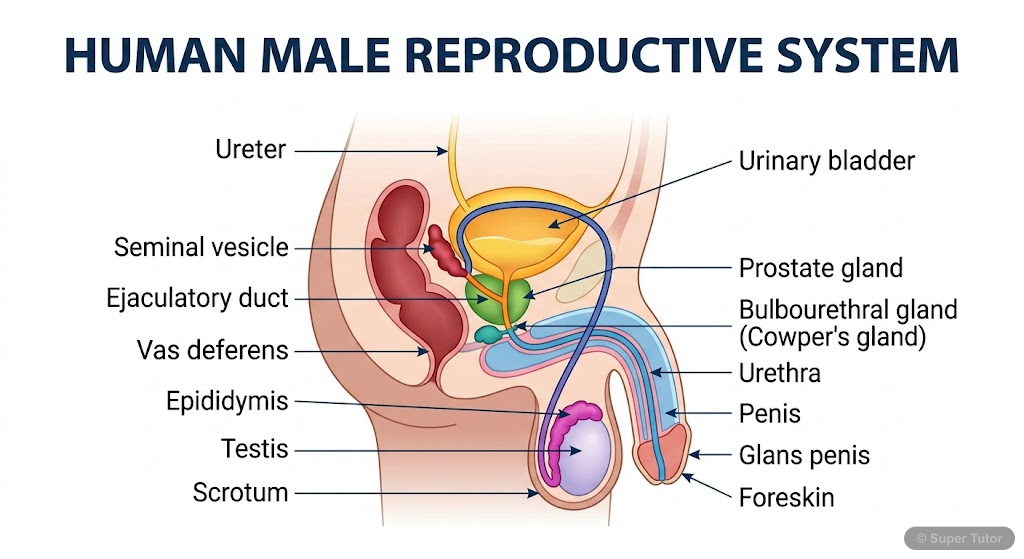
One of 7 illustrations for Human Reproduction in Super Tutor — alongside flashcards, concept maps and practice questions.
Key Topics to Revise
1
1. Human Reproductive System
- Humans are sexually reproducing organisms and are viviparous.
- The primary sex organs produce gametes and sex hormones.
- Testes are the primary male reproductive organs; ovaries are the primary female reproductive organs.
2
2. Male Reproductive System
- The testes are paired glands in the scrotum and are the primary male reproductive organs.
- Each adult testis measures about 4-5 cm long, 2-3 cm wide and weighs around 25 g.
- The testes develop in the abdominal cavity during early foetal life and descend into the scrotum through the inguinal canal during the 7th month of development.
3
3. Female Reproductive System
- The ovary is the primary female reproductive organ.
- Each ovary is almond shaped, about 2-4 cm long, 1.5 cm wide and 1.0 cm thick, and both ovaries weigh around 15 g.
- The ovary produces ova and secretes estrogens and progesterone.
4
4. Gametogenesis: Spermatogenesis and Oogenesis
- Gametogenesis is the process of formation of gametes in sexually reproducing animals.
- Spermatogenesis is the formation of male gametes in the testes.
- Oogenesis is the development of female gametes in the ovaries.
Get complete notes with diagrams and examples
Full NotesKey Concepts
The testes are the primary maleThe male reproductive system includes testesEach testis is covered by threeHuman sperm is about 60 µmThe female reproductive system includes ovaries
Frequently Asked Questions
What are the important topics in Human Reproduction for ICSE Class 12 Biology?
Key topics in Human Reproduction include Human Reproductive System, Male Reproductive System, Female Reproductive System, Gametogenesis: Spermatogenesis and Oogenesis. Study these first, then practise questions on each for the ICSE Class 12 board exam.
How should I revise Human Reproduction for the ICSE Class 12 board exam?
Learn the core ideas first, then work through the 104 practice questions on Human Reproduction. Revise definitions regularly and use flashcards for quick recall before the exam.
Sources & Official References
Content is aligned to the official syllabus. Refer to the board website for the latest curriculum.
More resources for Human Reproduction
For serious students
Get the full Human Reproduction chapter — start free.
Quizzes, flashcards, an AI doubt solver and a study plan for ICSE Class 12 Biology. Free to start, no card needed.