Evidences and Theories of Biological Evolution — Important Questions
ICSE · Class 12 · Biology
104 important questions from Evidences and Theories of Biological Evolution for ICSE Class 12 Biology, with answers. Written for the board exams 2027.
Interactive on Super Tutor
Studying Evidences and Theories of Biological Evolution? Get the full interactive chapter.
Quizzes, flashcards, AI doubt-solver and a step-by-step study plan — built for important questions and more.
Free trial, no card needed.
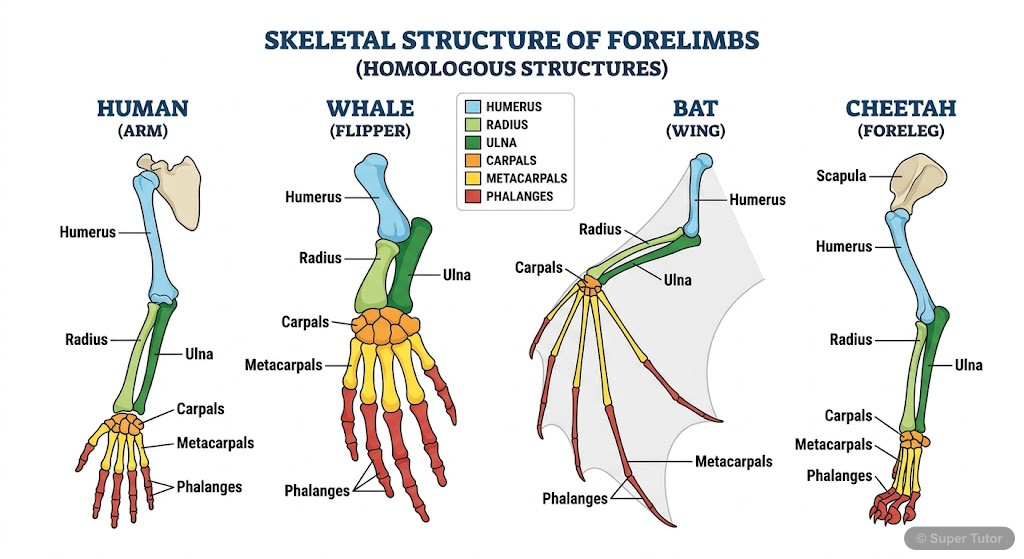
Learn better with visuals Super Tutor pairs illustrations like this with notes and quizzes for Evidences and Theories of Biological Evolution.
Important Questions from Evidences and Theories of Biological Evolution
What did Darwin observe on the Galapagos Islands that inspired his theory?
Show answer
13-14 species of finches with different beak shapes from one ancestor
On the Galapagos Islands, Darwin observed 13-14 species of finches, each with different beak morphologies adapted to different food sources, all descended from a single South American mainland ancestor. This is the classic example of adaptive radiation and provided key evidence for natural selection.
Haeckel's Biogenetic Law states that:
Show answer
Ontogeny recapitulates phylogeny
Ernst Haeckel's Biogenetic Law (1866) states 'Ontogeny recapitulates phylogeny' — the embryonic development (ontogeny) of an individual organism retraces the evolutionary history (phylogeny) of its species. Evidence: all vertebrate embryos show gill clefts and notochord at early stages.
Lamarckism proposes that characters acquired by an organism during its lifetime are inherited by its offspring.
Show answer
True
This is the core postulate of Lamarckism — the inheritance of acquired characters. Lamarck proposed that structural or functional changes acquired due to use/disuse or environmental influence during an organism's lifetime would be passed to offspring. This was disproved by Weismann's experiment and modern molecular genetics.
Which scientist proposed the theory of natural selection?
Show answer
Charles Darwin
Charles Darwin (1859) proposed the theory of natural selection in 'On the Origin of Species.' It was co-proposed independently by Alfred Russel Wallace. Darwin's theory had five main postulates: overproduction, variation, struggle for existence, natural selection, and inheritance.
+100 more questions on Evidences and Theories of Biological Evolution (ICSE Class 12 Biology)
Practise AllFrequently Asked Questions
What are the important topics in Evidences and Theories of Biological Evolution for ICSE Class 12 Biology?
How many important questions are there in Evidences and Theories of Biological Evolution?
Sources & Official References
Content is aligned to the official syllabus. Refer to the board website for the latest curriculum.
More resources for Evidences and Theories of Biological Evolution
Practice Quiz
Test yourself with a quick quiz
Revision Notes
Key points for last-minute revision
Formula Sheet
The chapter's formulas in one place
Chapter Summary
Understand the chapter at a glance
Concept Maps
See how topics connect
Study Plan
Step-by-step plan for this chapter
Flashcards
Quick-fire cards for active recall
Syllabus
What topics to cover
For serious students
Get the full Evidences and Theories of Biological Evolution chapter — start free.
Quizzes, flashcards, an AI doubt solver and a study plan for ICSE Class 12 Biology. Free to start, no card needed.