Evidences and Theories of Biological Evolution — Chapter Summary
ICSE · Class 12 · Biology
Summary of Evidences and Theories of Biological Evolution for ICSE Class 12 Biology. Part of the ICSE Class 12 Biology syllabus.
Interactive on Super Tutor
Studying Evidences and Theories of Biological Evolution? Get the full interactive chapter.
Quizzes, flashcards, AI doubt-solver and a step-by-step study plan — built for chapter summary and more.
Free trial, no card needed.
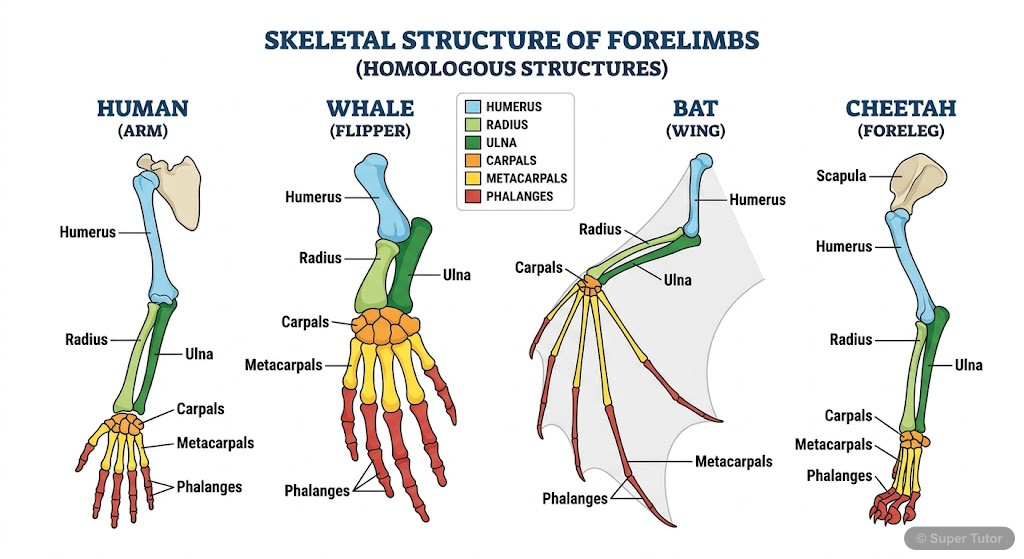
Learn better with visuals Super Tutor pairs illustrations like this with notes and quizzes for Evidences and Theories of Biological Evolution.
Overview
Biological evolution explains how simple organisms gave rise to complex forms over long periods of time. Evidence for evolution comes from fossils, comparative anatomy, embryology, cell biology, biochemistry, molecular biology and geographical distribution. The chapter also explains major ideas abou
Key Concepts
Fossils are the remains or traces
Fossils are the remains or traces of past life preserved in rocks, mostly in sedimentary rocks. Palaeontology is the study of fossils. Fossils provide
Important fossil types include petrification
Important fossil types include petrification, compression, incrustation, impression, coal balls, moulds and cast, and unaltered fossils. These preserv
Fossil age is estimated by radioactive
Fossil age is estimated by radioactive dating methods. Uranium changes into lead, and potassium-40 to argon and rubidium-87 to strontium are also used
The horse evolved through successive fossil
The horse evolved through successive fossil stages: Eohippus, Mesohippus, Merychippus and Equus. The series shows increase in height, reduction in dig
Archaeopteryx lithographica lived in the Jurassic
Archaeopteryx lithographica lived in the Jurassic period and shows both reptilian and avian features. It is a connecting fossil between reptiles and b
Learning Objectives
- Understand the main evidences that support biological evolution
- Explain fossil evidence, including fossil types, fossil dating and missing links
- Compare homologous, analogous, vestigial and connecting-link structures
- Describe embryological evidence and the recapitulation theory
- Recognize molecular and biochemical evidence for common ancestry
Frequently Asked Questions
What are the important topics in Evidences and Theories of Biological Evolution for ICSE Class 12 Biology?
How should I revise Evidences and Theories of Biological Evolution for the ICSE Class 12 board exam?
Sources & Official References
Content is aligned to the official syllabus. Refer to the board website for the latest curriculum.
More resources for Evidences and Theories of Biological Evolution
Practice Quiz
Test yourself with a quick quiz
Important Questions
Exam-style questions with answers
Revision Notes
Key points for last-minute revision
Formula Sheet
The chapter's formulas in one place
Concept Maps
See how topics connect
Study Plan
Step-by-step plan for this chapter
Flashcards
Quick-fire cards for active recall
Syllabus
What topics to cover
For serious students
Get the full Evidences and Theories of Biological Evolution chapter — start free.
Quizzes, flashcards, an AI doubt solver and a study plan for ICSE Class 12 Biology. Free to start, no card needed.