Evidences and Theories of Biological Evolution — Flashcards
ICSE · Class 12 · Biology
44 flashcards for Evidences and Theories of Biological Evolution (ICSE Class 12 Biology) to test yourself on key terms and facts.
Interactive on Super Tutor
Studying Evidences and Theories of Biological Evolution? Get the full interactive chapter.
Quizzes, flashcards, AI doubt-solver and a step-by-step study plan — built for flashcards and more.
Free trial, no card needed.
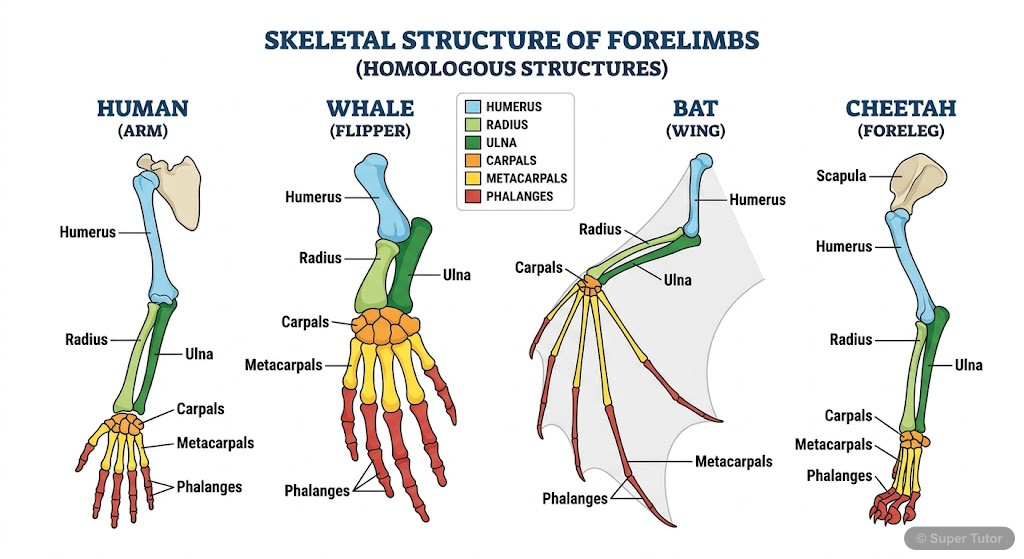
Learn better with visuals Super Tutor pairs illustrations like this with notes and quizzes for Evidences and Theories of Biological Evolution.
What is biological evolution?
Answer
Biological evolution is the process by which simple organisms gave rise to complex organisms over time. It explains the immense variety of life forms seen today and the basic unity common to all livin…
What are fossils and why are they important in evolution?
Answer
Fossils are the relics of former living plants or animals preserved in the earth. Fossils are mostly found in sedimentary rocks. They are important because they provide direct evidence of past life an…
Name the main types of fossils.
Answer
The main types of fossils are petrification, compression, incrustation, impression, coal balls, moulds and cast, and unaltered fossils. Each type preserves organisms in a different way and helps study…
How is the age of a fossil estimated?
Answer
The age of a fossil is estimated by studying radioactive substances in the rock in which it is found. Uranium decays into lead, and one million grams of uranium produce 17,600 grams of lead in one yea…
What is mass extinction?
Answer
Mass extinction is the extinction of a large number of species over a relatively short span of time. Five major mass extinctions occurred at the end of the Ordovician, Devonian, Permian, Triassic, and…
What is Archaeopteryx and why is it important?
Answer
Archaeopteryx lithographica is a fossil bird from the Jurassic period about 170 million years ago. It is important because it shows both reptilian and avian features, so it is a connecting fossil link…
What is homology?
Answer
Homologous organs are organs that are different in function but similar in embryonic origin and development, and have similar relationships with adjacent organs. Homology shows common ancestry and is …
What is analogy?
Answer
Analogous organs perform the same function and may look superficially similar, but they have different origin. Analogy is a result of convergent evolution. Example: wings of insects and birds, and ten…
+36 more flashcards
Practise AllFrequently Asked Questions
What are the important topics in Evidences and Theories of Biological Evolution for ICSE Class 12 Biology?
How many flashcards are available for Evidences and Theories of Biological Evolution?
How should I revise Evidences and Theories of Biological Evolution for the ICSE Class 12 board exam?
Sources & Official References
Content is aligned to the official syllabus. Refer to the board website for the latest curriculum.
More resources for Evidences and Theories of Biological Evolution
Practice Quiz
Test yourself with a quick quiz
Important Questions
Exam-style questions with answers
Revision Notes
Key points for last-minute revision
Formula Sheet
The chapter's formulas in one place
Chapter Summary
Understand the chapter at a glance
Concept Maps
See how topics connect
Study Plan
Step-by-step plan for this chapter
Syllabus
What topics to cover
For serious students
Get the full Evidences and Theories of Biological Evolution chapter — start free.
Quizzes, flashcards, an AI doubt solver and a study plan for ICSE Class 12 Biology. Free to start, no card needed.