Evidences and Theories of Biological Evolution — Revision Notes
ICSE · Class 12 · Biology
Evidences and Theories of Biological Evolution revision notes for ICSE Class 12 Biology: 4 topics in quick points.
Interactive on Super Tutor
Studying Evidences and Theories of Biological Evolution? Get the full interactive chapter.
Quizzes, flashcards, AI doubt-solver and a step-by-step study plan — built for revision notes and more.
Free trial, no card needed.
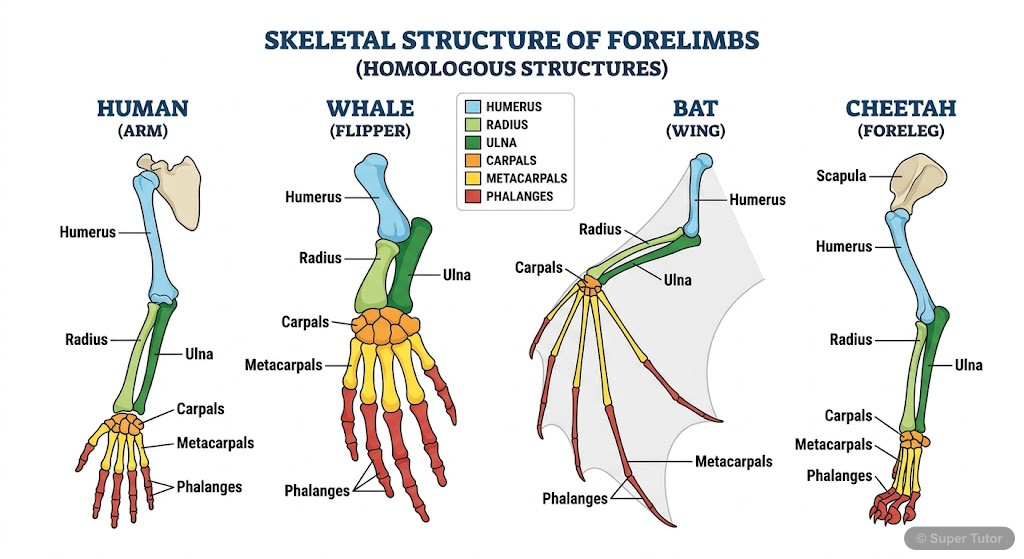
Learn better with visuals Super Tutor pairs illustrations like this with notes and quizzes for Evidences and Theories of Biological Evolution.
Key Topics to Revise
1. Evidences of Organic Evolution
- Evolution is supported by multiple independent lines of evidence.
- The major evidences are palaeontology, morphology and anatomy, embryology, cell biology and biochemistry, molecular genetics, and geographical distribution.
- These evidences show that present-day organisms arose by gradual change from pre-existing forms.
2. Palaeontological Evidence
- Fossils are the relics of former living plants or animals preserved in rocks.
- Fossils are mostly found in sedimentary rocks.
- Palaeontology is the study of fossils.
3. Fossil Series, Mass Extinction, and Geological Time Scale
- The horse fossil series is Eohippus → Mesohippus → Merychippus → Equus.
- Eohippus was about 30 cm high with four digits in the fore limb and three in the hind limb.
- Mesohippus was about 60 cm high with three digits in each leg, and the weight was supported mainly by the middle digit.
4. Comparative Anatomy: Homology, Analogy, Vestigial Organs, Connecting Links, Atavism
- Homologous organs have different functions but similar embryogenic origin and development.
- Homology indicates common ancestry and is the result of divergent evolution.
- Analogous organs perform the same function, have superficial resemblance, but different origin.
Get complete notes with diagrams and examples
Full NotesKey Concepts
Frequently Asked Questions
What are the important topics in Evidences and Theories of Biological Evolution for ICSE Class 12 Biology?
How should I revise Evidences and Theories of Biological Evolution for the ICSE Class 12 board exam?
Sources & Official References
Content is aligned to the official syllabus. Refer to the board website for the latest curriculum.
More resources for Evidences and Theories of Biological Evolution
Practice Quiz
Test yourself with a quick quiz
Important Questions
Exam-style questions with answers
Formula Sheet
The chapter's formulas in one place
Chapter Summary
Understand the chapter at a glance
Concept Maps
See how topics connect
Study Plan
Step-by-step plan for this chapter
Flashcards
Quick-fire cards for active recall
Syllabus
What topics to cover
For serious students
Get the full Evidences and Theories of Biological Evolution chapter — start free.
Quizzes, flashcards, an AI doubt solver and a study plan for ICSE Class 12 Biology. Free to start, no card needed.