Principles and Processes of Biotechnology — Practice Quiz
ICSE · Class 12 · Biology
Try a 4-question quiz on Principles and Processes of Biotechnology for ICSE Class 12 Biology: tap an answer to check it and see why.
Interactive on Super Tutor
Studying Principles and Processes of Biotechnology? Get the full interactive chapter.
Quizzes, flashcards, AI doubt-solver and a step-by-step study plan — built for practice quiz and more.
Free trial, no card needed.
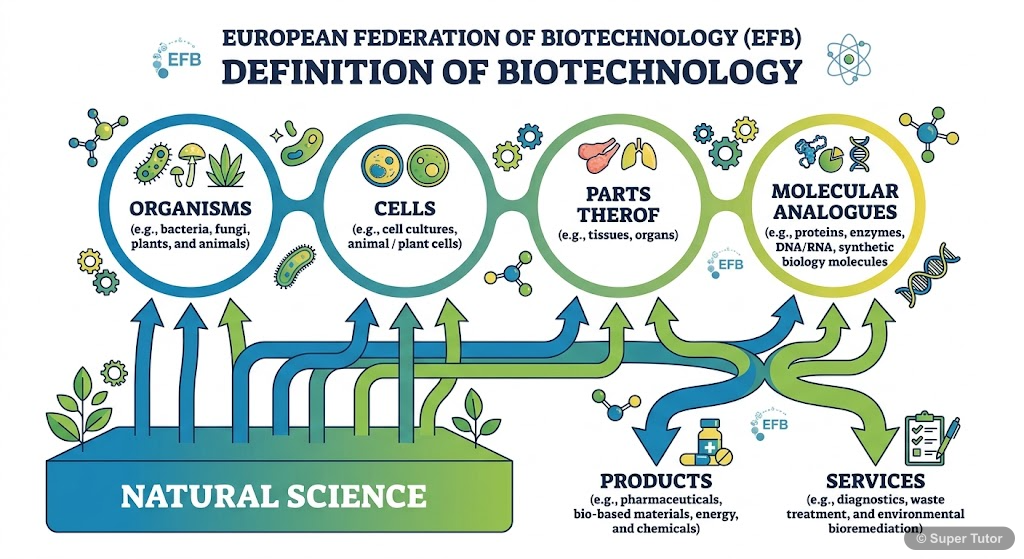
One of 10 illustrations for Principles and Processes of Biotechnology in Super Tutor — alongside flashcards, concept maps and practice questions.
Quick Quiz: Principles and Processes of Biotechnology
0/4Tap an answer to check it instantly. No sign-up needed for these 4.
Who coined the term 'Biotechnology'?
Who is called the 'Father of Genetic Engineering'?
What does the term 'rDNA' stand for?
Restriction enzymes are called 'molecular scissors' because they:
Sample Questions
The Nobel Prize in 1978 for the discovery of restriction enzymes was awarded to:
Show answer
W. Arber, H. Smith, and D. Nathan
The 1978 Nobel Prize in Physiology or Medicine was awarded to Werner Arber, Hamilton Smith, and Daniel Nathan for the discovery and application of restriction enzymes. Kary Mullis won the 1993 Nobel (Chemistry) for PCR.
The first restriction enzyme ever discovered was:
Show answer
HindII
HindII was the first restriction enzyme discovered, isolated from Haemophilus influenzae Rd by Hamilton Smith. EcoRI (from E. coli), BamHI, and HindIII were discovered later. Note: HindII produces blunt ends, while HindIII produces sticky ends.
What is a 'palindrome' in the context of DNA?
Show answer
A sequence that reads the same 5'→3' on both complementary strands
In DNA, a palindromic sequence reads identically in the 5'→3' direction on both complementary strands. For example, EcoRI's recognition site 5'-GAATTC-3' on the top strand — reading the complementary (bottom) strand 5'→3' also gives GAATTC. This symmetry is what restriction enzymes recognise.
DNA Ligase is called the 'molecular glue' because it:
Show answer
Joins DNA fragments by forming phosphodiester bonds
DNA Ligase catalyses the formation of a covalent phosphodiester bond between the 3'-OH and the 5'-phosphate ends of two adjacent DNA fragments. This 'glues' the fragments together — the opposite of what restriction enzymes do.
+56 more questions on Principles and Processes of Biotechnology (ICSE Class 12 Biology)
Practise AllFrequently Asked Questions
What are the important topics in Principles and Processes of Biotechnology for ICSE Class 12 Biology?
How many practice questions are there for Principles and Processes of Biotechnology?
Sources & Official References
Content is aligned to the official syllabus. Refer to the board website for the latest curriculum.
More resources for Principles and Processes of Biotechnology
Important Questions
Exam-style questions with answers
Revision Notes
Key points for last-minute revision
Chapter Summary
Understand the chapter at a glance
Concept Maps
See how topics connect
Study Plan
Step-by-step plan for this chapter
Flashcards
Quick-fire cards for active recall
Syllabus
What topics to cover
For serious students
Get the full Principles and Processes of Biotechnology chapter — start free.
Quizzes, flashcards, an AI doubt solver and a study plan for ICSE Class 12 Biology. Free to start, no card needed.