Principles and Processes of Biotechnology — Flashcards
ICSE · Class 12 · Biology
50 flashcards for Principles and Processes of Biotechnology (ICSE Class 12 Biology) to test yourself on key terms and facts.
Interactive on Super Tutor
Studying Principles and Processes of Biotechnology? Get the full interactive chapter.
Quizzes, flashcards, AI doubt-solver and a step-by-step study plan — built for flashcards and more.
Free trial, no card needed.
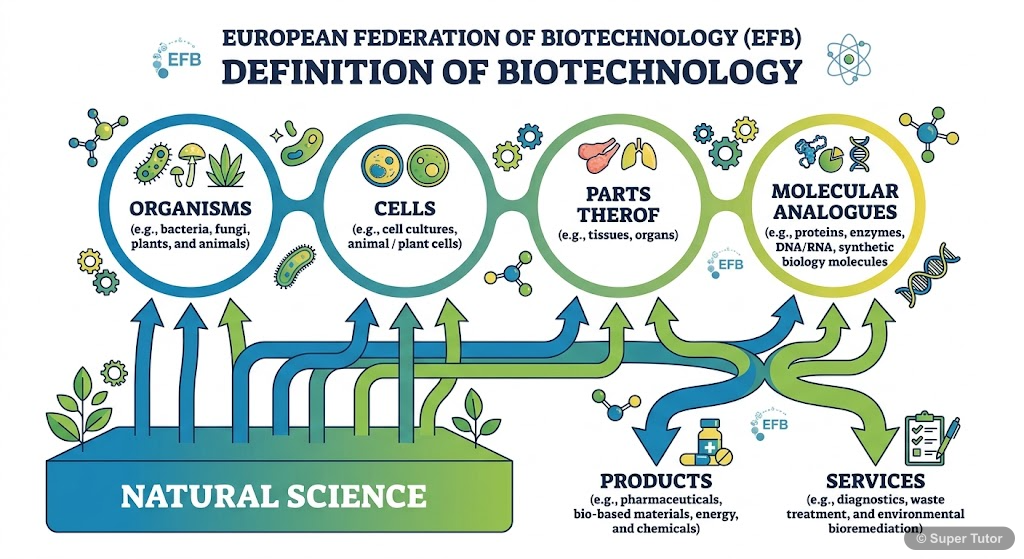
One of 10 illustrations for Principles and Processes of Biotechnology in Super Tutor — alongside flashcards, concept maps and practice questions.
What is biotechnology?
Answer
Biotechnology is the integration of natural sciences and engineering sciences concerned with the exploitation of microorganisms, cells, nuclei, plants, animals, chromosomes, genes, or their enzymes fo…
Who coined the term biotechnology, and when?
Answer
The term biotechnology was coined by Karoley Ereky in 1919. He is called the father of biotechnology.
What are the two core techniques that enabled modern biotechnology?
Answer
Modern biotechnology is based on genetic engineering and bioprocess engineering. Genetic engineering changes genetic material and transfers desired genes into a host, while bioprocess engineering main…
What is genetic engineering?
Answer
Genetic engineering is the manipulation of DNA to change its structure. It includes creating recombinant DNA, gene cloning, and gene transfer to alter the phenotype or expression of genes in an organi…
What is recombinant DNA technology?
Answer
Recombinant DNA technology means combining DNA from two different organisms to generate recombinant DNA. It is also called genetic engineering and produces chimeric DNA because material from two diffe…
Why is recombinant DNA called chimeric DNA?
Answer
Recombinant DNA is called chimeric DNA because it contains material from two different species. The DNA fragments are joined to form one new molecule with combined genetic material.
What three basic steps are needed to genetically modify an organism?
Answer
The three basic steps are: identification of DNA with desirable genes; introduction of the identified DNA into the host; and maintenance of the introduced DNA in the host with transfer to its progeny.
What are restriction enzymes?
Answer
Restriction enzymes are molecular scissors or chemical scalpels that cut DNA at specific sites into fragments containing identifiable genes. They help in cutting both the donor DNA and the vector DNA …
+42 more flashcards
Practise AllFrequently Asked Questions
What are the important topics in Principles and Processes of Biotechnology for ICSE Class 12 Biology?
How many flashcards are available for Principles and Processes of Biotechnology?
How should I revise Principles and Processes of Biotechnology for the ICSE Class 12 board exam?
Sources & Official References
Content is aligned to the official syllabus. Refer to the board website for the latest curriculum.
More resources for Principles and Processes of Biotechnology
Practice Quiz
Test yourself with a quick quiz
Important Questions
Exam-style questions with answers
Revision Notes
Key points for last-minute revision
Chapter Summary
Understand the chapter at a glance
Concept Maps
See how topics connect
Study Plan
Step-by-step plan for this chapter
Syllabus
What topics to cover
For serious students
Get the full Principles and Processes of Biotechnology chapter — start free.
Quizzes, flashcards, an AI doubt solver and a study plan for ICSE Class 12 Biology. Free to start, no card needed.