Organisms and Populations — Practice Quiz
ICSE · Class 12 · Biology
Try a 4-question quiz on Organisms and Populations for ICSE Class 12 Biology: tap an answer to check it and see why. 60 questions in the full chapter test.
Interactive on Super Tutor
Studying Organisms and Populations? Get the full interactive chapter.
Quizzes, flashcards, AI doubt-solver and a step-by-step study plan — built for practice quiz and more.
Free trial, no card needed.
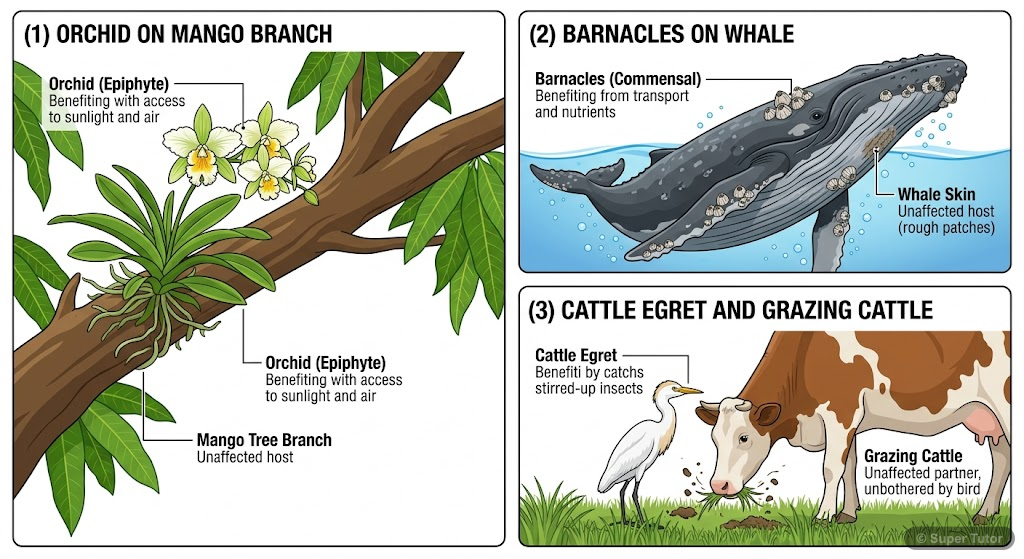
Learn better with visuals Super Tutor pairs illustrations like this with notes and quizzes for Organisms and Populations.
Quick Quiz: Organisms and Populations
0/4Tap an answer to check it instantly. No sign-up needed for these 4.
Ecology is the study of:
A habitat is best described as:
A niche is different from a habitat because it describes:
Birth rate in a population refers to:
Sample Questions
The J-shaped growth curve of a population represents:
Show answer
Exponential growth
Exponential (J-shaped) growth occurs when resources are unlimited and every individual reproduces at maximum rate. The population grows faster and faster over time, giving a J-curve.
The S-shaped growth curve of a population is called:
Show answer
Logistic growth curve
Logistic (S-shaped or sigmoid) growth occurs when resources are limited. Growth is initially exponential, then slows as the population approaches the carrying capacity (K), forming an S-curve.
Carrying capacity (K) refers to:
Show answer
The maximum population size an environment can sustain indefinitely
Carrying capacity (K) is the maximum population size that a given environment can support indefinitely, given the food, water, shelter, and other resources available.
In mutualism, the relationship between two species is:
Show answer
Both species benefit
Mutualism is a symbiotic relationship where both species benefit. Examples include pollination (insect gets nectar, plant gets pollinated) and mycorrhizal associations.
+56 more questions on Organisms and Populations (ICSE Class 12 Biology)
Practise AllFrequently Asked Questions
What are the important topics in Organisms and Populations for ICSE Class 12 Biology?
How many practice questions are there for Organisms and Populations?
Sources & Official References
Content is aligned to the official syllabus. Refer to the board website for the latest curriculum.
More resources for Organisms and Populations
Important Questions
Exam-style questions with answers
Revision Notes
Key points for last-minute revision
Formula Sheet
The chapter's formulas in one place
Chapter Summary
Understand the chapter at a glance
Concept Maps
See how topics connect
Study Plan
Step-by-step plan for this chapter
Flashcards
Quick-fire cards for active recall
Syllabus
What topics to cover
For serious students
Get the full Organisms and Populations chapter — start free.
Quizzes, flashcards, an AI doubt solver and a study plan for ICSE Class 12 Biology. Free to start, no card needed.