Solutions
ICSE · Class 12 · Chemistry
Most important questions from Solutions for ICSE Class 12 Chemistry board exam 2026. MCQs, short answer, and long answer questions with marks.
Interactive on Super Tutor
Studying Solutions? Get the full interactive chapter.
Quizzes, flashcards, AI doubt-solver and a step-by-step study plan — built for important questions and more.
1,000+ Class 12 students started this chapter today
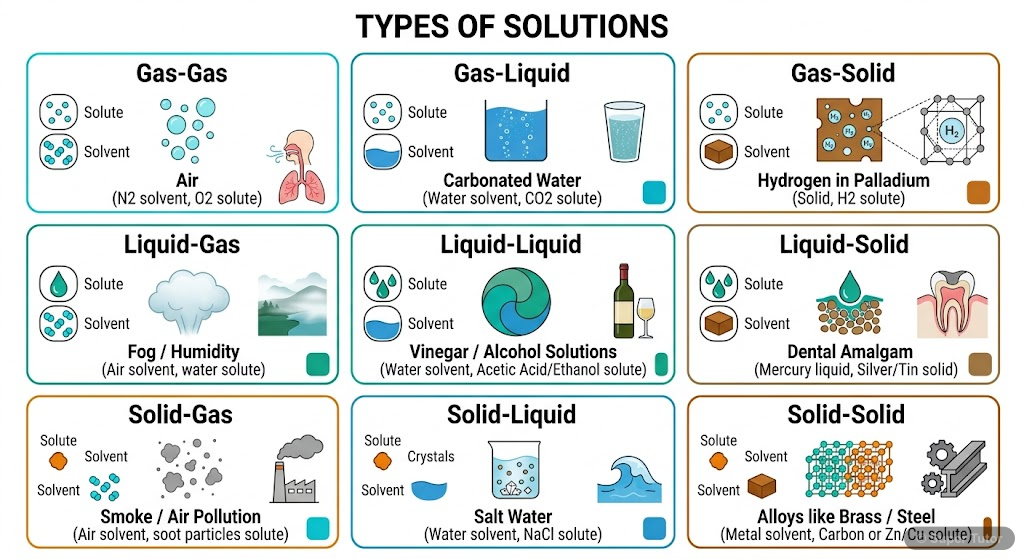
Super Tutor has 16+ illustrations like this for Solutions alone — flashcards, concept maps, and step-by-step visuals.
See them allSample Questions
ppm (parts per million) is used to express the concentration of very dilute solutions like pollutants in the environment.
Show answer
True
ppm = mass of solute / mass of solution × 10⁶. It is used for very dilute solutions — for example, 10 ppm SO₂ in air means 10 mL SO₂ per 10⁶ mL of air. Common for pollutants, dissolved oxygen, trace minerals.
The relative lowering of vapour pressure of a solution is equal to:
Show answer
Mole fraction of the solute
From Raoult's law: (p° − p)/p° = χ_solute. This is the mathematical statement of relative lowering of vapour pressure.
Ideal solutions obey Raoult's law at all concentrations and temperatures.
Show answer
True
An ideal solution obeys Raoult's law at all concentrations and temperatures. For it: ΔH_mix = 0 and ΔV_mix = 0. A–B forces are similar to A–A and B–B forces.
When a non-volatile solute is dissolved in a solvent, the boiling point of the solution:
Show answer
Increases
Adding a non-volatile solute lowers vapour pressure. To reach 1 atm (boiling point), a higher temperature is needed. Hence boiling point increases. ΔT_b = K_b × m.
+96 more questions available
Practice AllFrequently Asked Questions
What are the important topics in Solutions for ICSE Class 12 Chemistry?
How to score full marks in Solutions — ICSE Class 12 Chemistry?
How many important questions are there in Solutions?
Sources & Official References
Content is aligned to the official syllabus. Refer to the board website for the latest curriculum.
More resources for Solutions
Practice Quiz
Test yourself with a quick quiz
Revision Notes
Key points for last-minute revision
Formula Sheet
All formulas in one place
Chapter Summary
Understand the chapter at a glance
Concept Maps
See how topics connect visually
Study Plan
Step-by-step plan to ace this chapter
Flashcards
Quick-fire cards for active recall
Syllabus
What topics to cover
NCERT Solutions
Every textbook question solved step by step
For serious students
Get the full Solutions chapter — for free.
Quizzes, flashcards, AI doubt-solver and a step-by-step study plan for ICSE Class 12 Chemistry.