Solutions — Flashcards
ICSE · Class 12 · Chemistry
40 flashcards for Solutions (ICSE Class 12 Chemistry) to test yourself on key terms and facts. Sample: "What is a solution?"
Interactive on Super Tutor
Studying Solutions? Get the full interactive chapter.
Quizzes, flashcards, AI doubt-solver and a step-by-step study plan — built for flashcards and more.
Free trial, no card needed.
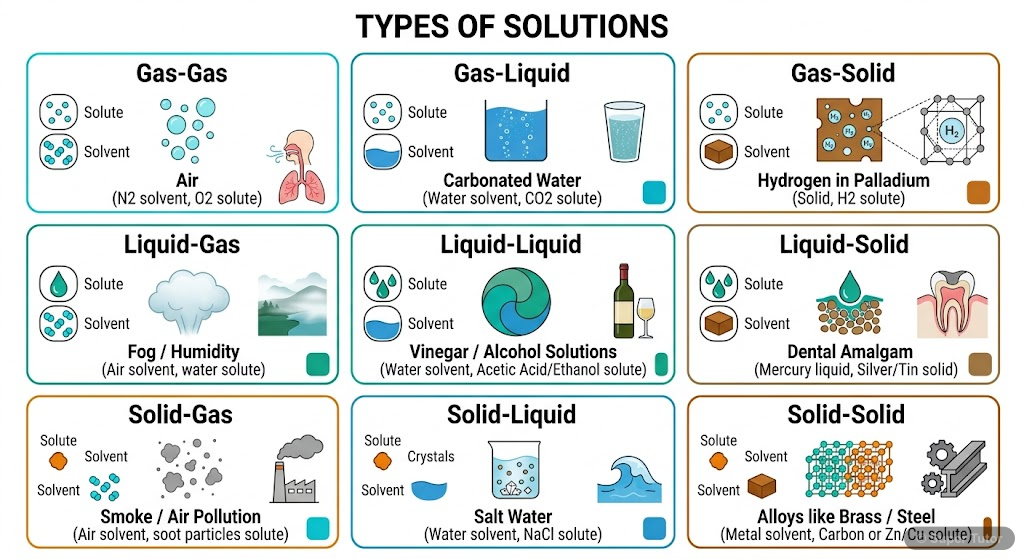
Learn better with visuals Super Tutor pairs illustrations like this with notes and quizzes for Solutions.
What is a solution?
Answer
A solution is a homogeneous mixture of two or more substances. Example: sugar dissolved in water forms a homogeneous liquid solution.
What is the solvent and what is the solute?
Answer
The component present in excess and whose physical state is the same as that of the solution is called the solvent. The other component present in smaller amount is called the solute. Example: in suga…
What are binary, ternary, and quaternary solutions?
Answer
Binary solutions have 2 components, ternary solutions have 3 components, and quaternary solutions have 4 components.
Why is solid always treated as the solute in solid-liquid solutions?
Answer
In solid-liquid solutions, solid is always considered as the solute, regardless of relative amounts. Example: salt in water is a solid-liquid solution, so salt is the solute.
What is mass percentage of a solute?
Answer
Mass percentage of solute = (Mass of solute / Mass of solution) × 100 Mass of solution = Mass of solute + Mass of solvent Example: 10 g solute in 100 g solution gives 10% by mass.
Calculate the mass percentage if 10 g of urea is dissolved in 100 g of solution.
Answer
Mass percentage = (Mass of solute / Mass of solution) × 100 = (10 g / 100 g) × 100 = 10% Answer: 10% (by mass)…
What is molarity and why does it change with temperature?
Answer
Molarity (M) = number of moles of solute dissolved per litre of solution at a particular temperature. M = n / V It changes with temperature because volume changes with temperature.
Calculate the molarity of a solution containing 4 g NaOH in 200 cm³ of solution.
Answer
Given: mass of NaOH = 4 g, molar mass = 40 g mol⁻¹, volume = 200 cm³ = 0.2 L Step 1: moles = 4/40 = 0.1 mol Step 2: M = n/V = 0.1/0.2 = 0.5 mol L⁻¹ Answer: 0.5 M…
+32 more flashcards
Practise AllFrequently Asked Questions
What are the important topics in Solutions for ICSE Class 12 Chemistry?
How many flashcards are available for Solutions?
How should I revise Solutions for the ICSE Class 12 board exam?
Sources & Official References
Content is aligned to the official syllabus. Refer to the board website for the latest curriculum.
More resources for Solutions
Practice Quiz
Test yourself with a quick quiz
Important Questions
Exam-style questions with answers
Revision Notes
Key points for last-minute revision
Formula Sheet
The chapter's formulas in one place
Chapter Summary
Understand the chapter at a glance
Concept Maps
See how topics connect
Study Plan
Step-by-step plan for this chapter
Syllabus
What topics to cover
For serious students
Get the full Solutions chapter — start free.
Quizzes, flashcards, an AI doubt solver and a study plan for ICSE Class 12 Chemistry. Free to start, no card needed.