Solutions — Syllabus
ICSE · Class 12 · Chemistry
What Solutions covers in ICSE Class 12 Chemistry: 4 topics, for the 2026-27 session. Part of the ICSE Class 12 Chemistry syllabus.
Interactive on Super Tutor
Studying Solutions? Get the full interactive chapter.
Quizzes, flashcards, AI doubt-solver and a step-by-step study plan — built for syllabus and more.
Free trial, no card needed.
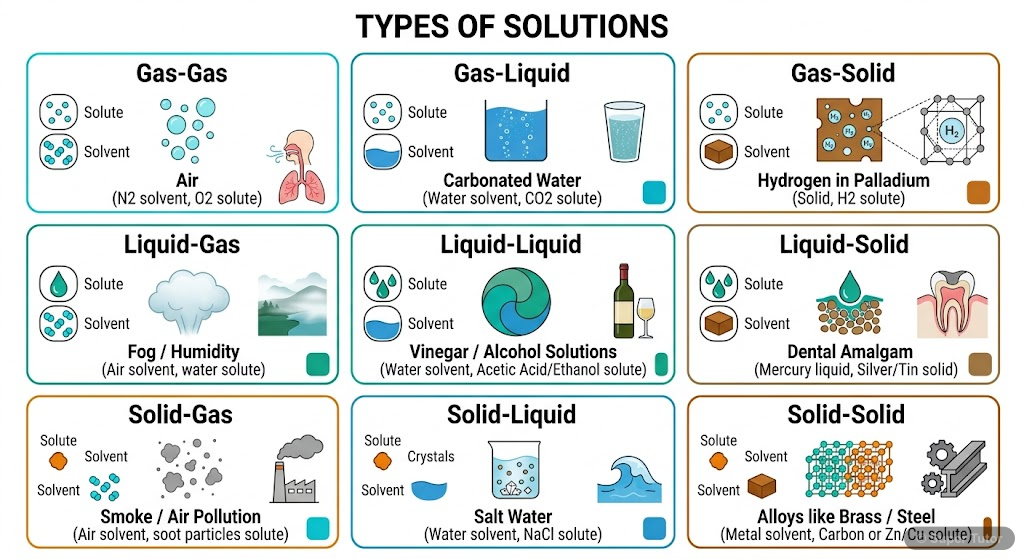
Learn better with visuals Super Tutor pairs illustrations like this with notes and quizzes for Solutions.
Topics in Solutions
1. Basics of Solutions and Types
- A homogeneous mixture of two or more substances is called a solution.
- A solution may exist in solid, liquid, or gaseous form.
- The component present in excess and having the same physical state as the solution is the solvent.
2. Concentration Units
- Mass percentage means grams of solute per 100 g of solution.
- Volume percentage means volume of solute per 100 units of solution volume.
- ppm is used for very dilute solutions and gaseous pollutants.
3. Gas Solubility and Henry's Law
- Gases like H2, N2, and O2 are only slightly soluble in water.
- CO2, NH3, and HCl are highly soluble gases and react chemically with water.
- Gas dissolution in liquid is exothermic.
4. Vapour Pressure and Raoult's Law
- A liquid in a closed container reaches dynamic equilibrium between evaporation and condensation.
- Vapour pressure is the pressure exerted by vapour of a liquid at a particular temperature in equilibrium with the liquid.
- Liquids with weaker intermolecular forces have higher vapour pressure.
Key Concepts
Central concept: A solution is a homogeneous mixture of two or more substances, and its behaviour depends on composition, concentration, solubility, vapour pressure, colligative properties, osmosis, and association or dissociation of solute particles.
Work through every topic in Solutions with notes and quizzes
Start This ChapterFrequently Asked Questions
What are the important topics in Solutions for ICSE Class 12 Chemistry?
How should I revise Solutions for the ICSE Class 12 board exam?
Sources & Official References
Content is aligned to the official syllabus. Refer to the board website for the latest curriculum.
More resources for Solutions
Practice Quiz
Test yourself with a quick quiz
Important Questions
Exam-style questions with answers
Revision Notes
Key points for last-minute revision
Formula Sheet
The chapter's formulas in one place
Chapter Summary
Understand the chapter at a glance
Concept Maps
See how topics connect
Study Plan
Step-by-step plan for this chapter
Flashcards
Quick-fire cards for active recall
For serious students
Get the full Solutions chapter — start free.
Quizzes, flashcards, an AI doubt solver and a study plan for ICSE Class 12 Chemistry. Free to start, no card needed.