Alcohols, Phenols and Ethers — Syllabus
ICSE · Class 12 · Chemistry
What Alcohols, Phenols and Ethers covers in ICSE Class 12 Chemistry: 4 topics, for the 2026-27 session. Part of the ICSE Class 12 Chemistry syllabus.
Interactive on Super Tutor
Studying Alcohols, Phenols and Ethers? Get the full interactive chapter.
Quizzes, flashcards, AI doubt-solver and a step-by-step study plan — built for syllabus and more.
Free trial, no card needed.
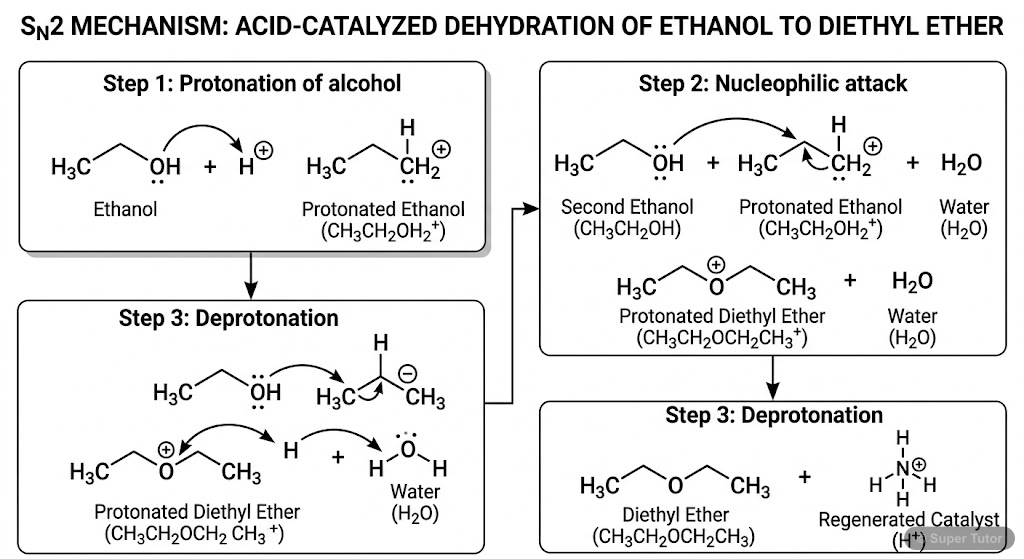
Learn better with visuals Super Tutor pairs illustrations like this with notes and quizzes for Alcohols, Phenols and Ethers.
Topics in Alcohols, Phenols and Ethers
1. Alcohols: Basic Ideas, Classification and Properties
- Alcohols are hydroxy derivatives of aliphatic hydrocarbons and have the general formula R-OH.
- Monohydric alcohols are classified as primary, secondary or tertiary depending on the carbon atom attached to the -OH group.
- Alcohols show chain, position, functional and optical isomerism.
2. Alcohols: Preparation, Commercial Forms and Important Tests
- Ethanol is manufactured mainly by fermentation and is available in several commercial forms.
- Rectified spirit contains about 95.5 percent ethyl alcohol and the rest water.
- Absolute alcohol is 100 percent pure ethanol.
3. Phenols: Structure, Acidity and Reactions
- Phenols are hydroxy derivatives of arenes in which the -OH group is directly attached to the aromatic ring.
- Phenols are classified as monohydric, dihydric and trihydric phenols.
- Phenols are more acidic than alcohols because the phenoxide ion is stabilised by resonance.
4. Ethers: Structure, Preparation and Physical Properties
- Ethers have the general formula R-O-R prime, where R and R prime may be alkyl or aryl groups.
- When both groups are the same, the ether is simple or symmetrical; when different, it is mixed or unsymmetrical.
- Aromatic ethers are of two types: alkyl aryl ethers and diaryl ethers.
Key Concepts
Central concept: Alcohols, Phenols and Ethers
Work through every topic in Alcohols, Phenols and Ethers with notes and quizzes
Start This ChapterFrequently Asked Questions
What are the important topics in Alcohols, Phenols and Ethers for ICSE Class 12 Chemistry?
How should I revise Alcohols, Phenols and Ethers for the ICSE Class 12 board exam?
Sources & Official References
Content is aligned to the official syllabus. Refer to the board website for the latest curriculum.
More resources for Alcohols, Phenols and Ethers
Practice Quiz
Test yourself with a quick quiz
Important Questions
Exam-style questions with answers
Revision Notes
Key points for last-minute revision
Chapter Summary
Understand the chapter at a glance
Concept Maps
See how topics connect
Study Plan
Step-by-step plan for this chapter
Flashcards
Quick-fire cards for active recall
For serious students
Get the full Alcohols, Phenols and Ethers chapter — start free.
Quizzes, flashcards, an AI doubt solver and a study plan for ICSE Class 12 Chemistry. Free to start, no card needed.