d- and f-Block Elements — Syllabus
ICSE · Class 12 · Chemistry
What d- and f-Block Elements covers in ICSE Class 12 Chemistry: 4 topics, for the 2026-27 session. Part of the ICSE Class 12 Chemistry syllabus.
Interactive on Super Tutor
Studying d- and f-Block Elements? Get the full interactive chapter.
Quizzes, flashcards, AI doubt-solver and a step-by-step study plan — built for syllabus and more.
Free trial, no card needed.
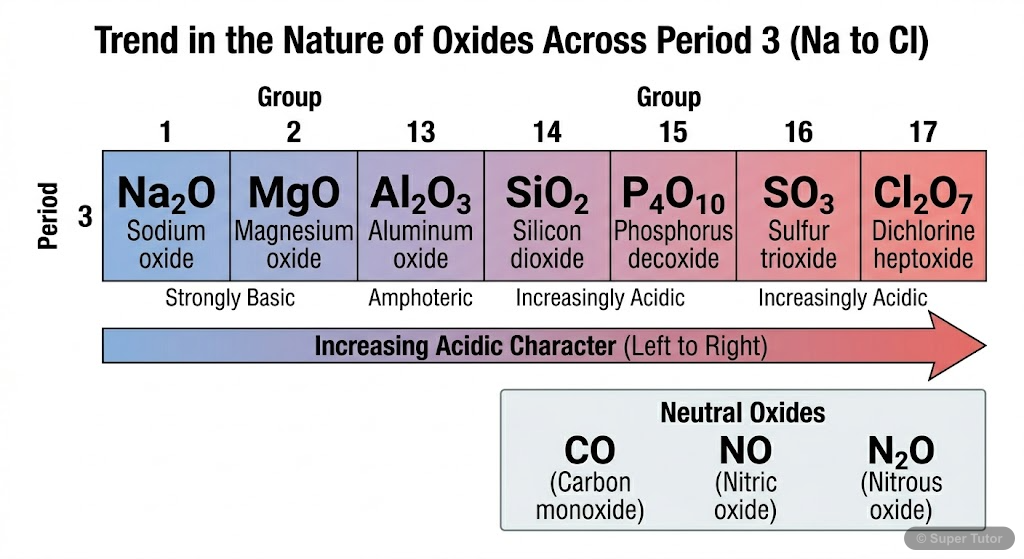
One of 17 illustrations for d- and f-Block Elements in Super Tutor — alongside flashcards, concept maps and practice questions.
Topics in d- and f-Block Elements
1. Position, Definition, and Classification
- Transition elements are those in which the differentiating electron enters the (n-1)d subshell.
- They belong to groups 3 to 12 of the periodic table.
- The d-block lies between the s-block and p-block and shows intermediate behaviour between them.
2. Electronic Configuration and Exceptional Cases
- Transition elements usually have electronic configuration of the type (n-1)d1-10 ns1-2.
- In the first transition series, electrons fill the 3d subshell from Sc to Zn.
- Cr has the exceptional configuration [Ar] 3d5 4s1.
3. Atomic Size, Ionic Size, Density, and Metallic Nature
- Atomic radii in a transition series generally decrease with atomic number.
- The decrease becomes small after the middle of the series.
- Near the end of a series, atomic radii increase slightly due to increased electron-electron repulsion.
4. Ionisation Enthalpy, Oxidation States, and Electrode Potentials
- Ionisation enthalpies of transition elements lie between those of s-block and p-block elements.
- The first ionisation enthalpy generally increases across a transition series, but not regularly.
- First ionisation enthalpies of the third transition series are higher than those of the first and second series.
Key Concepts
Central concept: d- and f-Block Elements
Work through every topic in d- and f-Block Elements with notes and quizzes
Start This ChapterFrequently Asked Questions
What are the important topics in d- and f-Block Elements for ICSE Class 12 Chemistry?
How should I revise d- and f-Block Elements for the ICSE Class 12 board exam?
Sources & Official References
Content is aligned to the official syllabus. Refer to the board website for the latest curriculum.
More resources for d- and f-Block Elements
Practice Quiz
Test yourself with a quick quiz
Important Questions
Exam-style questions with answers
Revision Notes
Key points for last-minute revision
Chapter Summary
Understand the chapter at a glance
Concept Maps
See how topics connect
Study Plan
Step-by-step plan for this chapter
Flashcards
Quick-fire cards for active recall
For serious students
Get the full d- and f-Block Elements chapter — start free.
Quizzes, flashcards, an AI doubt solver and a study plan for ICSE Class 12 Chemistry. Free to start, no card needed.