Alcohols, Phenols and Ethers — Practice Quiz
ICSE · Class 12 · Chemistry
Try a 4-question quiz on Alcohols, Phenols and Ethers for ICSE Class 12 Chemistry: tap an answer to check it and see why.
Interactive on Super Tutor
Studying Alcohols, Phenols and Ethers? Get the full interactive chapter.
Quizzes, flashcards, AI doubt-solver and a step-by-step study plan — built for practice quiz and more.
Free trial, no card needed.
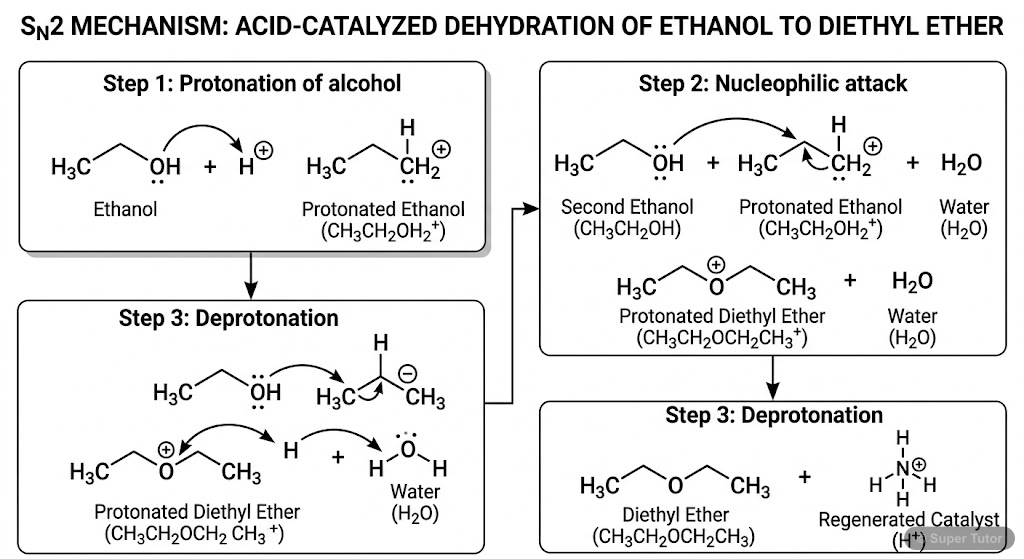
Learn better with visuals Super Tutor pairs illustrations like this with notes and quizzes for Alcohols, Phenols and Ethers.
Quick Quiz: Alcohols, Phenols and Ethers
0/4Tap an answer to check it instantly. No sign-up needed for these 4.
Ethanol (CH3CH2OH) is classified as which type of alcohol?
What is the IUPAC name for (CH3)2CHOH?
Fermentation of glucose produces ethanol and:
Alcohols have higher boiling points than corresponding alkanes because:
Sample Questions
The reagent used in the Lucas test to distinguish 1°, 2°, 3° alcohols is:
Show answer
Anhydrous ZnCl2 + conc. HCl
Lucas test uses anhydrous ZnCl2 + conc. HCl (Lucas reagent). Turbidity (cloudiness) appears when alkyl chloride is formed. Rate: 3° (immediate) > 2° (a few minutes) > 1° (no turbidity at RT). ZnCl2 is a Lewis acid that activates the OH as a leaving group.
Which alcohol is formed when a Grignard reagent reacts with formaldehyde (HCHO)?
Show answer
Primary alcohol (one C more)
RMgX + HCHO → R-CH2-OMgX → H3O+ → R-CH2-OH (1° alcohol with one more C than R). Pattern: Grignard + HCHO → 1° alcohol; + RCHO → 2°; + R2CO → 3° alcohol.
What is the product of the reaction of phenol with FeCl3 solution?
Show answer
Violet/purple coloration
Phenol gives characteristic violet/purple colour with FeCl3 solution (ferric phenoxide complex). This is the diagnostic test for phenolic compounds. Alcohols do NOT give this colour — distinguishes phenols from alcohols.
Why is phenol more acidic than ethanol?
Show answer
The phenoxide ion is stabilised by resonance with the benzene ring, making phenol more willing to donate H+
Phenoxide (C6H5O⁻) has its negative charge delocalised into the benzene ring via resonance → 6 resonance structures → more stable → easier formation → phenol more acidic. Ethoxide (C2H5O⁻) has no resonance stabilisation. pKa: phenol ≈ 10; ethanol ≈ 16.
+100 more questions on Alcohols, Phenols and Ethers (ICSE Class 12 Chemistry)
Practise AllFrequently Asked Questions
What are the important topics in Alcohols, Phenols and Ethers for ICSE Class 12 Chemistry?
How many practice questions are there for Alcohols, Phenols and Ethers?
Sources & Official References
Content is aligned to the official syllabus. Refer to the board website for the latest curriculum.
More resources for Alcohols, Phenols and Ethers
Important Questions
Exam-style questions with answers
Revision Notes
Key points for last-minute revision
Chapter Summary
Understand the chapter at a glance
Concept Maps
See how topics connect
Study Plan
Step-by-step plan for this chapter
Flashcards
Quick-fire cards for active recall
Syllabus
What topics to cover
For serious students
Get the full Alcohols, Phenols and Ethers chapter — start free.
Quizzes, flashcards, an AI doubt solver and a study plan for ICSE Class 12 Chemistry. Free to start, no card needed.