Alcohols, Phenols and Ethers — Chapter Summary
ICSE · Class 12 · Chemistry
Summary of Alcohols, Phenols and Ethers for ICSE Class 12 Chemistry. Key concepts: Alcohols are hydroxy, Phenols are hydroxy and Ethers have the general.
Interactive on Super Tutor
Studying Alcohols, Phenols and Ethers? Get the full interactive chapter.
Quizzes, flashcards, AI doubt-solver and a step-by-step study plan — built for chapter summary and more.
Free trial, no card needed.
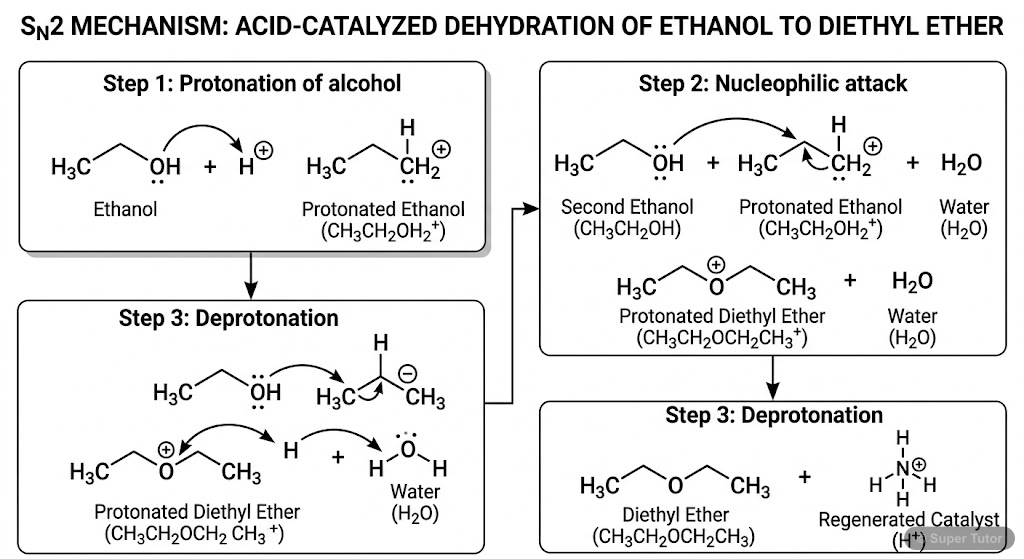
Learn better with visuals Super Tutor pairs illustrations like this with notes and quizzes for Alcohols, Phenols and Ethers.
Overview
Alcohols, phenols and ethers are important oxygen-containing organic compounds with wide use in industry, medicine, fuel technology and laboratory work. Alcohols contain the hydroxyl group attached to an alkyl group, phenols contain the hydroxyl group directly attached to an aromatic ring, and ether
Key Concepts
Alcohols are hydroxy derivatives of aliphatic
Alcohols are hydroxy derivatives of aliphatic hydrocarbons with general formula R-OH. They are classified as primary, secondary and tertiary based on
Phenols are hydroxy derivatives of arenes
Phenols are hydroxy derivatives of arenes in which -OH is directly attached to an aromatic ring. The phenoxide ion is resonance-stabilised, so phenols
Ethers have the general formula R
Ethers have the general formula R-O-R'. They may be symmetrical or unsymmetrical, simple or mixed, and aromatic ethers may be alkyl aryl ethers or dia
Williamson's synthesis forms ethers by reacting
Williamson's synthesis forms ethers by reacting sodium alkoxide or sodium phenoxide with an alkyl halide: R-O(-) Na(+) + R'X → R-O-R' + NaX. It is esp
Alcohols form ethers on heating
Alcohols form ethers on heating with excess alcohol and conc. H2SO4 at 413 K, while higher temperature at 443 K gives alkenes as the major product. Va
Learning Objectives
- Identify and classify alcohols, phenols and ethers from their structures.
- Understand important methods of preparation of alcohols, phenols and ethers.
- Explain physical properties such as boiling point, solubility, dipole moment and density using structure.
- Write balanced equations for major reactions of alcohols, phenols and ethers.
- Compare the acidic nature of alcohols and phenols.
Frequently Asked Questions
What are the important topics in Alcohols, Phenols and Ethers for ICSE Class 12 Chemistry?
How should I revise Alcohols, Phenols and Ethers for the ICSE Class 12 board exam?
Sources & Official References
Content is aligned to the official syllabus. Refer to the board website for the latest curriculum.
More resources for Alcohols, Phenols and Ethers
For serious students
Get the full Alcohols, Phenols and Ethers chapter — start free.
Quizzes, flashcards, an AI doubt solver and a study plan for ICSE Class 12 Chemistry. Free to start, no card needed.