Population — Practice Quiz
ICSE · Class 12 · Geography
Try a 4-question quiz on Population for ICSE Class 12 Geography: tap an answer to check it and see why. 45 questions in the full chapter test.
Interactive on Super Tutor
Studying Population? Get the full interactive chapter.
Quizzes, flashcards, AI doubt-solver and a step-by-step study plan — built for practice quiz and more.
Free trial, no card needed.
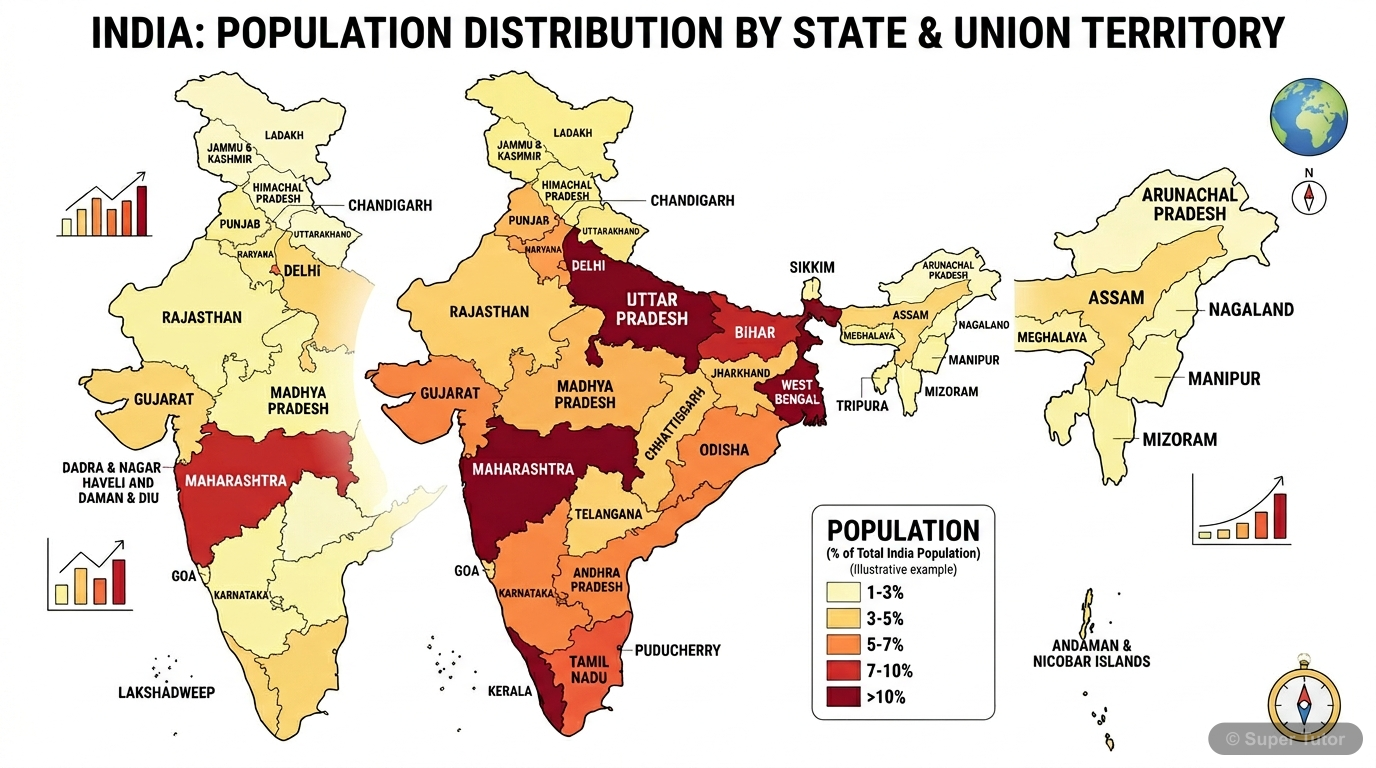
One of 3 illustrations for Population in Super Tutor — alongside flashcards, concept maps and practice questions.
Quick Quiz: Population
0/4Tap an answer to check it instantly. No sign-up needed for these 4.
What percentage of the world's total population does India support?
Which was the first complete and synchronous census conducted in India covering the entire country?
According to the 2011 Census, which state has the highest population in India?
What is the density of population of India according to the 2011 Census?
Sample Questions
Which state has the LOWEST population density according to the 2011 Census among all states of India?
Show answer
Arunachal Pradesh
Step 1: Population density refers to the number of persons per square kilometre. Step 2: The chapter provides a ranking of states and union territories by density. Step 3: Arunachal Pradesh has the lowest density among all states at just 17 persons per sq. km. Step 4: Sikkim has 86, Mizoram has 52, and Jammu & Kashmir has 124 persons per sq. km. – all higher than Arunachal Pradesh. Step 5: Arunachal Pradesh is a hilly, forested state in the North-East with a very sparse population – hence it has the lowest density.
Which Union Territory has the HIGHEST population density in India according to the 2011 Census?
Show answer
NCT of Delhi
Step 1: Among union territories, density is very high because UTs are small in area but have large populations. Step 2: The chapter clearly states that Delhi is the most thickly populated with 11,297 persons per sq. km. Step 3: Chandigarh has 9,252 persons per sq. km – second highest. Puducherry has 2,598 persons per sq. km. Lakshadweep has 2,013 persons per sq. km. Step 4: Delhi's extremely high density is due to its status as the national capital – it attracts migrants from all over India and has massive urbanisation. Step 5: NCT of Delhi, with 11,297 persons per sq. km., has the highest den
The census year 1921 is called the 'Great Demographic Divide' in India because:
Show answer
India recorded a negative growth rate of population for the only time
Step 1: The term 'Great Demographic Divide' refers to a turning point in India's population history. Step 2: In the 1921 census, India recorded a slight decline in population of -0.03% (or -0.31% in absolute numbers), making it the only time India recorded a negative growth rate. Step 3: This happened due to large-scale deaths from fatal diseases – influenza alone claimed about 12 million lives in 1918. World War I (1914-18) also led to loss of many soldiers' lives. Step 4: Since 1921, India's population has been increasing consistently. Option A is factually incorrect. Option C confuses with
Which formula correctly represents Arithmetical Density of Population?
Show answer
Total Population ÷ Total Area
Step 1: The chapter defines three types of population density. Step 2: Arithmetical Density is the simplest and most commonly used formula. It is calculated as Total Population ÷ Total Area. Step 3: Physiological Density = Total Population ÷ Net Cultivated Area. This reflects the pressure of total population on cultivated land. Step 4: Agricultural Density = Total Agricultural Population ÷ Net Cultivable Area. This is more specific to farming communities. Step 5: The formula 'Total Population ÷ Total Area' is the standard arithmetical density formula used in census data and general geographic
+41 more questions on Population (ICSE Class 12 Geography)
Practise AllFrequently Asked Questions
What are the important topics in Population for ICSE Class 12 Geography?
How many practice questions are there for Population?
Sources & Official References
Content is aligned to the official syllabus. Refer to the board website for the latest curriculum.
More resources for Population
Important Questions
Exam-style questions with answers
Revision Notes
Key points for last-minute revision
Formula Sheet
The chapter's formulas in one place
Chapter Summary
Understand the chapter at a glance
Concept Maps
See how topics connect
Study Plan
Step-by-step plan for this chapter
Flashcards
Quick-fire cards for active recall
Syllabus
What topics to cover
For serious students
Get the full Population chapter — start free.
Quizzes, flashcards, an AI doubt solver and a study plan for ICSE Class 12 Geography. Free to start, no card needed.