Rural Settlements — Practice Quiz
ICSE · Class 12 · Geography
Try a 4-question quiz on Rural Settlements for ICSE Class 12 Geography: tap an answer to check it and see why. 45 questions in the full chapter test.
Interactive on Super Tutor
Studying Rural Settlements? Get the full interactive chapter.
Quizzes, flashcards, AI doubt-solver and a step-by-step study plan — built for practice quiz and more.
Free trial, no card needed.
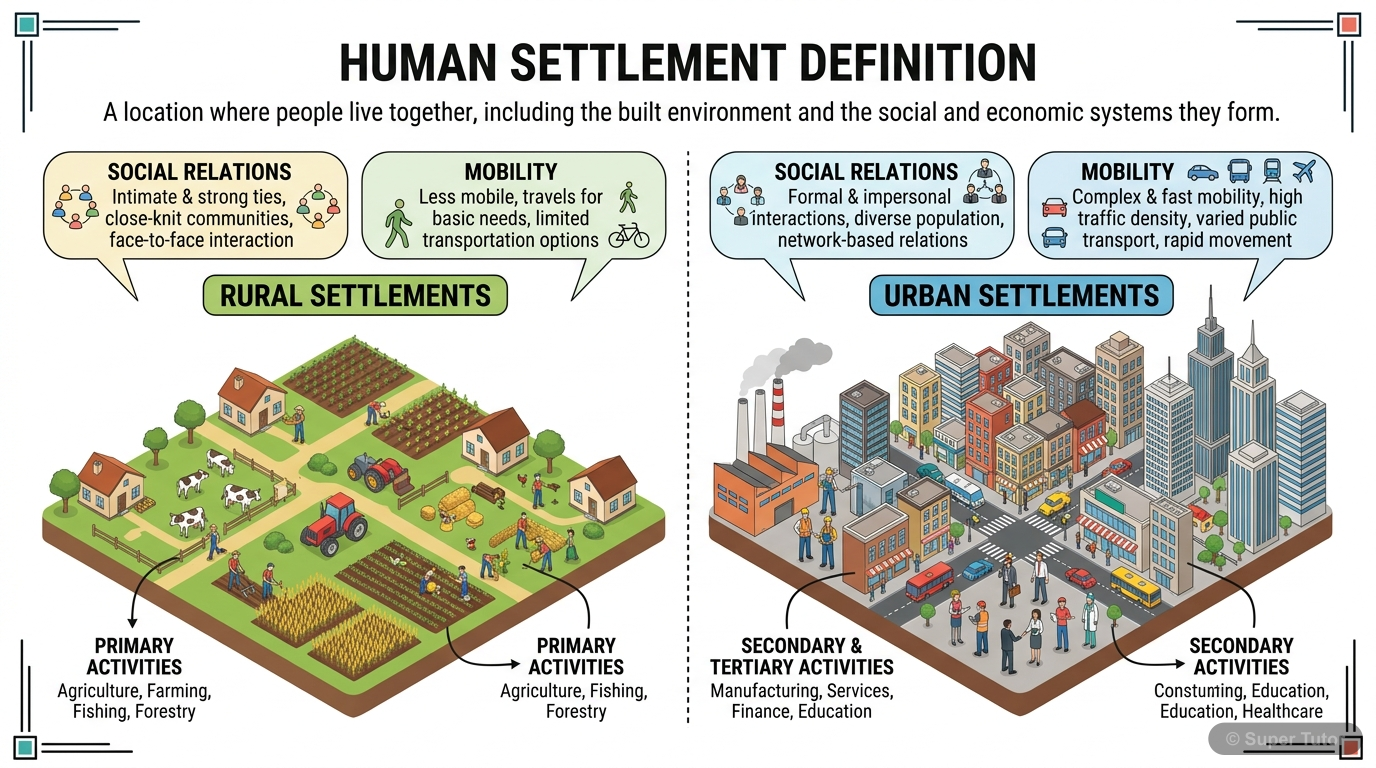
One of 2 illustrations for Rural Settlements in Super Tutor — alongside flashcards, concept maps and practice questions.
Quick Quiz: Rural Settlements
0/4Tap an answer to check it instantly. No sign-up needed for these 4.
In Rajasthan's Thar Desert, rural settlements are characteristically compact and nucleated. Which combination of factors BEST explains this pattern?
The term 'ali' used in Maharashtra's village layout refers to which of the following?
According to Census 2011, which state has the LARGEST number of villages with population of 10,000 or more?
Star-like settlement pattern develops when streets radiate from a common centre. In which regions of India is this pattern PRIMARILY found?
Sample Questions
Dispersed settlements in northeastern states like Arunachal Pradesh, Nagaland, and Meghalaya are primarily a result of which combination of factors?
Show answer
Difficult terrain, thick forests, and swift-flowing streams
Step 1: The question targets dispersed settlements specifically in northeast India. Step 2: The chapter explicitly states: 'Most of the isolated settlements in the north-eastern states are the result of difficult terrain, thick forests and swift flowing streams.' Step 3: These physical barriers prevent large-scale clustering — cultivable land is not available in large patches, so farmers build homes close to their individual plots of land. Step 4: Eliminate wrong options — Caste segregation and historical invasions relate to nucleated settlements in north India plains. Water scarcity relates t
Which settlement pattern is MOST characteristic of fishing villages along India's coastline and why?
Show answer
Linear pattern, because houses form rows parallel to the coastline or waterfront
Step 1: Coastal fishing villages have a specific geographical constraint — they must remain close to the sea for their livelihood. Step 2: The chapter describes linear pattern as: 'two parallel rows of houses facing each other across a wide village thoroughfare' with the 'main street running parallel to a road, railway line or water front.' Step 3: Fishing villages along the coast naturally form a line parallel to the sea, creating a linear settlement. This is explicitly confirmed: 'The fishing villages in the coastal areas also look like linear cluster.' Step 4: Eliminate wrong options — Circ
In the context of Indian rural settlements, secondary settlement units that form due to caste-based fragmentation of a nucleated village are called by various names. Which of the following is NOT one of these terms?
Show answer
Jot
Step 1: The question asks which term does NOT refer to a caste-based secondary settlement unit. Step 2: From the chapter: 'Secondary settlement units are often known as para, palli, nagla or dhani' — these are fragments of a nucleated settlement caused by social/caste segregation. Step 3: 'Jot' is mentioned in a completely different context: 'In Tarai and Bhabar, the social unit is not the village but the jot or farm i.e., the homestead of a substantial farmer or jotdar with houses of his relations, tenants, farm labourers clustered round it.' Step 4: So 'jot' refers to a farm-based homestead
According to Census 2011, India has a total of how many villages, and which state has the maximum number of villages?
Show answer
6,40,867 villages; Uttar Pradesh
Step 1: The chapter gives a precise figure from Census 2011 — India has 6,40,867 villages in all. Step 2: Among all states, Uttar Pradesh has the highest number of villages — 97,814, which is over 15% of all villages in India. Step 3: Eliminate wrong options — 5,93,615 is an incorrect figure. 7,25,000 is also incorrect. While Rajasthan has 43,264 villages and Madhya Pradesh has 51,929, neither surpasses Uttar Pradesh's 97,814. Step 4: It is important not to confuse Uttar Pradesh's position as the state with MOST TOTAL villages with Bihar's position as having the most LARGE villages (10,000+ po
+41 more questions on Rural Settlements (ICSE Class 12 Geography)
Practise AllFrequently Asked Questions
What are the important topics in Rural Settlements for ICSE Class 12 Geography?
How many practice questions are there for Rural Settlements?
Sources & Official References
Content is aligned to the official syllabus. Refer to the board website for the latest curriculum.
More resources for Rural Settlements
Important Questions
Exam-style questions with answers
Revision Notes
Key points for last-minute revision
Chapter Summary
Understand the chapter at a glance
Concept Maps
See how topics connect
Study Plan
Step-by-step plan for this chapter
Flashcards
Quick-fire cards for active recall
Syllabus
What topics to cover
For serious students
Get the full Rural Settlements chapter — start free.
Quizzes, flashcards, an AI doubt solver and a study plan for ICSE Class 12 Geography. Free to start, no card needed.