Climate — Practice Quiz
ICSE · Class 12 · Geography
Try a 4-question quiz on Climate for ICSE Class 12 Geography: tap an answer to check it and see why. 45 questions in the full chapter test.
Interactive on Super Tutor
Studying Climate? Get the full interactive chapter.
Quizzes, flashcards, AI doubt-solver and a step-by-step study plan — built for practice quiz and more.
Free trial, no card needed.
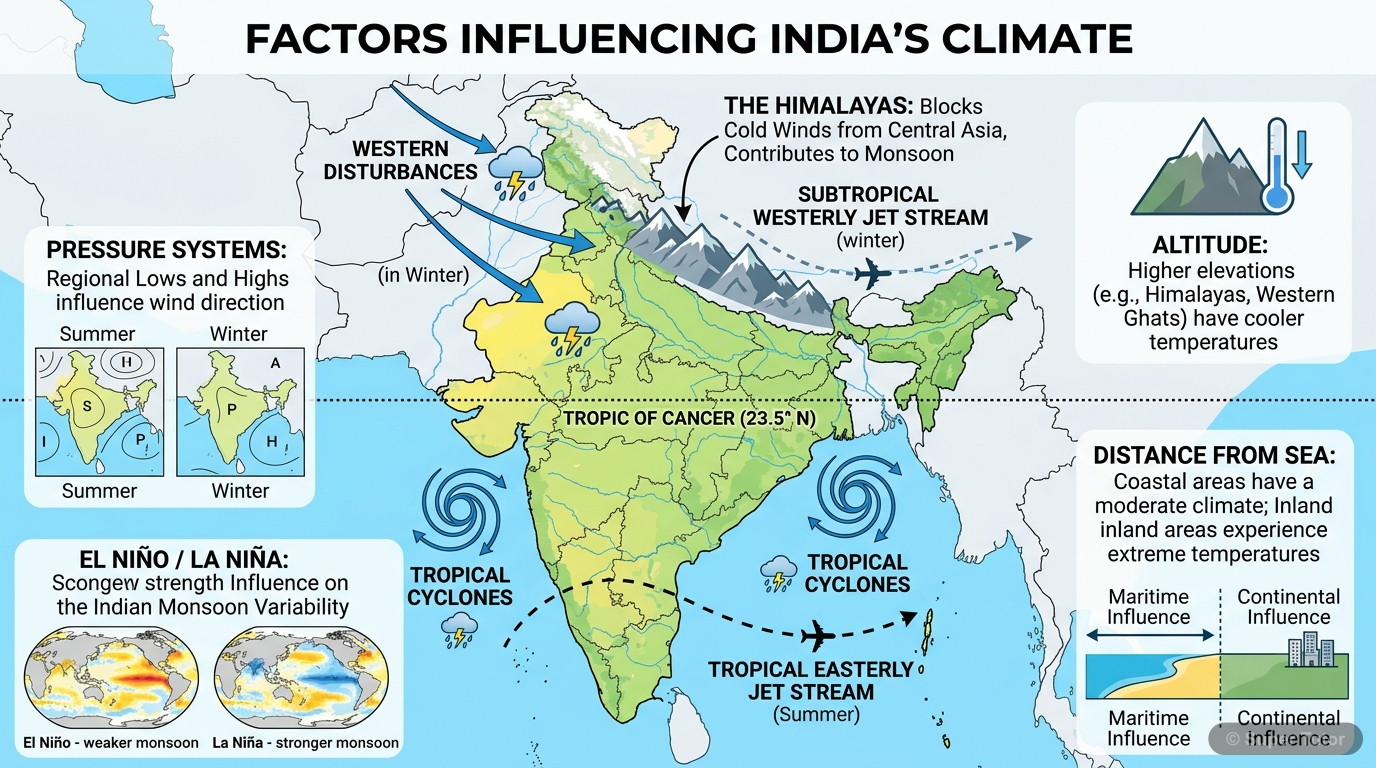
Learn better with visuals Super Tutor pairs illustrations like this with notes and quizzes for Climate.
Quick Quiz: Climate
0/4Tap an answer to check it instantly. No sign-up needed for these 4.
The word 'monsoon' has been derived from the Arabic word 'mausim'. What does 'mausim' mean?
The Tropic of Cancer passes through which part of India?
Which type of climate is experienced by the coastal regions of India due to the surrounding water bodies?
Which place in India is recognized as the rainiest place in the world?
Sample Questions
The southwest monsoon normally arrives at the Kerala coast by which date?
Show answer
1st June
Step 1: The southwest monsoon follows a fixed pattern of arrival across India. Step 2: It sets in over the Kerala coast by 1st June — this is considered the official onset of the southwest monsoon in India. Step 3: From Kerala, it reaches Mumbai and Kolkata by 10–13 June. Step 4: It spreads all over the subcontinent by 15th July. Step 5: 1st May is too early, 15th June is the time it reaches other parts, and 1st July is approximately when it reaches the northwestern parts.
The hot and dry winds that blow in the northern plains of India during summer are called:
Show answer
Loo
Step 1: During summer, the northern plains of India experience extremely high temperatures. Step 2: Hot, dry, and oppressing winds blow during the daytime over the northern and northwestern India, especially between Punjab and Bihar. Step 3: These winds are called 'Loo'. They are most intense between Delhi and Patna. Step 4: Mango Showers are pre-monsoon showers in Kerala that help ripen mangoes. Step 5: Nor Westers (Kalbaisakhi) are thunderstorms in Bengal and Assam — not hot dry winds of the north.
The Inter-Tropical Convergence Zone (ITCZ) shifts to approximately which latitude over India during summer?
Show answer
25°N
Step 1: The ITCZ is the zone where northeast and southeast trade winds converge near the equator. Step 2: Its position shifts with the apparent movement of the sun — northward in summer and southward in winter. Step 3: In summer, as the sun moves towards the Tropic of Cancer, the ITCZ shifts northward to about 25°N over India and Pakistan. Step 4: This northward shift creates low pressure over northwestern India and attracts the southwest monsoon winds. Step 5: 0°, 10°N, and 15°N are positions of the ITCZ during other times or seasons — not during Indian summer.
Which branch of the southwest monsoon causes very heavy rainfall on the western slopes of the Western Ghats?
Show answer
Arabian Sea Current
Step 1: The southwest monsoon has two main branches — the Arabian Sea Current and the Bay of Bengal Current. Step 2: The Arabian Sea Current originates in the Arabian Sea and reaches the western coast of India. Step 3: One sub-current of the Arabian Sea Current strikes the Western Ghats and causes heavy rainfall (above 250 cm) on the western slopes and the West Coastal Plain. Step 4: After crossing the Western Ghats, it enters the rain-shadow area and causes little rainfall there. Step 5: The Bay of Bengal Current mainly affects northeastern India and the Ganga plains — not the Western Ghats d
+41 more questions on Climate (ICSE Class 12 Geography)
Practise AllFrequently Asked Questions
What are the important topics in Climate for ICSE Class 12 Geography?
How many practice questions are there for Climate?
Sources & Official References
Content is aligned to the official syllabus. Refer to the board website for the latest curriculum.
More resources for Climate
Important Questions
Exam-style questions with answers
Revision Notes
Key points for last-minute revision
Chapter Summary
Understand the chapter at a glance
Concept Maps
See how topics connect
Study Plan
Step-by-step plan for this chapter
Flashcards
Quick-fire cards for active recall
Syllabus
What topics to cover
For serious students
Get the full Climate chapter — start free.
Quizzes, flashcards, an AI doubt solver and a study plan for ICSE Class 12 Geography. Free to start, no card needed.