Population — Revision Notes
ICSE · Class 12 · Geography
Population revision notes for ICSE Class 12 Geography: 4 topics in quick points. Part of the ICSE Class 12 Geography syllabus.
Interactive on Super Tutor
Studying Population? Get the full interactive chapter.
Quizzes, flashcards, AI doubt-solver and a step-by-step study plan — built for revision notes and more.
Free trial, no card needed.
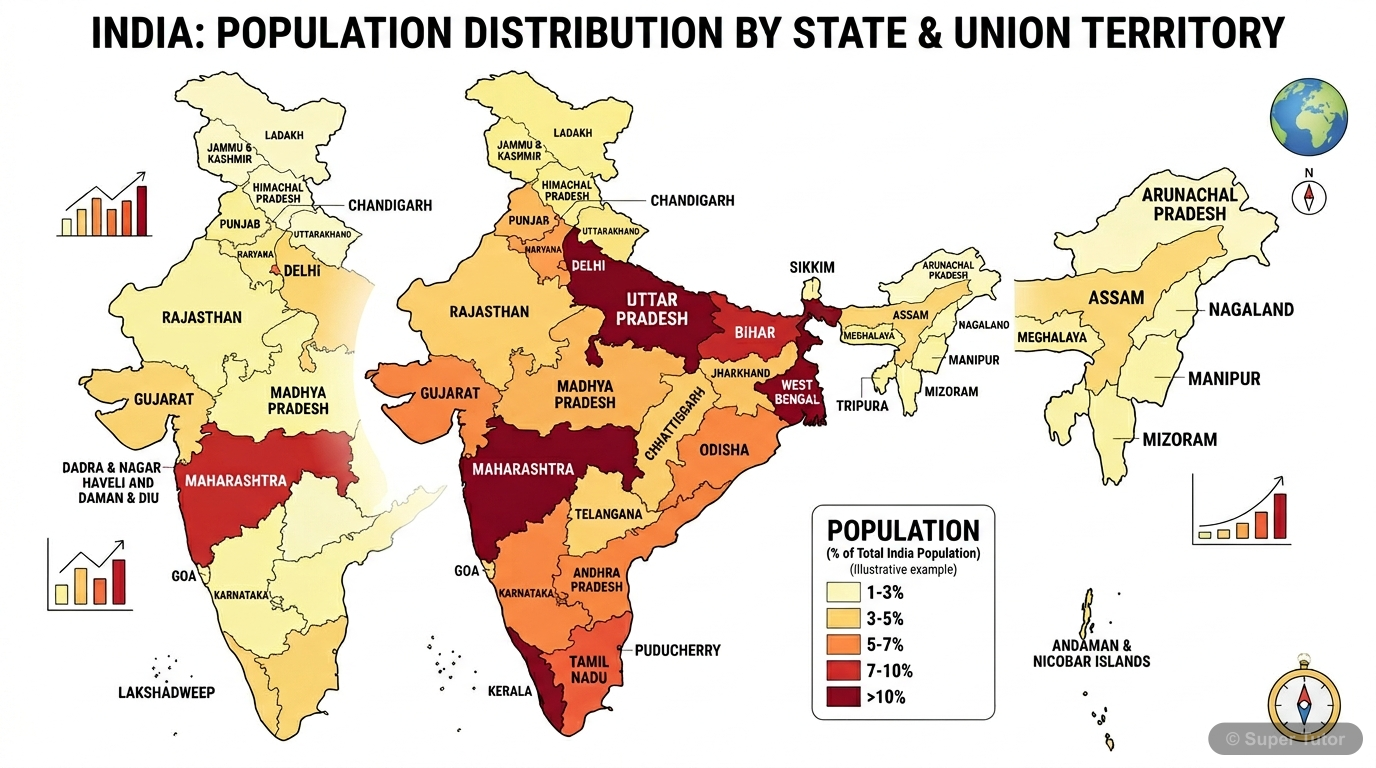
One of 3 illustrations for Population in Super Tutor — alongside flashcards, concept maps and practice questions.
Key Topics to Revise
1. India in the World Population Context
- India covers only 2.4% of the world's surface area but supports 17.5% of the world's population.
- India became the second country after China to cross the one billion mark at the dawn of the 21st century.
- India crossed China as the most populous country of the world in 2023, and India's total population in 2024 was 143.8 crores.
2. Census of Population in India
- The year 1872 marked the beginning of census taking in India.
- The first complete and synchronous census covering the entire country was conducted in 1881.
- Censuses in India have been conducted every ten years since 1881.
3. Distribution of Population in India
- India's total population according to the 2011 census was 1210.2 million.
- Population distribution in India is very uneven.
- Uttar Pradesh has the largest population in India with 199.5 million people.
4. Density of Population
- Population density is the number of persons per unit area.
- India's population density in 2011 was 382 persons per sq. km.
- The calculation uses total population of 1210.1 million and total area of 3.17 million sq. km.
Get complete notes with diagrams and examples
Full NotesKey Concepts
Frequently Asked Questions
What are the important topics in Population for ICSE Class 12 Geography?
How should I revise Population for the ICSE Class 12 board exam?
Sources & Official References
Content is aligned to the official syllabus. Refer to the board website for the latest curriculum.
More resources for Population
Practice Quiz
Test yourself with a quick quiz
Important Questions
Exam-style questions with answers
Formula Sheet
The chapter's formulas in one place
Chapter Summary
Understand the chapter at a glance
Concept Maps
See how topics connect
Study Plan
Step-by-step plan for this chapter
Flashcards
Quick-fire cards for active recall
Syllabus
What topics to cover
For serious students
Get the full Population chapter — start free.
Quizzes, flashcards, an AI doubt solver and a study plan for ICSE Class 12 Geography. Free to start, no card needed.